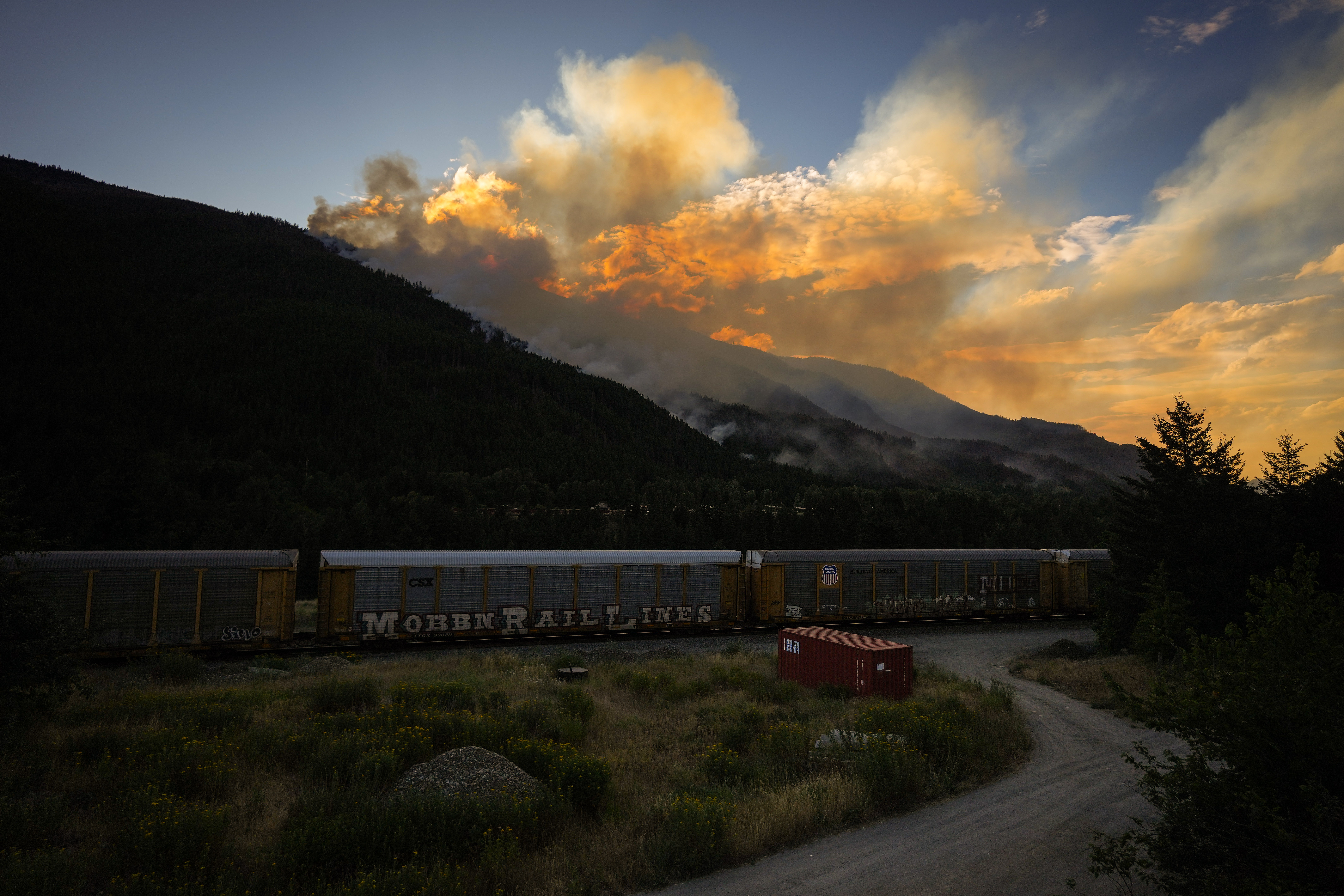
Every summer, British Columbia officials mount the podium, clear their throats, and deliver the same grim warning. They tell us dry lightning is coming. They tell us the province is bracing for a catastrophic weekend of ignitions. They deploy air tankers, mobilize ground crews, and pray for rain.
This annual theater of bureaucratic panic treats dry lightning as an invading army. It frames nature as an unpredictable, malicious enemy and positions human suppression technology as our only shield.
It is a comforting narrative. It is also completely wrong.
The panic surrounding dry lightning in B.C. hides a fundamental truth that fire ecologists have known for decades: the lightning is not the problem. The problem is the fuel we have spent a century packing into our forests. By treating every dry lightning ignition as an emergency to be extinguished, we are not saving the province. We are merely underwriting a massive ecological debt that will eventually be paid in unstoppable, catastrophic crown fires.
We do not need to brace for dry lightning. We need to stop fighting it.
The Wildfire Deficit and the Illusion of Control
For more than a century, forestry management in North America operated under a simple, flawed mandate: put out every fire by 10:00 AM the morning after it is spotted.
This strategy was highly successful. For decades, crews put out 95 to 98 percent of all forest fires, whether they were started by a discarded cigarette or a lightning strike. But this success was an ecological disaster.
Forests in the dry interior of British Columbia evolved to burn. Historically, frequent, low-intensity surface fires—often ignited by lightning or managed by Indigenous communities—cleared out the underbrush, thinned out weak trees, and kept fuel loads low. These frequent burns created a mosaic of open grasslands, mature forests, and young stands. When lightning struck a tree, the fire would crawl along the forest floor, consuming pine needles and small shrubs, before naturally running out of fuel.
By putting out those small fires, we broke the cycle.
Without fire, our forests became dense, overcrowded thickets. Stands that once held 50 trees per hectare now pack in 500 or more. Dead wood, pine needles, and ladder fuels—low-hanging branches that allow ground fires to climb into the canopy—have accumulated to historic levels.
We created a fire deficit.
When dry lightning strikes today, it does not find a resilient, self-thinning ecosystem. It finds a highly pressurized fuel bomb. The B.C. Wildfire Service can throw every helicopter, water bomber, and ground crew at these starts, but they are fighting physics. The sheer volume of fuel guarantees that any fire that escapes initial attack will turn into an uncontrollable, high-intensity inferno.
Dismantling the Dry Lightning Scapegoat
The media and provincial officials love to talk about dry lightning because it absolves them of responsibility. It is presented as an unavoidable natural disaster, an act of God worsened by climate change.
Let us look at the actual mechanics of dry lightning.
A dry thunderstorm occurs when lightning strikes from a storm system where the accompanying rain evaporates before reaching the ground. This evaporation happens in dry lower atmospheres, which are common in the B.C. interior during July and August.
This is not a new, mutant weather phenomenon. It is a standard feature of the Cordilleran climate. The only variable that has radically changed is the condition of the forest floor receiving those strikes.
When B.C. officials announce they are bracing for dry lightning, they are focusing on the trigger rather than the loaded gun. If we managed our forests properly through thinning, prescribed burns, and managed wildfires, a hundred dry lightning strikes in a weekend would not be a crisis. It would be a routine ecological maintenance event.
By framing dry lightning as the primary threat, the government shifts the focus away from their own policy failures. They avoid hard conversations about industrial forestry practices, the conversion of diverse natural forests into monoculture timber plantations, and the massive backlog of necessary prescribed burning.
The Suppression Trap and the Industrial Fire Complex
Taxpayers pay billions of dollars for the illusion of safety.
I have watched agencies pour millions of dollars a day into dumping water and retardant on fires burning in remote, high-elevation wilderness zones where no homes or timber values are at risk. Why? Because the public demands action, and the political cost of letting a fire burn is too high.
This has created a self-reinforcing loop:
- Suppression: We put out every fire we can reach, ensuring that only the most intense, wind-driven fires escape our control.
- Fuel Accumulation: The forests that do not burn continue to accumulate dead wood and dense vegetation.
- Escalation: The next round of fires burns hotter, faster, and larger, threatening communities that were previously safe.
- Budget Inflation: The provincial government increases emergency wildfire funding, buying more high-tech suppression gear to fight the monsters we helped create.
This is the suppression trap. The more successful we are at fighting fires today, the worse the fires will be tomorrow.
We cannot log or bulldoze our way out of this loop. Mechanical thinning has its place near community borders, but we cannot manually thin tens of millions of hectares of rugged, mountainous terrain. The only tool capable of managing fuel loads at the landscape scale is fire itself.
Yet, when dry lightning offers us free, natural ignitions in remote areas, our immediate response is to snuff them out. We are actively rejecting the only force that can restore balance to our ecosystems.
Dismantling the Flawed Questions We Ask About Wildfire
When the public and media talk about wildfire response, they consistently ask the wrong questions. Let us dismantle the most common queries and look at the hard truth behind them.
"Why can’t we just put out fires immediately when they are small?"
This question assumes that we have the physical capability to extinguish every fire, regardless of location or weather. It is a fantasy.
When a dry lightning front passes over the province, it can deliver thousands of strikes in a matter of hours, starting dozens of fires simultaneously. Many of these occur in steep, inaccessible terrain where ground crews cannot safely work, and where air tankers have little effect.
More importantly, putting out every small fire is what got us into this mess. If we continue to extinguish every manageable ignition, we guarantee that the only fires that ever burn are the ones that are completely uncontrollable from day one. We are trading small, manageable, ecologically beneficial fires for massive, destructive crown fires.
"Are dry lightning fires inherently more dangerous than human-caused fires?"
No. A fire does not care what ignited it.
The danger of a fire is determined entirely by fuel, weather, and topography. The reason dry lightning fires are often perceived as more dangerous is that they frequently occur in remote, rugged areas where detection is delayed and access is difficult.
But this remoteness is actually an opportunity. A fire burning in a remote subalpine forest, far from communities, is not a disaster. It is an ecological benefit. It creates fuel breaks, rejuvenates wildlife habitat, and reduces the intensity of future fires in that watershed. Treating these remote ignitions with the same panic as a fire on the edge of a major town is a waste of resources and a disservice to the landscape.
"Can't we just rely on logging to thin out the forests and prevent these fires?"
Industrial logging is not a substitute for fire.
In fact, modern clear-cut logging often increases wildfire risk. When a mature forest is clear-cut, the microclimate changes. The canopy that once shaded the forest floor and kept it cool and moist is gone. The site becomes hot, dry, and windy.
Furthermore, clear-cuts are typically replanted with dense, single-species stands of conifers, usually pine or Douglas fir. These young, even-aged plantations are highly flammable. They lack the structural diversity and species variety of natural forests, which include fire-resistant broadleaf trees like aspen and birch. When a fire hits a young plantation, it does not crawl along the ground—it rips through the canopy like paper.
A Blueprint for Living With Fire
If we want to stop the endless cycle of smoke-choked summers and evacuated towns, we have to change our relationship with fire. We must move from a strategy of total suppression to one of active co-existence.
Here is how we do that:
1. Establish Go/No-Go Zones for Wildfire
We must draw clear lines on the map.
Within a certain radius of communities, infrastructure, and critical drinking water watersheds, we must practice aggressive suppression and intensive fuel mitigation. Here, we cannot afford to let fires burn.
Outside of these zones, in our vast backcountry and wilderness areas, our default response to dry lightning should be to monitor, not suppress. We must allow these natural fires to do the hard work of restoring pyrodiversity to the landscape. Yes, this means more smoke in the short term. Yes,Why British Columbias Wildfire Strategy Is Guaranteed to Fail
news
Every summer, British Columbia officials trot out the same tired script. They look at the sky, point to dry lightning forecasts, and tell the public to brace for impact. It is a masterclass in bureaucratic buck-passing. By blaming the weather, management agencies shift the blame from their own systemic failures to an act of God.
Dry lightning is not a freak anomaly. It is a predictable, recurring atmospheric event that has shaped Western forests for millennia. The real crisis is not that lightning is hitting the ground; it is what happens when it lands. Decades of aggressive fire suppression have turned the province into a massive, contiguous tinderbox.
By treating every single blaze as an emergency to be extinguished, we have engineered the exact conditions that make dry lightning lethal. We are trapped in a vicious cycle where successful suppression today guarantees catastrophic failure tomorrow.
The Fire Suppression Paradox
Forestry management has operated under a flawed premise for over a century: that a healthy forest is an unburned forest. This mentality has systematically scrubbed low-and-moderate-intensity fires from the ecosystem.
In a natural cycle, regular lightning strikes ignite small fires that clear out underbrush, dead wood, and overly dense saplings. These frequent burns act as a pressure release valve. They keep the forest floor clean and create a patchy mosaic across the terrain, which naturally prevents future fires from spreading uncontrollably.
When you extinguish every small fire immediately, the fuel accumulates. Dead needles, fallen branches, and tightly packed trees build up year after year. When dry lightning hits this unnatural accumulation of fuel during a drought, the result is not a manageable ecological fire. It is a high-intensity crown fire that burns so hot it sterilizes the soil and destroys entire communities.
The BC Wildfire Service spends hundreds of millions of dollars annually fighting a symptom while actively worsening the disease. Statistics show that the province suppresses roughly 90% of all wildfires early. Celebrate that efficiency if you want, but realize that the remaining 10% become the uncontrollable monsters that dominate the evening news. We are merely kicking the bucket down the road, and the bucket is filling with dynamite.
The Multi Billion Dollar Industrial Complex
Follow the money and the policy inertia makes perfect sense. Firefighting is a massive seasonal economy. When a crisis hits, budgets open up, emergency funds flow, and political leaders get to wear high-visibility jackets for photo ops on the front lines.
Reactive suppression is politically safe. If a government spends half a billion dollars flying water bombers to save a town, they look heroic. If that same government deliberately lets a lightning-caused fire burn in a remote valley to reduce fuel loads, they face immense public backlash and political ruin if the wind shifts.
This risk aversion has created a deeply broken incentive structure. We have built an infrastructure optimized for high-tech warfare against nature, rather than long-term stewardship. Heavy machinery, chemical retardants, and aviation fleets are expensive tools that look impressive but fail to address the core issue.
I have watched agencies pour millions into dropping water on deep-woods fires that posed zero threat to human infrastructure, simply because the public demanded action. It is security theater disguised as environmental protection.
Dismantling the Deflection Tactics
When facing criticism, officials routinely point to climate data. They argue that longer droughts and higher temperatures mean the old rules no longer apply. This argument is a convenient shield.
While a warming climate undoubtedly extends the fire season and dries out fuels faster, it does not change the fundamental mechanics of combustion. A fire still requires heat, oxygen, and fuel. We cannot control the heat from the sun, and we cannot control the oxygen in the air. The only variable within human control is the fuel.
Blaming climate change for catastrophic wildfires without addressing fuel accumulation is like blaming a spark for exploding a warehouse full of fireworks. Yes, the spark started it, but storing fireworks next to an open flame was the structural failure.
The common public question is straightforward: How do we stop dry lightning from causing massive disasters? The brutal truth is that we do not. We need to stop trying to stop it. The focus must shift from total suppression to aggressive fuel management and community resilience.
Shifting From Defense to Managed Burning
If British Columbia wants to break this cycle, it must adopt an aggressive strategy that embraces fire as an essential tool.
First, we must dramatically scale up prescribed burning during the shoulder seasons. Spring and fall offer windows where moisture levels allow for controlled, low-intensity burns that clear out undergrowth without threatening mature canopies. Currently, the bureaucratic red tape, liability fears, and air quality regulations make scheduling a prescribed burn a logistical nightmare. We need to cut the red tape and treat smoke from prescribed burns as a necessary, minor inconvenience that prevents the suffocating, toxic smoke of a mid-August inferno.
Second, we must practice managed wildfire. When dry lightning ignites a fire deep in the backcountry, far from communities or critical infrastructure, the default response should not be immediate containment. If weather conditions allow, these fires should be monitored and allowed to fulfill their ecological role of thinning the forest.
Third, the burden of protection must shift to the wildland-urban interface. Instead of trying to defend millions of hectares of wilderness, resources must be hyper-focused on hardening communities. This means enforcing strict building codes that mandate fire-resistant roofing, clearing defensible space around every structure, and aggressively thinning vegetation within a two-kilometer radius of towns.
This approach is not without risk. Controlled burns can escape. Managed fires can turn unpredictable. Air quality will suffer during periods of intentional burning. It requires accepting short-term discomfort and calculated risks to avoid long-term catastrophe.
Continuing down the current path of total suppression while praying for a summer without lightning is not a strategy. It is collective delusion. The sky will continue to produce lightning, the forests will continue to dry out, and until we change how we manage the ground, the province will continue to burn.