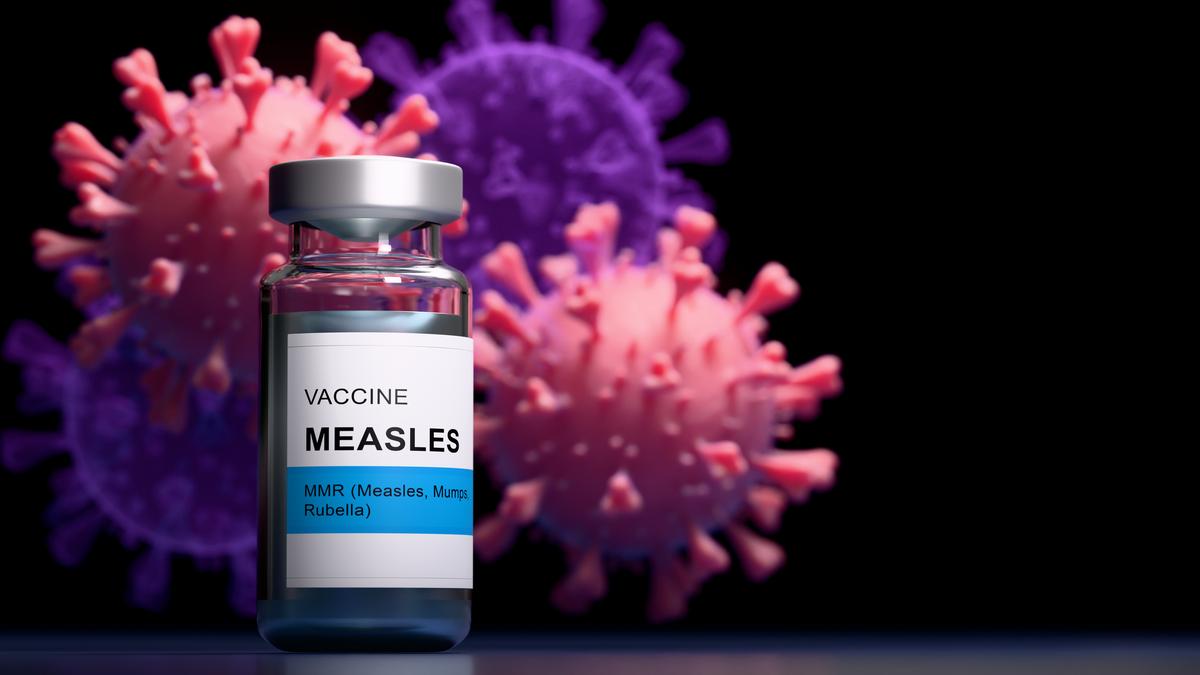
The air in the makeshift clinic smells of damp earth and antiseptic. It is a sharp, medicinal scent that fights a losing battle against the heat of the Cox’s Bazar afternoon. Outside, the monsoon rains have left the ground slick, a treacherous slurry of mud that swallows the footsteps of those who arrive in silence. They come carrying bundles. These bundles are small, wrapped in faded cotton, and they are burning.
A mother sits on a plastic chair, her eyes fixed on a spot on the floor. She does not look at the needle. She does not look at the health worker. She only looks at her three-year-old son, whose skin is mapped with a constellation of angry, flat red spots. This is the face of a measles outbreak. It isn’t a headline. It isn’t a statistic in a WHO report. It is the sound of a child struggling to pull air into lungs that feel like they are filled with glass.
Bangladesh is currently a theater of war. The enemy is not human, but it is relentless. As the virus sweeps through the densely populated corridors of refugee camps and overstretched urban centers, the government and international partners have pivoted toward a desperate, essential defense: an emergency vaccination campaign. The goal is simple, yet Herculean. Reach every child. Stop the fire.
The Ghost in the Body
Measles is often dismissed by those with the luxury of distance as a "childhood rite of passage." That is a dangerous lie. In reality, the rubeola virus is one of the most contagious pathogens known to science. It does not merely cause a rash; it executes a tactical strike on the immune system.
Consider a hypothetical child named Arifa. Before the fever, Arifa’s immune system was a library of defenses, filled with "memory cells" that knew how to fight off every cold, cough, and infection she had ever encountered. When measles enters Arifa’s system, it doesn't just make her sick. It burns the library.
This phenomenon is called immune amnesia. The virus wipes out the cells that remember previous infections, leaving the child’s body as vulnerable as a newborn’s. Even if Arifa survives the initial pneumonia or the swelling of the brain—and many do not—she is left standing naked against every other germ in the world for months or years to come.
This is why the current campaign in Bangladesh is not just about one disease. It is about preventing a secondary wave of mortality that follows in the wake of the "red plague." When the Ministry of Health announces they are targeting millions of children, they are trying to save the libraries.
The Logistics of Hope
Moving a vaccine from a laboratory to a remote village in the Chittagong Hill Tracts is an act of industrial poetry. It requires the "cold chain," a continuous, unbroken link of refrigeration that must persist through power outages, flooded roads, and 40-degree heat. If the temperature rises too high for even an hour, the liquid in the vial becomes nothing more than expensive water.
Health workers are the heartbeat of this movement. They are mostly women. They wear blue vests and carry insulated boxes slung over their shoulders. They walk. They take rickshaws. They navigate the narrow, winding alleys of the Kutupalong camp, where a single cough in a crowded shelter can infect a dozen people by nightfall.
The stakes are invisible until they are undeniable. To achieve "herd immunity"—the point where a virus can no longer find enough hosts to survive—roughly 95% of the population must be vaccinated. In the chaos of mass migration and global pandemic recovery, that percentage slipped. The gap was small. A few percentage points. A few thousand missed children.
But a virus is an opportunist. It found the gap.
Now, the emergency campaign is an attempt to close the door before the house burns down. It is a race against biology. Every needle prick is a tiny, localized victory against the dark.
The Weight of a Choice
There is a specific kind of silence that happens when a parent has to trust a stranger with their child’s life. In the clinics, you see it in the way hands are held. There is often hesitation, fueled by whispers and misinformation that travel faster than any virus.
"Will it make him sicker?"
"Is it safe?"
The health workers do not respond with lectures. They respond with presence. They explain that the slight fever a child might get after the shot is a sign of strength—a training exercise for the body. They explain that the alternative is a silence that no parent should ever have to endure.
In the 1980s, before global vaccination efforts gained true momentum, measles killed millions of people every year. We have forgotten what that world looked like. We have forgotten the sound of neighborhoods where every third house was in mourning. Bangladesh, through its robust expanded program on immunization, had spent decades pushing those memories into the past. This current surge is a reminder that the past is never as far away as we think.
The Architecture of the Outbreak
Why now? Why here?
The answer is a complex mosaic of geography and circumstance. Bangladesh is one of the most densely populated nations on earth. When you have a high concentration of people living in close proximity, the "R-naught" of measles—the number of people one infected person will likely pass the virus to—skyrockets. In a typical setting, that number is between 12 and 18. In a refugee camp, it can feel infinite.
Furthermore, the global focus on COVID-19 created a "shadow" crisis. Routine immunization schedules were disrupted. Supply chains shifted. Resources were diverted. Across the globe, we are seeing the bill for those lost years coming due. Bangladesh is simply one of the first places where the invoice has arrived in the form of an outbreak.
But there is a resilience here that is rarely captured in the news. The emergency campaign isn't just a government directive; it is a community mobilization. Imams mention the importance of health in their sermons. Teachers track which of their students have been reached. It is a collective recognition that a child’s health is not a private matter, but a public trust.
The Needle and the Silk
Back in the clinic, the boy in the cotton bundle flinches. It is a quick, sharp pinch. He cries for a moment, a loud, healthy sound that fills the small room. His mother exhales. It is the first time her shoulders have dropped in three days.
She receives a small purple mark on her thumbnail, a sign that her child is protected. It is a badge of participation in a grand, silent defense.
The medicine is cold. The needle is thin. The cost is high, and the effort is exhausting for the thousands of volunteers working through the mud and the heat. But as the sun begins to set over the hills of Cox’s Bazar, the line of parents does not shorten. They stand in the rain, waiting for their turn to ensure that their children’s libraries remain intact.
We often look for heroism in the spectacular—in the grand gestures and the loud proclamations. We forget that sometimes, heroism looks like a woman in a blue vest, standing in the mud, holding a vial of cold liquid, waiting to save a life she will never truly know.
The fire is still burning, but the water is finally arriving.