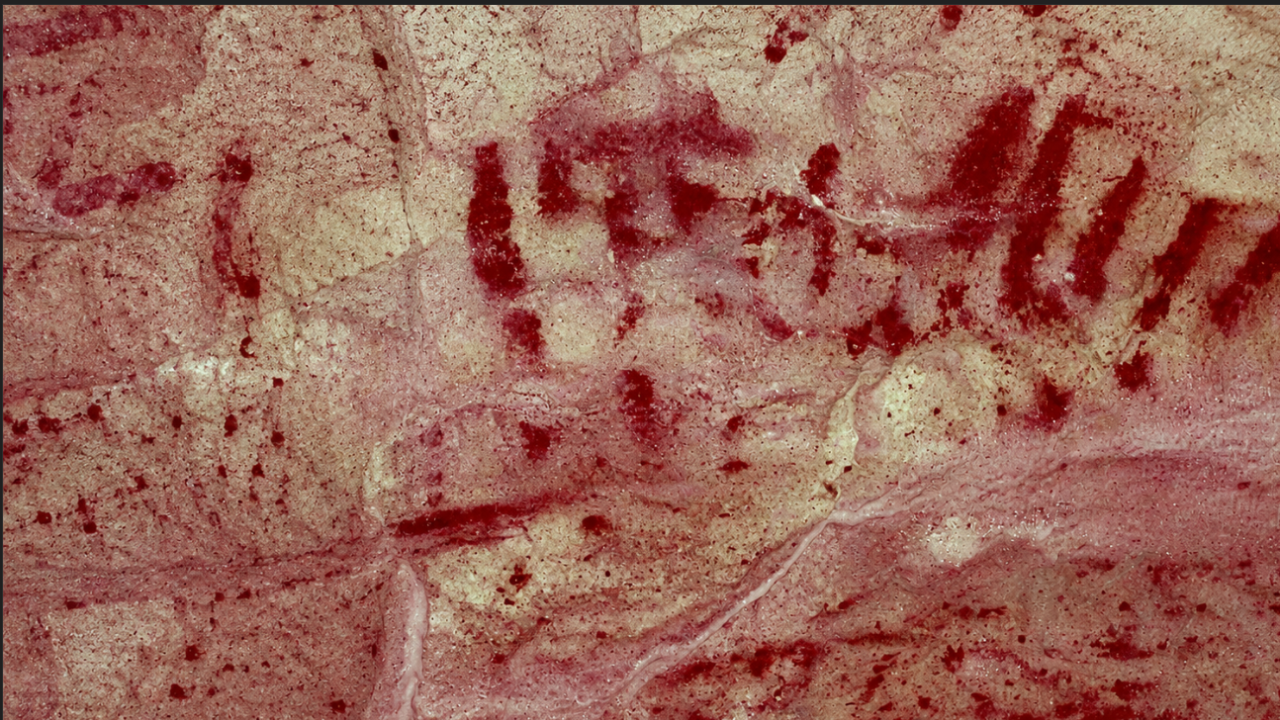
Archaeologists spent decades walking right past them. To the untrained eye, the marks looked like natural iron staining or random mud splatters on the limestone walls. They weren't. Those faint red smudges inside Cathole Cave on the Gower Peninsula in Wales are actually Britain's oldest cave art, dating back around 17,100 years.
This changes things. For generations, textbook history suggested that Ice Age Britons were too busy surviving the brutal cold to worry about self-expression. The famous, elaborate cave paintings were supposedly happening over in France and Spain, while Britain was just an icy wasteland. This discovery completely busts that myth.
It turns out our ancestors were marking their territory and leaving their stories behind much earlier than we thought. Understanding this art isn't just about admiring old paint. It's about recognizing that these ancient people possessed the exact same creative drive that we do today.
The Shocking Truth Behind the Red Stains
Cathole Cave is a well-known spot. It sits in a limestone cliff in a beautiful Welsh valley. Thousands of hikers and amateur explorers have walked through it. Nobody noticed the art because they expected something like Lascaux in France. They wanted to see massive, vivid bulls and horses charging across the rock face.
Instead, Britain's oldest art is incredibly subtle. It consists of a series of stylized lines and dots made with red ochre, a natural clay pigment mixed with animal fat or water.
Dr. George Nash, the archaeologist who initially spotted the carvings and marks, had to use specialist lighting and digital enhancement to verify what he was looking at. The art depicts a reindeer, carved into the rock, flanked by these crucial red ochre stains and lines.
The dating process was rigorous. Scientists used uranium-series dating on the flowstone—the mineral crust that had naturally grown over the top of the art. Because the mineral layer formed on top of the pigment, the art itself must be older than the crust. The results came back at 17,100 years old. This places the creation of the art right at the tail end of the Last Glacial Maximum, when the climate was starting a slow, unstable thaw.
Why Ice Age Britons Weren't Just Thugs
There's a common misconception that humans living in the Upper Paleolithic period were primitive brutes. We picture them shivering in furs, chewing on raw meat, and thinking about nothing but the next hunt.
The red ochre at Cathole Cave proves they had an inner life.
Creating cave art requires planning. You don't just stumble into a dark, damp cave and accidentally paint a reindeer. Here is what went into it:
- Resource gathering: They had to find high-quality ochre, grind it into a fine powder, and mix it with a binder.
- Logistics: The art is often found in dark zones. They needed fat-burning lamps or torches just to see what they were doing.
- Symbolism: The images aren't random doodles. They represent the animals these people relied on, or perhaps spiritual guides.
When you look at it that way, these "stains" are evidence of a complex culture. They were communicating. We don't know the exact message—maybe it was a hunting ritual, a boundary marker, or a tribal story—but the intent to record something permanent is undeniable.
The Map of British Cave Art is Expanding
For a long time, Creswell Crags on the border of Derbyshire and Nottinghamshire was the golden child of British archaeology. It holds incredible rock engravings of birds, stags, and bison dating to around 13,000 years ago.
Cathole Cave pushes the timeline back by thousands of years and shifts the geographic focus west to Wales.
It makes you realize how much we've probably missed. Limestone caves are fragile environments. Tourism, graffiti, changing humidity, and natural erosion destroy ancient pigments easily. What we see today is just a tiny fraction of what used to exist.
If you want to understand the scale of this history, you need to look at the wider landscape. The Gower Peninsula was not a peninsula 17,000 years ago. The sea levels were much lower because so much water was locked up in glaciers. The Bristol Channel was a vast, sweeping grassland valley. Cathole Cave would have looked out over a hunting ground teeming with mammoth, woolly rhino, and reindeer herds. The people making this art were sitting on a hill, watching their food walk by.
How to Spot Genuine Ancient History Yourself
You don't need a PhD to appreciate this stuff, but you do need to know what you're looking at. Most people ruin their chances of seeing real archaeology because they look for the wrong things.
First, stop looking for perfection. Ancient graffiti isn't fine art. It is often hidden in deep recesses where the rock face is protected from rain and wind. Look for geometric patterns, vertical lines grouped together, or areas where the rock surface has been smoothed down intentionally before pigment was applied.
Second, respect the site. If you visit places like the Gower or Creswell Crags, never touch the walls. The oils on your fingers can ruin 17,000 years of preservation in seconds. Use a torch with a warm beam rather than a harsh blue LED; the side-glare from a warm light reveals carvings and textures that flat light completely hides.
Get outside and look at the topography of the land. Don't just look at the cave; look at what the cave looks at. Find the high vantage points where a hunter would wait. That is where you find the real stories of the people who built the foundations of Britain.