The wind whipping across the National Mall in early March carries a specific kind of bite. It is the kind of cold that seeps through wool coats and makes the tourists huddled near the reflecting pool move a little faster toward the sanctuary of the Smithsonian museums. But on this particular morning, people weren't moving fast. They were stopping. They were staring. Some were laughing with a hollow, jagged sound, while others simply stood in a stunned, heavy silence that felt as gray as the D.C. sky.
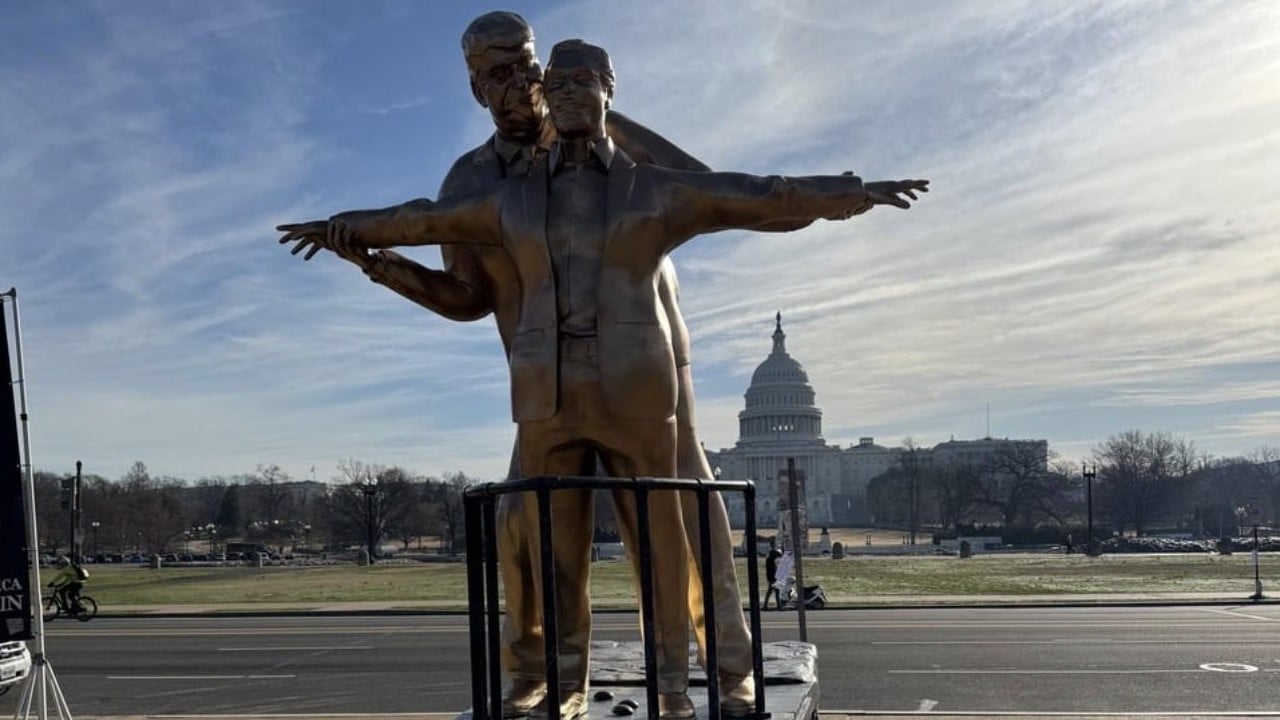
There, positioned with a jarring prominence near the United States Capitol, stood a statue that felt like a fever dream rendered in three dimensions.
It wasn't a soaring tribute to a Founding Father or a somber memorial to a fallen soldier. Instead, the passersby were confronted with a life-sized, bronze-colored tableau of Donald Trump and Jeffrey Epstein. They weren't just standing there; they were locked in the iconic, windswept embrace from the film Titanic. Trump stood behind, his arms outstretched as if guiding a ship through treacherous waters, while Epstein leaned forward, eyes fixed on an invisible horizon.
The scene was absurd. It was grotesque. It was, by every definition of the word, a spectacle. But as the crowd grew, the laughter began to thin out, replaced by the realization that this wasn't just a prank. It was a mirror.
The Anatomy of an Uncomfortable Sight
Street art in Washington, D.C., usually follows a predictable script. You see the wheat-pasted posters, the occasional rogue projection on a building, or the organized protests with pre-printed signs. This was different. This was heavy. The sheer physical effort required to transport and install a life-sized sculpture on federal land suggests a level of coordination that transcends simple vandalism.
The statue didn't just appear; it arrived.
Consider the logistics of such a feat. Imagine a small crew moving under the cover of darkness, navigating the security perimeters of one of the most monitored patches of earth on the planet. They aren't just artists; they are tacticians. They chose the "King of the World" pose not because it was funny—though the dark irony is hard to miss—but because it captures a specific cultural memory of invincibility and impending doom.
The Titanic was the "unsinkable" ship. We all know how that story ended.
By placing these two figures in that specific pose, the anonymous creators bypassed the brain's logical defenses and went straight for the gut. They forced a conversation about power, shadow, and the uncomfortable intersections of American high society that most would rather leave in the archives of sealed court documents.
The Ghost in the Bronze
As the morning light hit the statue, the details became sharper. The textures of the suits, the specific set of the jaws—it was high-quality work. This wasn't a caricature made of paper-mâché. It had the weight of permanence, which is exactly why it felt so invasive.
The National Mall is sacred ground in the American psyche. It is where we go to remember our best selves. We walk past Lincoln’s stoic gaze and King’s mountain of hope. To place a monument to scandal and unresolved questions in that particular "hallway" of history is an act of narrative violence. It demands that you look at the parts of the national story that don't fit into a textbook.
A young woman in a beige trench coat stood ten feet away, her phone held up to record a video. She didn't look angry. She looked tired.
"It’s just so loud," she whispered to no one in particular.
She was right. The statue was a shout in a place designed for whispers and reverence. It tapped into a pervasive modern exhaustion—the feeling that no matter how much information comes to light, the core of the truth remains just out of reach, protected by the very bronze and marble that defines the city.
Why We Can’t Look Away
There is a psychological phenomenon that occurs when we see something that shouldn't exist in its environment. It’s called cognitive dissonance, but in the context of political art, it functions more like a trap. You want to look away because the subject matter is repellent, yet you are drawn in by the sheer audacity of the execution.
The creators of the Trump-Epstein statue understood this perfectly. They leveraged the visual language of Hollywood to discuss the realities of power.
In the film, the pose represents a moment of pure, unadulterated freedom before the tragedy strikes. In the context of the statue, it represents a different kind of freedom: the freedom of the ultra-powerful to operate in a sphere that exists above the law, above scrutiny, and above the consequences that govern the rest of us.
The statue wasn't just about two men. It was about an era. It was about the late-night flights, the private islands, and the handshake deals that happen in rooms where the light never reaches. By bringing that darkness into the bright, open space of the National Mall, the artists were effectively saying, "You cannot ignore what happened just because it is uncomfortable to remember."
The Vanishing Act
The life of guerrilla art is intentionally short. Within hours, the authorities arrived. The yellow tape went up. The heavy machinery was brought in. The spectacle was dismantled as efficiently as it had been installed.
Watching the statue being hoisted into the back of a truck was perhaps the most poignant part of the entire event. As it dangled from a crane, the "Titanic" duo looked less like kings of the world and more like discarded toys. The bronze luster seemed to fade under the fluorescent lights of the removal crew.
But the removal didn't erase the impact. In the digital age, a statue doesn't need to stand for a century to be permanent. It only needs to stand long enough to be photographed. Within minutes of its discovery, the image had circled the globe, sparking debates in languages the creators likely don't even speak.
The physical object was gone, but the questions it raised remained anchored in the soil of the Mall.
People lingered at the site long after the grass was empty again. They looked at the rectangular patch of flattened turf where the base had sat. They talked to strangers. They argued. They pointed toward the Capitol dome, which sat indifferent and massive in the background.
The statue was gone, but the silence of the National Mall had been broken. It was a reminder that the stories we tell ourselves about our leaders, our history, and our justice system are often as fragile as a film set—and that sometimes, it takes a piece of rogue bronze to show us where the cracks are starting to show.
The cold wind continued to blow, but the air felt different. It felt charged. It felt like the start of a conversation that no one was quite ready to have, yet no one could figure out how to stop.