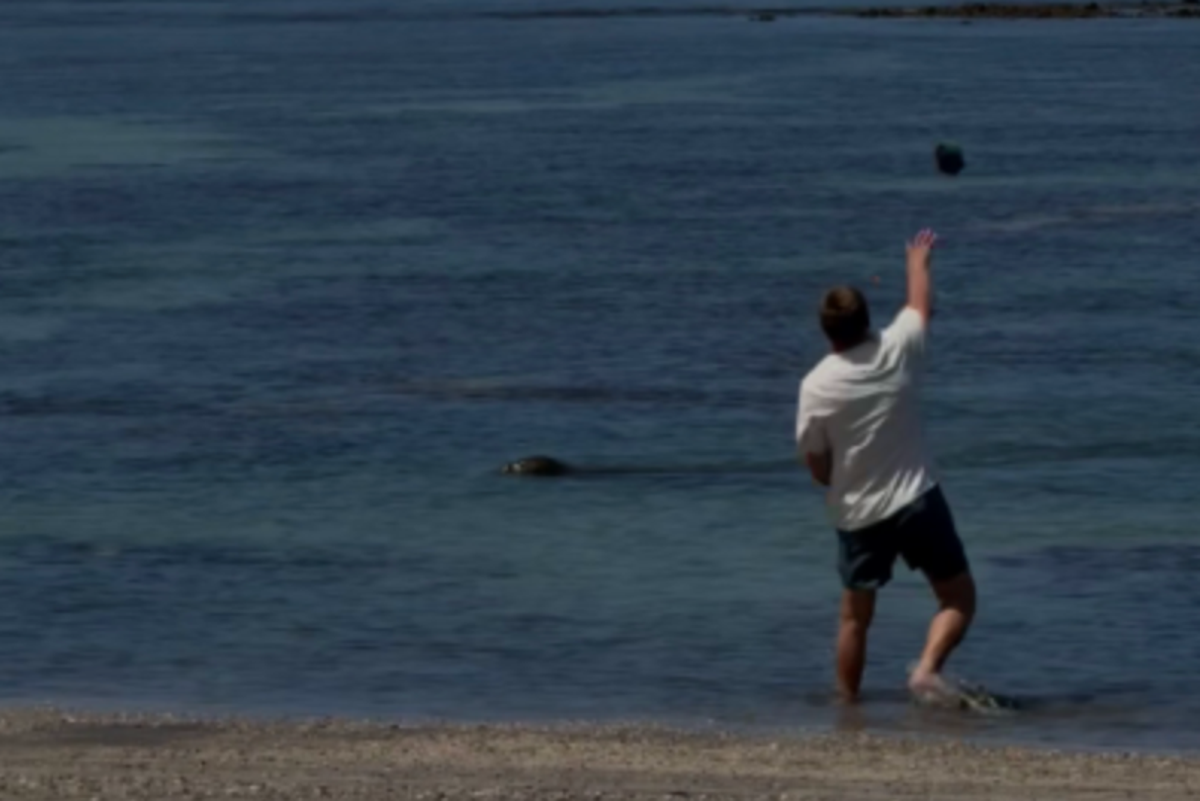
A tourist now faces federal and state charges after a video surfaced showing a rock being hurled at an endangered Hawaiian monk seal. The footage, which spread across social media platforms with predictable speed, captured a blatant violation of the Marine Mammal Protection Act. For the visitor, it was a momentary lapse in judgment or a misguided attempt at engagement. For the seal, a species with a population hovering around 1,600, it was an act of aggression that underscores a deepening crisis in Pacific conservation. This isn't just about one person behaving badly on a beach. It is about the systemic failure of tourism management to protect the very biological treasures used to market the islands.
The High Price of Ignorance
The legal fallout for harassing a monk seal, or ’Ilio holo i ka uaua, is severe. Under federal law, the penalties include fines up to $50,000 and the potential for a year in prison. State laws in Hawaii add another layer of prosecution, often resulting in additional thousands of dollars in restitution. Law enforcement didn't have to work hard to find the perpetrator; the digital trail left by onlookers and the suspect themselves provided a roadmap for the Department of Land and Natural Resources (DLNR). Meanwhile, you can find similar stories here: Why Blaming Chinese Tourists For Fast Fashion Waste Is Lazy Economics.
Most visitors view these animals as props. They see a 600-pound mammal lounging on the sand and assume it is a static part of the scenery. It isn't. These seals are often exhausted, having spent days diving to depths of 1,500 feet to hunt. The beach is their only sanctuary for sleep and thermoregulation. When a human disturbs that rest—whether by throwing a rock, trying to pet them, or getting too close for a selfie—they force the animal back into the water prematurely. This drains vital energy reserves, making the seal vulnerable to shark attacks and malnutrition.
The Tourism Friction Point
Hawaii’s relationship with its visitors has reached a boiling point. The state’s economy relies on the influx of travelers, yet the infrastructure to educate those travelers is crumbling under the weight of sheer volume. We are seeing a pattern where the "aloha spirit" is being traded for a transactional view of the environment. To see the bigger picture, check out the detailed report by Condé Nast Traveler.
The incident on the beach is a symptom of a larger disconnect. People fly thousands of miles to experience "untouched nature" but arrive with the mindset of a theme park guest. In a theme park, the animals are managed. In Hawaii, the animals are wild, protected, and culturally significant. The local community views the monk seal as a family member or a guardian. When a tourist strikes one with a rock, they aren't just breaking a federal statute. They are committing an act of profound cultural disrespect that resonates through the entire archipelago.
Why Education Fails at the Gate
Airlines play videos. Hotels hand out pamphlets. Signs are posted at every major trailhead and beach access point. Yet, the incidents continue. Why? Because the current education model assumes the visitor is a rational actor seeking to follow the rules. In reality, the "influencer" mindset prioritizes the content over the consequence. The rock-thrower in the viral video wasn't looking to study biology. They were looking for a reaction.
We have created a feedback loop where extreme behavior is rewarded with views. This creates a perverse incentive to interact with wildlife in ways that are increasingly dangerous for both the human and the animal. A monk seal may look lethargic, but it can move with surprising speed when threatened. They have powerful jaws designed to crush shells and bone. If that seal had lunged, the narrative would have shifted to the "dangerous animal" rather than the "negligent human."
The Resource Gap in Enforcement
The DLNR and the National Oceanic and Atmospheric Administration (NOAA) are tasked with guarding thousands of miles of coastline with a handful of officers. It is a mathematical impossibility. This leaves the burden of protection on volunteer groups like Hawaii Marine Animal Response (HMAR). These volunteers spend their days roping off sections of beach and standing guard over sleeping seals, often enduring verbal abuse from tourists who feel their "vacation rights" are being infringed upon.
The dependency on volunteers is a precarious way to manage an endangered species. If the state is going to collect billions in tourism taxes, a larger portion of that revenue must be diverted into hard enforcement. Signs are passive. Officers are active. We need boots on the sand, not just flyers in a seatback pocket.
The Biological Reality of a Tiny Population
To understand why a single rock matters, you have to look at the numbers. While the population has seen a slight uptick in recent years, the Hawaiian monk seal remains one of the most endangered marine mammals on the planet. They face a gauntlet of threats:
- Entanglement in discarded fishing gear.
- Toxoplasmosis, a disease spread by feral cat feces.
- Habitat loss due to rising sea levels in the Northwestern Hawaiian Islands.
- Human interference in the main Hawaiian Islands.
When a seal is harassed in a populated area like Oahu or Maui, it creates a "displacement" effect. The animal learns that the beach is unsafe and may move to a less ideal location, or stay at sea longer than is healthy. For a pregnant female or a weaning pup, this displacement can be fatal. Every interaction counts. Every disturbance is a setback for a species that is literally clawing its way back from the brink of extinction.
Rebuilding the Visitor Contract
The solution isn't more signs. It is a fundamental shift in how we grant access to these environments. Some have suggested a mandatory orientation for all incoming travelers, similar to the permits required for certain national parks. If you want the privilege of visiting a fragile ecosystem, you should be required to demonstrate an understanding of the rules that govern it.
The tourist in the viral video will likely pay a heavy price. Their name is now synonymous with wildlife abuse, and the financial toll will be significant. But the goal of the legal system shouldn't just be punishment; it should be a deterrent that actually works. As long as the "apology" is seen as part of the travel cost, nothing changes.
Hawaii is not a playground. It is a complex, living ecosystem that is currently under siege by the very people who claim to love it. The next time you see a monk seal on the sand, remember that your proximity is a metric of your respect. If you can’t keep your distance, you don’t deserve the view.
Stop treating the ocean like a backdrop and start treating it like a sanctuary. Use your zoom lens or stay in the hotel pool. There is no middle ground when a species is fighting for its life.