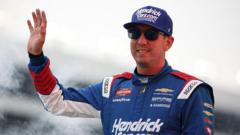
The stock car racing world shifted on its axis on May 21, 2026, when NASCAR confirmed that two-time Cup Series champion Kyle Busch died at the age of 41 following a sudden hospitalization for a severe, undisclosed illness. The news struck like a concrete wall. Just days prior, Busch was strapped into his number 8 Richard Childress Racing Chevrolet, chasing the limits of adhesion at 180 mph. His sudden absence leaves an immediate, agonizing void at the center of American motorsports. He was not just a driver; he was the sport's primary antagonist, its most prolific winner, and its undisputed competitive anchor.
To understand modern stock car racing is to understand the polarizing orbit of Kyle Busch. He won 234 races across NASCAR’s top three national divisions, a staggering record that will likely never be matched in the modern era. He captured the Cup Series championship in 2015 and 2019, earned the nickname "Rowdy" through an unyielding, aggressive driving style, and spent over two decades serving as the benchmark against which all other drivers measured their talent and grit.
The Medical Mystery and the Sudden Exit
The timeline of Busch’s final weeks reveals a competitor fighting through escalating physical distress while refusing to yield the cockpit. During the Cup Series race at Watkins Glen on May 10, 2026, team radio transmissions captured Busch requesting medical assistance and an injection from the trackside medical team immediately upon the race's conclusion.
Television broadcasts noted that Busch had been battling an apparent severe sinus infection. Managing a heavy head cold while enduring the brutal G-forces, crushing heat, and constant elevation changes of the New York road course would break an ordinary athlete. Busch drove through it to finish eighth.
The situation deteriorated rapidly behind closed doors over the subsequent days. On May 21, the Busch family announced that Kyle had been hospitalized with a severe illness and would miss the upcoming race weekend at Charlotte Motor Speedway. Hours later, NASCAR released a statement confirming his passing. The racing sanctioning body expressed deep heartbreak, calling Busch one of the sport's greatest and fiercest drivers.
A Record of Pure Dominance
The raw numbers define his elite status, but they fail to capture the mechanical sympathy and sheer adaptability that made him a terror on any track surface.
- 234 Total National Series Wins: The absolute benchmark across the Cup, Xfinity (O'Reilly Auto Parts), and Craftsman Truck Series.
- 63 Cup Series Victories: Placing him ninth on the all-time premier series wins list.
- 19 Consecutive Winning Seasons: A NASCAR record that underscored his uncanny ability to find the checkered flag regardless of shifting aerodynamic packages or team transitions.
- The Triple Threat: The first driver to sweep all three national series races in a single weekend, a grueling physical feat he accomplished twice at Bristol Motor Speedway.
Busch's career was forged in the furnace of late-model short tracks around Las Vegas before he exploded onto the national scene with Roush Racing and later Hendrick Motorsports. It was his 15-year tenure with Joe Gibbs Racing, driving the iconic M&M's sponsored number 18 Toyota, that cemented his legacy. He won on superspeedways, intermediate ovals, short tracks, and road courses. If a vehicle had four wheels and a steering wheel, Busch could squeeze more speed out of it than the engineers thought mathematically possible.
The Architect of Modern Racing Conflict
NASCAR thrives on narrative, and for two decades, Kyle Busch authored the most compelling storylines in the garage. He embraced the black hat. When crowds booed him during driver introductions, he responded by bowing or mimicking a crying baby to mock his detractors. He understood that a sport needs a villain just as much as it needs a hero.
Yet, the hostility from fans eventually transformed into profound respect. Drivers hated seeing him in their rearview mirrors because they knew he would force them into a mistake or pass them through sheer bravado. Off the track, his technical feedback helped elevate Joe Gibbs Racing into a perennial powerhouse. His own operation, Kyle Busch Motorsports, served as a premier developmental pipeline for the sport, discovering and refining the talents of numerous drivers who now populate the Cup Series grid.
His move to Richard Childress Racing in 2023 was a late-career gamble that proved his enduring market value and competitive fire. Even as the team struggled to find consistent speed with the Next Gen car package during the 2026 season, Busch remained the operational center of gravity for the organization.
The Intangible Toll on the Sport
The loss extends far beyond the statistics or the immediate scramble to fill the seat of the number 8 Chevrolet. NASCAR is currently navigating a transitional period, balancing traditional short-track roots with a push into international markets and street courses. Busch was the bridge between the old-school, uncompromising era of Dale Earnhardt and the hyper-polished, corporate reality of modern sports.
His peers now face a garage area stripped of its loudest, most authentic voice. He leaves behind his wife Samantha, his 11-year-old son Brexton—who is already carving out his own path in youth dirt racing—and his 4-year-old daughter Lennix.
The upcoming garage walk at Charlotte will be silent. The sport will move forward because the schedule demands it, but the competitive landscape of stock car racing will never look the same without the shadow of the number 8 looming in the mirrors.