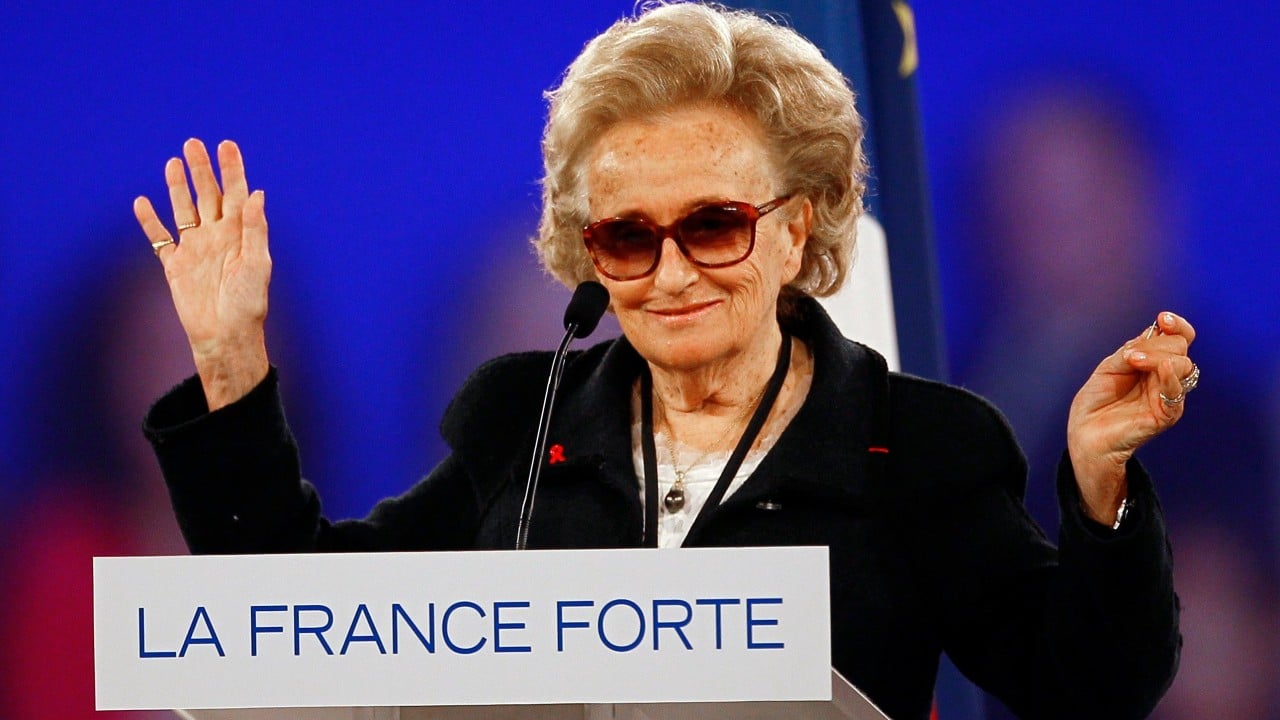
Bernadette Chirac, the steel-willed former first lady of France who weaponized traditional conservative deference to build her own political fiefdom, has died at 93. Her daughter, Claude Chirac, confirmed that she passed away peacefully on June 5, 2026, in Paris.
To the global public, she was often caricatured as the archetype of the long-suffering bourgeois wife. She endured 63 years of marriage to President Jacques Chirac, weathering his notorious, flagrant infidelities with a dry, devastating humor. Yet, reducing Bernadette Chirac to a passive victim of the Elysee Palace’s patriarchal history entirely misreads the mechanics of French political power. She did not merely survive the brutal arena of the Fifth Republic. She mastered it, establishing an independent electoral mandate and forcing a male-dominated political establishment to operating on her terms.
The Illusion of the Shadow Wife
The conventional obituary frame for a political spouse is predictable. It paints a portrait of a woman standing three steps behind a charismatic husband, smoothing over his flaws while sacrificing her own ambitions. Jacques Chirac was a human hurricane, a man of voracious physical and political appetites who climbed from parliament to the mayoralty of Paris, twice serving as prime minister before capturing the presidency in 1995.
Bernadette, born into the old-money, strictly Catholic aristocracy as Bernadette Chodron de Courcel, seemed ill-suited to the mud-slinging of modern campaigns. When the couple met at the prestigious Paris Institute of Political Studies (Sciences Po) in the 1950s, she was the refined product of diplomats and industrialists. He was the brash, handsome climbing centrist. When they married in 1956, she conformed to the expectations of her era, leaving her degree unfinished to raise their daughters, Laurence and Claude, and anchor her husband's domestic life.
But beneath the pearls, Chanel suits, and lacquered blond hair lay a razor-sharp tactical mind. While the French media initially mocked her for an icy aristocratic hauteur, she quietly recognized that her husband’s handlers viewed her as a liability to be tucked away. She refused to play the part. Instead of retreating, she leveraged her perceived weakness into a political armor.
The Rural Stronghold and the Ballot Box
While Jacques Chirac operated in the grand theater of Paris, he dispatched his wife to tend to his rural political base in the Corrèze department of central France. It was meant to be a caretaking operation. Instead, Bernadette turned it into her personal fortress.
In 1971, she won election as a municipal councilor in the tiny village of Sarran. By 1979, she cracked an invisible glass ceiling by winning election to the Departmental Council of Corrèze. She did not just hold that seat; she defended it successfully through successive elections for 36 years until 2015.
Bernadette Chirac's Political Timeline:
+------+--------------------------------------------------+
| Year | Political Milestone                              |
+------+--------------------------------------------------+
| 1956 | Marries Jacques Chirac                           |
| 1971 | Elected Municipal Councilor in Sarran            |
| 1979 | Wins Corrèze Departmental Council Seat           |
| 1994 | Assumes Leadership of Pièces Jaunes Charity      |
| 1995 | Becomes First Lady of France                     |
| 2001 | Publishes Best-Selling Memoir "Conversation"      |
| 2015 | Steps Down from Local Political Office           |
| 2026 | Passes Away in Paris at Age 93                   |
+------+--------------------------------------------------+
This regional mandate transformed her status inside the Gaullist party apparatus. She was no longer just the president’s spouse; she was an elected official with grass-roots legitimacy that many palace advisors lacked. Conservative politicians seeking national office quickly learned that a trek to Corrèze to secure "Bernie’s" blessing was a mandatory campaign stop. She understood that raw political capital is built on a ledger of localized debts, small favors, and deep-seated grudges.
Weaponizing the Yellow Coins
The defining transformation of her public image came not from a political speech, but through a calculated charitable campaign. In 1994, she took control of the Fondation Hôpitaux de Paris-Hôpitaux de France and launched the Opération Pièces Jaunes (Yellow Coins). The initiative, which placed cardboard coin-collection boxes in post offices and schools across the country to fund pediatric hospital wards, became a national phenomenon.
The brilliant cynicism of her detractors faded as the reality of the campaign took hold. Millions of ordinary French citizens who had once viewed her as a cold aristocrat saw her on their television screens shaking hands with pop stars and comforting sick children. She single-handedly invented a American-style public relations apparatus within a French executive branch that had traditionally treated the first lady as a silent ornament.
This populist pivot reached its zenith during the 2002 presidential election. Jacques Chirac’s inner circle was blind to the rising tide of far-right nationalism led by Jean-Marie Le Pen. Bernadette was not. She spent her days listening to rural voters far outside the Parisian bubble. She explicitly warned her husband that an electoral disaster was brewing. Her instincts were vindicated when Le Pen shocked the world by knocking the socialist prime minister out of the first round, forcing a tense runoff that Jacques Chirac ultimately won.
Tragedy, Humiliation, and the Price of Endurance
The public resilience required to maintain this facade came at an immense personal cost. The Chirac marriage was a transaction of power, punctuated by public humiliation. Jacques Chirac’s affairs were an open secret in French journalistic circles, a reality Bernadette eventually confronted with stunning, unvarnished directness in her 2001 memoir, Conversation.
"At first, it was hard. I was very heartbroken, and then I got used to it," she remarked in a later television documentary. "I told myself that was how things were and that I had to accept it with as much dignity as possible."
✨ Don't miss: The Silence in the Diner and the Math of a Midterm Storm
This steel was forged in private tragedy. The couple’s eldest daughter, Laurence, contracted meningitis during adolescence, which triggered severe, chronic anorexia and multiple suicide attempts. Laurence remained a ghost in the family narrative, protected from the press but consuming her mother's private devotion until her death in 2016. It was this intimate acquaintance with medical suffering that fueled Bernadette's manic energy for her hospital charity work.
When Jacques Chirac left office in 2007, his health rapidly deteriorated, and his cognitive faculties slipped away. The fierce gatekeeper of the Elysee became his primary nurse, protecting his dignity with the same fierce territoriality she had used to guard his presidency. By the time he died in 2019, she was too frail to attend his state funeral mass, retreating into the quiet seclusion of her final years.
The French public's fascination with her never truly waned, culminating in the 2023 biographical satire Bernadette, where Catherine Deneuve portrayed her as a discarded wife who orchestrates a brilliant corporate-style comeback. It was a fitting, if slightly exaggerated, homage to a woman who looked at a system stacked against her and decided to conquer it from within. She leaves behind a blueprint for female political power in France that did not rely on changing the rules of the old boys' club, but on playing them with far more ruthlessness than the men could ever muster.