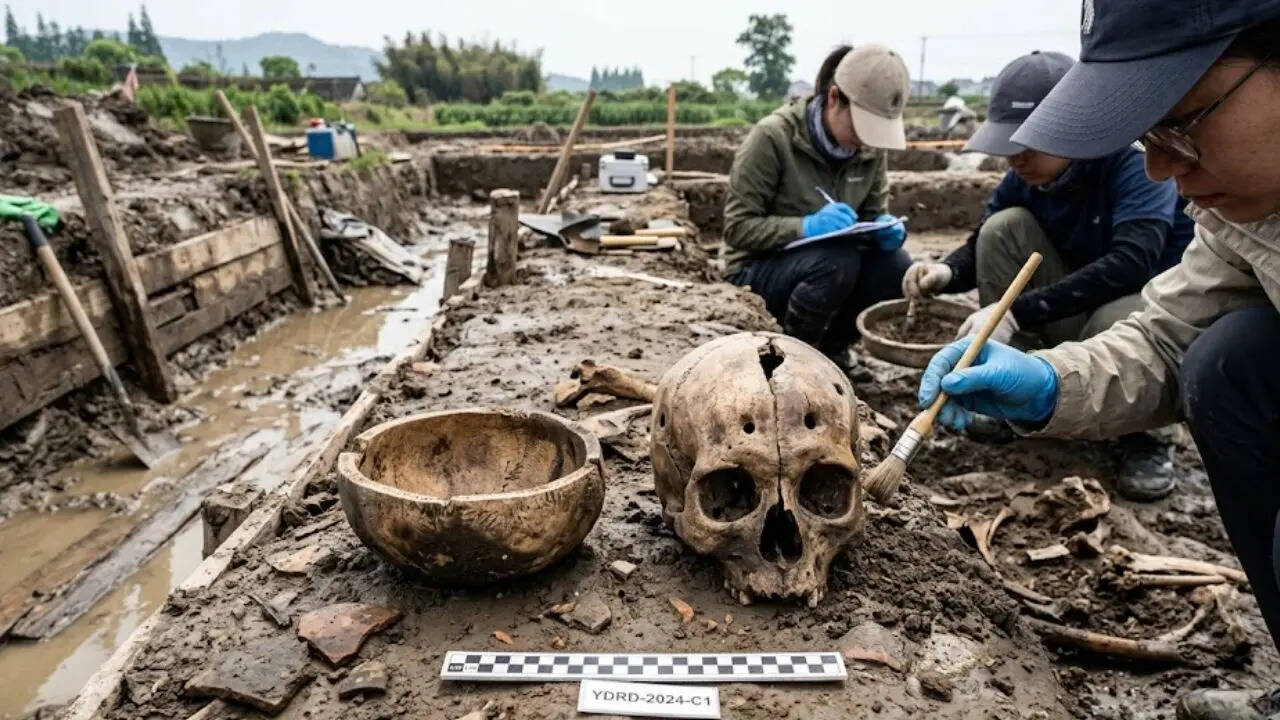
Recent excavations in the Yangtze River Delta have unearthed a grim collection of 5,000-year-old human remains modified into cups and masks. These finds, primarily associated with the Liangzhu culture, shatter the image of a purely peaceful, agrarian society. The discovery of skull caps meticulously carved into drinking vessels and facial bones shaped into masks suggests a sophisticated, albeit violent, system of ritualized social control. These are not the random products of tribal skirmishes. They are the artifacts of a highly organized state using the human body as a medium for political and religious messaging.
Archaeologists working at sites like Wangzhuang in eastern China are seeing a pattern that suggests these bone artifacts were used to cement the authority of a rising elite class. By transforming the remains of the dead—whether ancestors or enemies—into functional objects, the Liangzhu people created a visual language of dominance that lasted for centuries.
The Engineering of Death
The craftsmanship required to turn a human cranium into a functional cup is immense. This was not a hurried process. Analysis shows that the makers used specialized stone tools to saw through the thickest parts of the skull, followed by intensive grinding to smooth the jagged edges. The goal was clearly aesthetic as much as it was functional.
In the Yangtze Delta, the environment is acidic, which usually destroys organic matter. However, these bone artifacts were often found in specific burial pits or ritual layers where the soil conditions or the presence of jade and lacquer helped preserve them. When you hold a 5,000-year-old piece of polished human bone, you aren't just looking at a macabre curiosity. You are looking at an object that required hours of labor by a skilled artisan who likely held a high status within the community.
This level of detail implies a standardized practice. We aren't looking at a one-off event. The consistency in how these masks were shaped—often removing the jaw and focusing on the ocular and nasal cavities—indicates a shared cultural liturgy. The masks were likely worn by shamans or priests during ceremonies designed to bridge the gap between the living and the spirit world, using the physical remains of the deceased to channel power.
Power Dynamics in the Jade Age
The Liangzhu culture is famous for its intricate jade work, particularly the cong (tubes) and bi (disks). For years, these jades were considered the primary symbols of authority. The discovery of the bone cups and masks adds a darker, more visceral layer to this hierarchy. While jade represented cosmic order and wealth, the bone artifacts likely represented the raw power of life and death.
There is a long-standing debate among historians regarding whether these bones belonged to revered ancestors or defeated foes. In many Neolithic societies, drinking from the skull of an ancestor was a way to inherit their wisdom and strength. Conversely, doing the same with an enemy’s skull was the ultimate act of humiliation and trophy-taking.
In the context of the Yangtze Delta’s rapid urbanization 5,000 years ago, both theories point toward the same reality: extreme social stratification. The people who owned these objects were not farmers. They were a class of rulers who managed massive water-conservancy projects and controlled the distribution of resources. They used these grisly items to remind the populace that their power extended beyond the physical world and into the afterlife.
Comparison of Ritual Artifacts
| Artifact Type | Primary Material | Probable Function | Social Significance |
|---|---|---|---|
| Skull Cup | Human Cranium | Ritual Drinking | Transference of power or victory trophy |
| Bone Mask | Facial Skeletal Structure | Shamanistic Rituals | Communication with spirits/Ancestors |
| Jade Cong | Nephrite Jade | Burial Offering | Earthly wealth and cosmic alignment |
The Yangtze Delta as a Crucible of Conflict
The geography of the Yangtze Delta 5,000 years ago was a labyrinth of marshes, lakes, and rivers. Managing this environment required a massive, disciplined workforce. It also led to inevitable friction between expanding settlements. As populations grew, the competition for arable land and trade routes intensified.
We see evidence of this tension in the skeletal remains. Many of the skulls used for these artifacts show signs of perimortem trauma—injuries occurring at or near the time of death. This suggests that the "raw material" for these cups and masks was often sourced through warfare. The ritualization of these remains served as a psychological tool. If you can turn your neighbor into a piece of dinnerware, you have achieved a level of psychological dominance that a simple stone axe cannot provide.
It is easy to view this through a lens of modern morality and see it as "savage." That is a mistake. This was a calculated, state-sponsored activity. The Liangzhu were a "complex society," a term archaeologists use to describe a civilization with a clear government and specialized labor. Their use of bone masks was as much a part of their governance as their irrigation systems.
Debunking the Myth of the Peaceful Neolithic
For decades, the narrative surrounding early Chinese civilization focused on the "Yellow River" as the sole cradle of culture, often portraying the southern Yangtze cultures as secondary or more "naturalistic." These bone finds prove that the Yangtze Delta was home to a power structure just as ruthless and sophisticated as any in the north.
The masks, in particular, suggest a theatrical element to their religion. Imagine a torch-lit ceremony on top of a massive earthen mound, with a high priest wearing a mask carved from a human face. The visual impact would have been terrifying and awe-inspiring. This wasn't just religion; it was political theater designed to ensure total compliance from the working classes who built the dams and harvested the rice.
Some researchers argue that the bone masks were not for the living to wear, but for the dead. They may have been placed on the faces of the deceased to grant them a new identity in the spirit realm. Even if this is the case, the act of "harvesting" the bone from one individual to adorn another speaks to a culture that viewed the human body as a resource.
The Technical Execution of Ritual
The tools used for these modifications were likely made of flint or hardened stone, as bronze had not yet become the dominant metal in the region. Microsufface analysis on the bone cups shows circular scratching patterns, indicating a rotary motion during the grinding phase. This suggests the use of a primitive lathe or a very steady, disciplined hand.
The precision is haunting. To remove the facial structure without shattering the delicate bones around the nose and eyes requires an intimate knowledge of anatomy. This implies that the people performing these tasks were specialists—perhaps the same individuals who performed burials or sacrifices. They understood the physical limits of human bone.
Why the Rituals Vanished
By around 2300 BC, the Liangzhu culture collapsed. The massive cities were abandoned, and the intricate jade and bone traditions faded away. Most scholars point to environmental factors, such as massive flooding or a shift in the coastline, as the cause.
When a society is built on a rigid hierarchy and intense ritualization, it is incredibly fragile. If the "god-kings" who wore the bone masks could not stop the floods, their authority vanished overnight. The bone cups and masks were abandoned in the mud, left to be discovered five millennia later as a reminder of a civilization that tried to conquer death through craftsmanship.
The artifacts found in the Yangtze Delta are more than just archaeological curiosities. They are the physical remains of a period when humanity was first experimenting with the limits of power and the costs of civilization. Every polished edge of a bone cup represents a life lived, a life taken, and a system of belief that demanded the ultimate sacrifice for the sake of social order.
Archaeology is currently moving toward more advanced DNA and isotopic analysis of these bones. This will eventually tell us exactly who these people were—where they grew up, what they ate, and whether they were related to the people who eventually turned them into masks. Until then, we are left with the objects themselves: cold, hard evidence of a time when the line between the sacred and the macabre did not exist.
If you want to understand the origins of the state, you have to look at how it treats the human body. In the Yangtze Delta, 5,000 years ago, the body was the ultimate canvas for authority.