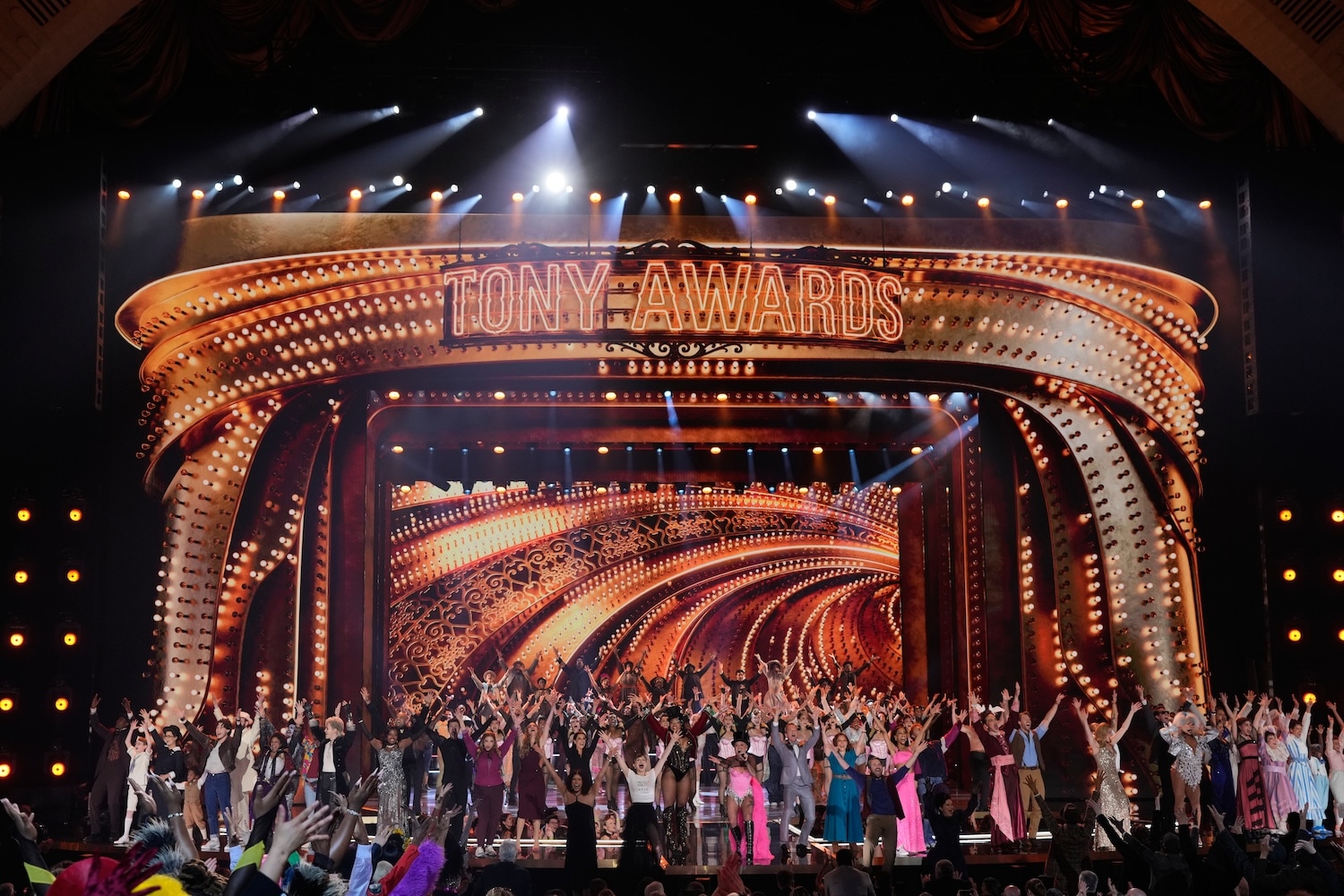
Broadway just celebrated a record-shattering season, pulling in $1.91 billion in grosses, but the 2026 Tony Awards exposed a deep, structural schism in the American theater ecosystem. On Sunday night at Radio City Music Hall, the Tony voters executed a tactical split-screen strategy. They handed the night's most commercial trophy, Best Musical, to Schmigadoon!, a glittering, self-referential parody of Golden Age theater. Yet underneath that layer of pure escapism, the actual artistic consensus veered sharply toward bruising, socially conscious works that confront uncomfortable political realities.
The industry is using nostalgia to balance its ledgers while using high-minded drama to salvage its soul.
This tension between pure commercial escapism and urgent societal critique defined the 79th annual ceremony, hosted by pop star Pink. While Schmigadoon!—adapted from the Apple TV+ series—anchored the industry’s financial ambitions by turning Broadway's own history into a bankable tourist draw, the real narrative emerged in the straight play categories and major revivals. Theater artists are not looking backward to comfort the audience; they are digging into historical and modern scars.
The Illusion of the Commercial Juggernaut
To understand why Schmigadoon! won Best Musical despite walking away with only four awards total, one has to look at the financial pressures facing modern producers. Broadway is dealing with soaring production costs and an audience base that remains risk-averse. Schmigadoon!, written by Cinco Paul, won because it satisfies the ultimate institutional desire: it is an on-ramp for casual theatergoers, wrapped in a brilliant critique of the genre’s own tropes.
But a four-win night for a Best Musical victor is a historically soft mandate. It tied with The Lost Boys and the revival of Ragtime, proving that the community's passion was scattered across the board rather than consolidated behind a single blockbuster.
The musical categories revealed an industry battling over its identity. Cats: The Jellicle Ball took home three awards, including historic wins for directors Zhailon Levingston and Bill Rauch, alongside choreographers Omari Wiles and Arturo Lyons. By shifting Andrew Lloyd Webber's classic into the world of contemporary ballroom culture, the production proved that radical reinvention can generate immense critical capital. Costume designer Qween Jean also made history as the first openly transgender Tony winner for her work on the production, signaling a massive cultural shift in who gets celebrated behind the scenes.
The Pulitzer to Tony Pipeline and Female Playwrights
The straight play categories offered no such escapism. Bess Wohl’s Liberation secured the award for Best Play, a victory that directly reflects the current cultural anxieties surrounding bodily autonomy and the unfinished business of second-wave feminism.
Wohl’s win is momentous, but the historical context is sobering. She is only the fourth female playwright to win Best Play in the entire history of the Tony Awards, and the first to do so since 2009. Liberation came into the night armed with the 2026 Pulitzer Prize for Drama, and its win demonstrates that the straight play on Broadway is currently sustained by works that double as urgent social testimony. The play does not coddle its audience; it interrogates the cost of systemic regression.
Female Best Play Winners in Tony History:
1. Wendy Wasserstein (The Heidi Chronicles, 1989)
2. Yasmina Reza (Art, 1998 / God of Carnage, 2009)
3. Lynn Nottage (Ruined - Pulitzer winner, but did not win the Tony; Sweat was nominated)
4. Bess Wohl (Liberation, 2026)
History at Eighty and the Weight of Apologies
Nowhere was the appetite for complex moral ambiguity more evident than in the acting categories. John Lithgow won Best Leading Actor in a Play for his performance as Roald Dahl in Giant. At 80 years old, Lithgow made history by securing his third Tony Award—a full 53 years after his Broadway debut in The Changing Room in 1973.
Giant deals with Dahl in the 1980s, trapped in the fallout of his own antisemitic remarks, weighing the preservation of his public reputation against the necessity of a genuine apology. It is a grueling, deeply unflattering look at a literary icon. Lithgow’s victory emphasizes a broader trend: the industry is rewarding veteran actors who are willing to dismantle the mythology of great men.
A similar gravity carried through the rest of the dramatic acting categories:
- Lesley Manville won Best Leading Actress in a Play for her performance as Jocasta in Robert Icke's Oedipus, which recontextualized Sophocles' ancient tragedy as a modern, high-stakes political thriller.
- Laurie Metcalf won Featured Actress in a Play for her portrayal of Linda Loman in Arthur Miller's Death of a Salesman, marking her third Tony win.
- Alden Ehrenreich won Featured Actor in a Play for his sharp turn in Becky Shaw.
The Revival Paradox
The night’s numeric heavyweight was Joe Mantello’s staging of Death of a Salesman, which collected six Tony Awards, the most of any production this season. The sweep, which included Best Revival of a Play and Best Direction for Mantello, underscores an uncomfortable truth for Broadway: the industry remains structurally reliant on the dead.
When Broadway needs to make a definitive statement about contemporary American rot, it frequently defaults to Arthur Miller. Mantello’s production managed to make a decades-old script feel shockingly immediate, but the fact that a revival completely outpaced every new play on the boards in terms of total trophies highlights a lack of institutional confidence in newer, riskier dramatic voices.
On the musical side, Ragtime pulled off a major coup by defeating the highly favored Cats: The Jellicle Ball for Best Revival of a Musical. Ragtime operates on an epic scale, tracking the collision of Black, immigrant, and wealthy white lives at the turn of the 20th century. Its victories for lead performers Caissie Levy and Joshua Henry marked the first time in 28 years that a musical revival claimed both top acting prizes.
The win for Ragtime is a reminder that the "promise of the American Dream" remains Broadway’s most reliable narrative currency, provided it is seasoned with a heavy dose of historical critique.
The Cost of the $1.91 Billion Season
While the cumulative gross of $1.91 billion sounds like an unmitigated triumph, it masks an increasingly precarious economic reality. The money is heavily consolidated at the top. Audiences are flocking to massive, recognizable intellectual properties or star-driven revivals, leaving mid-tier productions and original dramas scrambling to survive past their opening weeks.
Broadway has successfully engineered a financial recovery, but it has done so by accelerating a bifurcated market. You either offer total, glittering amnesia like Schmigadoon!, or you offer the elite prestige of Death of a Salesman and Liberation. The middle ground—where weird, experimental, and unclassifiable theater used to live—is effectively gone.
The 2026 Tony Awards did not just hand out trophies; they mapped the borders of a survival strategy. Producers have cracked the code on how to get people through the doors of Radio City Music Hall and the historic theaters of midtown, but the art itself is reflecting a culture under immense duress. Broadway is rich again, but its stages tell the story of a world that is deeply fractured.