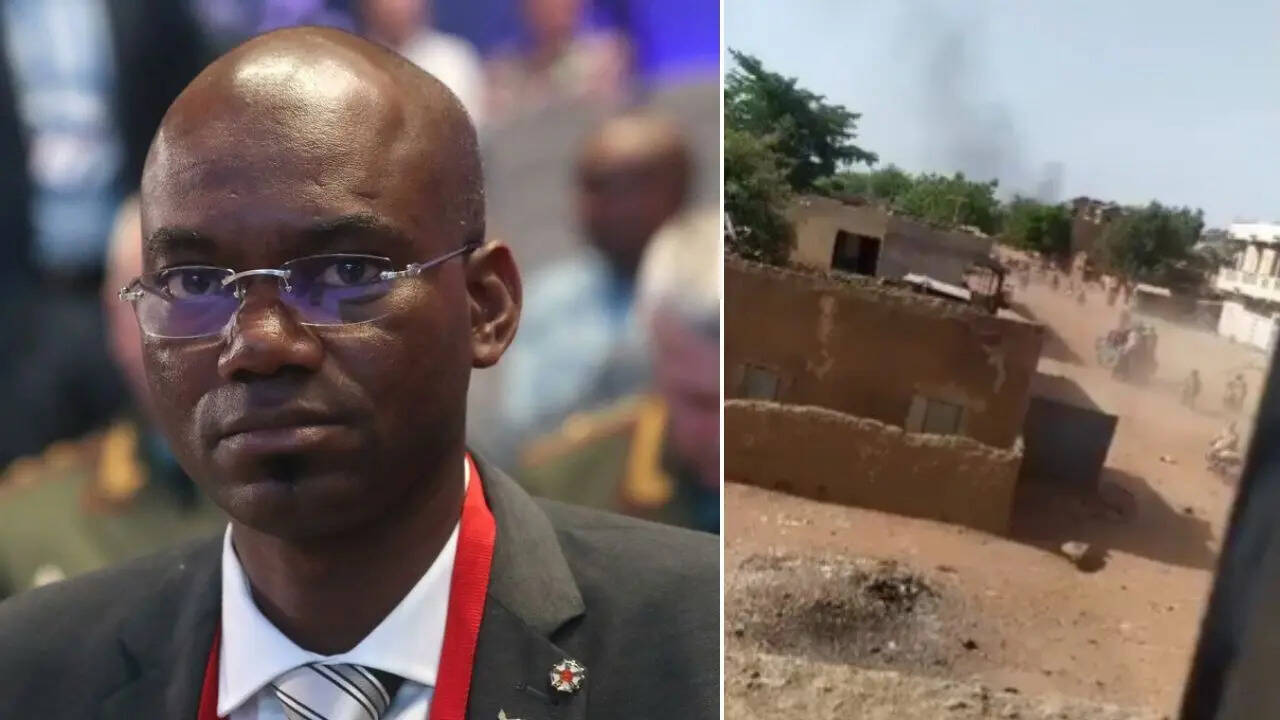
The iron-fisted architecture of the Malian junta fractured on April 25, 2026, when a car laden with explosives breached the residence of Defence Minister Sadio Camara in Kati. Camara, the primary architect of Mali’s pivot toward Moscow and away from Western security alliances, did not survive the blast. His death, confirmed by state television after a day of chaotic silence, marks the most significant blow to the transitional government since the 2020 coup. It is not merely a high-profile assassination; it is a systemic failure of the "security first" promise that the military used to justify its grip on power.
While the government initially attempted to downplay the scale of the carnage, the reality is a nightmare of coordination. This was not a lone-wolf strike. It was a synchronized offensive across the nation, targeting the heart of the military establishment in Bamako and strategic hubs in the north. The strike on Kati—the very citadel of the ruling junta located just 15 kilometers from the capital—proves that no one is safe in the new Mali.
The Unholy Alliance
For years, the Malian military insisted that its shift toward the Russian-backed Africa Corps, formerly known as the Wagner Group, would provide the "robust" security that French and UN forces failed to deliver. Saturday's events dismantled that narrative. The attacks were a rare joint operation between the al-Qaida-affiliated Jama'at Nusrat al-Islam wal-Muslimin (JNIM) and the Tuareg-dominated Azawad Liberation Front (FLA).
These groups have historically been at odds, often fighting for the same territory and influence. Their sudden tactical alignment suggests a desperate but effective realization: the common enemy in Bamako is more vulnerable than previously thought. By hitting Bamako’s international airport, military bases in Gao, and the town of Kati simultaneously, they stretched the Malian Armed Forces and their Russian allies to a breaking point.
The Breach at Kati
The assassination of Camara at his home is a staggering intelligence failure. Kati is not a normal town; it is a fortress. It houses the primary barracks for the army and the personal residences of the country’s top leadership, including President Assimi Goïta.
Eyewitnesses described a suicide attacker driving a vehicle-borne explosive device (VBIED) directly into the minister's residence during the early morning hours. Reports suggest Camara died while engaging the attackers in a firefight, a desperate last stand in a hallway that should have been the most secure location in West Africa. The explosion was so massive it leveled an adjacent mosque, claiming the lives of several worshippers. This collateral damage highlights the indiscriminate brutality of the current conflict, where the line between military targets and civilian life has been erased.
The Russian Question
The death of Sadio Camara is a personal disaster for the Kremlin. Camara was the "fixer" who negotiated the entry of Russian mercenaries into Mali. He was the man who traded Western diplomatic ties for Russian hardware and boots on the ground.
With Camara gone, the Africa Corps loses its most powerful domestic advocate. The mercenaries are currently fighting to hold Kidal and Gao, but their reputation as an invincible security solution is in tatters. Images of a downed Mil Mi-8 helicopter near Wabaria and reports of Russian casualties in Sevare point to a force that is overextended and failing to adapt to the fluid, multi-front nature of this new insurgency.
Malian citizens are left wondering what they bought with their sovereignty. The "security" promised by the junta has resulted in the largest coordinated attack in recent history and the death of the man in charge of the nation's defense.
A Fragile Capital
Bamako remains under a "fragile calm," a term used by analysts when the streets are empty not because of peace, but because of fear. Access to military facilities is blocked by tires and barriers. The international airport, once the gateway for the region's economy, is now a zone of smoldering wreckage and heavy patrols.
The government’s official tally of 16 wounded is viewed with deep skepticism. Hospitals in Bamako and Kati tell a different story, one of overwhelmed wards and a death toll that likely climbs into the hundreds when accounting for the battles in the north. In Kidal, the FLA has already claimed total control, forcing the Malian army and their Russian allies into a retreat that looks more like a rout.
The junta now faces a choice between doubling down on a failed strategy or seeking a political exit that they have spent years avoiding. Without Camara's strategic mind, the path forward is obscured by the smoke of his own residence. The "terrorist attack" label used by state media is an easy shorthand, but it fails to capture the true depth of the crisis. This is a war of attrition that the state is currently losing.
Mali’s transition was supposed to lead to stability. Instead, it has led to the heart of the government being blown apart in a gated military stronghold. The era of believing that a change in international partners would magically solve decades of ethnic and religious tension is over. The reality is much colder: the protectors of Mali cannot even protect themselves.