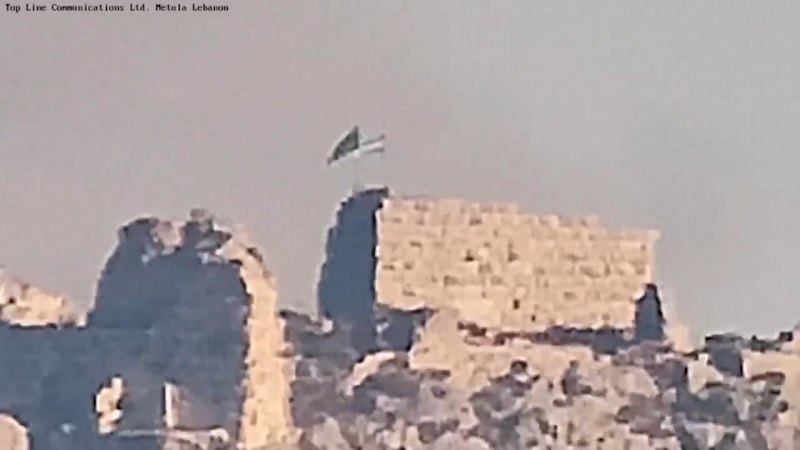
The return of the Israeli flag to the ramparts of Beaufort Castle marks the formal death of the April ceasefire and the birth of a permanent new occupation buffer zone in southern Lebanon. By crossing the Litani River and seizing the 900-year-old Crusader fortress, Israeli forces have executed their deepest ground push into Lebanese territory in over a quarter-century. This is not a temporary cross-border raid. It is a calculated geopolitical pivot designed to break the diplomatic stalemate by creating unalterable facts on the ground before upcoming talks at the US State Department.
The Myth of the April Ceasefire
For six weeks, international diplomats maintained the fiction that a cessation of hostilities was holding in southern Lebanon. The capture of the fortress, locally known as Qalaat al-Shaqif, shatters that illusion completely.
The military reality changed rapidly when the Israel Defense Forces launched a coordinated assault across the Litani River into the Wadi al-Saluki area. This offensive followed weeks of tactical frustration. Hezbollah had been leveraging low-altitude fiber-optic drones to bypass Israeli air defense systems, inflicting steady casualties on assembly points in northern Galilee.
The decision to advance was catalyzed by a heavy barrage of over 25 projectiles fired into northern Israel, which triggered sirens in cities like Karmiel and Safed for the first time since April. The response from West Jerusalem was swift and unyielding. Extensive preparatory airstrikes, heavy artillery barrages, and armored engineering units systematically cleared the approaches to Nabatiyeh, reducing surrounding villages to scorched earth to guarantee a secure path to the summit.
The Long Shadow of 1982
To understand why this specific mountain matters, one must understand the deep psychological scars it carries for both sides.
Historical Control of Beaufort Castle:
[12th Century: Crusaders] -> [Saladin's Army] -> [Mamluks/Ottomans] -> [PLO (Pre-1982)] -> [Israel Occupation (1982-2000)] -> [Hezbollah (2000-2026)] -> [IDF Capture (May 2026)]
When Israeli troops from the Golani Brigade raised their national colors alongside their unit flag on Sunday, they were consciously resurrecting ghosts. In 1982, the brutal battle to capture Beaufort from the Palestine Liberation Organization became the defining symbol of the First Lebanon War. It was an operation that achieved its immediate objective but ultimately locked Israel into an exhausting, 18-year war of attrition that ended in a unilateral withdrawal in 2000.
For a generation of Israeli soldiers, the castle represented a bloody, static quagmire. For Hezbollah, the 2000 withdrawal from the fortress was their foundational triumph.
By reclaiming the summit 44 years to the day after that initial battle, Prime Minister Benjamin Netanyahu is attempting to rewrite that history. His administration is explicitly framing this capture not as a repetition of a past mistake, but as a correction. The political message intended for the Israeli public is clear: the era of retreat is over.
The Strategic Value of the High Ground
The military logic dictating the assault is as old as warfare itself. Perched on a sheer cliff rock face nearly 2,300 feet above the Litani River valley, Beaufort Castle commands an unobstructed view of the entire region.
From this vantage point, military forces can monitor and direct fire across massive swathes of southern Lebanon and deep into the Galilee Panhandle. The ridge effectively controls the access routes to Nabatiyeh, a major logistical hub and historical Hezbollah stronghold just five kilometers to the north.
By occupying this dominant terrain, the Israeli military establishes an unblinking surveillance eye over the rolling green hills that Hezbollah long used to conceal rocket launchers. Defense Minister Israel Katz confirmed this long-term intent, stating that the military plans to hold the ridge permanently as an expanded Forward Defense Line. This strategy transforms the castle from a historical curiosity into an active intelligence and fire-control node designed to prevent any armed return to the border zone.
The Cost of the Scorched Earth Strategy
The operational execution of this advance has left a trail of total devastation. The Israeli military issued sweeping evacuation orders covering all territory south of the Zahrani River and north of the Litani, a massive combat zone extending roughly 40 kilometers deep into Lebanon.
Entire villages flanking the approach to the castle have been systematically leveled by engineering corps and heavy airstrikes. Black smoke continues to billow from the neighboring town of Arnoun, providing a grim backdrop to the flag-raising ceremonies on the ridge.
Lebanese Prime Minister Nawaf Salam condemned the incursion, accusing Israel of executing a deliberate policy of collective punishment and permanent territorial expropriation. The human toll of this expanded campaign is staggering:
- Over 1.2 million Lebanese citizens have been displaced from their homes.
- More than 3,300 fatalities have been recorded by the Lebanese ministry of public health.
- Approximately 20 percent of those casualties comprise women, children, and medical first responders.
This systematic destruction of civilian infrastructure serves a dual military purpose. It denies Hezbollah physical structures to use for cover, and it creates a completely uninhabitable dead zone that prevents the civilian population from returning to the border region.
The Multi Front Expansion Strategy
The conquest of the Beaufort Ridge must be viewed as part of a broader, aggressive restructuring of regional borders. Netanyahu explicitly stated that the capture represents a dramatic shift in border policy, noting that Israel is actively breaking the barrier of fear by establishing external security zones across multiple frontiers simultaneously.
This strategy is playing out with equal intensity in other theaters. Just days prior to the advance in Lebanon, the Israeli government instructed the military to dramatically expand its territorial control inside the Gaza Strip, with the stated objective of seizing over 70 percent of that territory. Currently, Israeli forces maintain direct control over roughly 60 percent of Gaza.
Simultaneously, military operations and security zones have been reinforced along the Syrian border. The long-term goal is no longer containment or deterrence. The current administration is systematically pushing national security perimeters deep into sovereign neighboring territories to build permanent, militarized buffers that insulate domestic communities from cross-border fire.
The Collapse of Diplomatic Leverage
The timing of this military escalation is explicitly designed to compromise international mediation. Representatives from regional powers and Western nations are scheduled to meet at the US State Department for a critical round of talks aimed at salvaging regional stability.
By presenting the international community with an active, deeply entrenched military presence atop Lebanon’s most strategic ridge, Israel has effectively neutralized the pre-existing negotiation frameworks. Diplomatic demands to return to the status quo of the April agreement are now entirely obsolete.
The move also introduces severe complications for broader regional diplomacy. Iran has repeatedly signaled that any overarching agreement regarding its own strategic posture must remain conditional on an immediate end to hostilities in Lebanon.
By deepening the invasion and threatening to advance further toward the coastal city of Tyre, Israel has raised the stakes for Tehran. The capture of Beaufort proves that the Israeli war cabinet is entirely willing to absorb international condemnation to achieve permanent territorial depth, leaving diplomats to scramble for a solution while the artillery fire around Nabatiyeh continues to echo across the Litani valley.