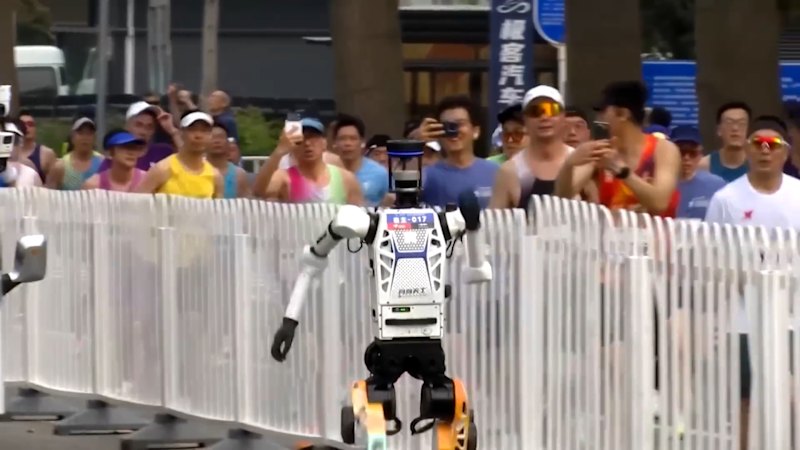
The mechanical legs don't sweat. They don't experience the searing lactic acid buildup that makes a human runner’s lungs feel like they are swallowing crushed glass at mile ten. Recently, a bipedal robot clocked a half-marathon time that didn't just beat the average amateur—it threatened the middle-of-the-pack professional. While the headlines focused on the novelty of a "robot race," the real story lies in the terrifying efficiency of power-to-weight ratios and the collapse of biological limits.
Humans are built for endurance, but we are plagued by inefficient cooling systems and fragile joints. A robot operates on lithium-ion density and carbon-fiber resilience. When we talk about a machine completing 13.1 miles, we aren't just looking at a fancy remote-controlled car. We are witnessing the first practical application of mobile, autonomous kinetic energy that can outlast the greatest distance runners in history.
The Engineering Behind the Mechanical Stride
The fundamental problem with human running is gravity. Every time a human foot hits the pavement, the body absorbs a force equal to nearly three times its weight. We dissipate that energy through cartilage and bone, which eventually fail. Engineers have bypassed this biological bottleneck by using high-torque brushless motors and regenerative braking systems that capture energy during the descent of a stride.
In recent trials, bipedal models like those developed by Agility Robotics and various university labs have moved beyond the "stutter-step" of early prototypes. They now employ dynamic gait controllers. These systems calculate surface friction and center-of-mass shifts in microseconds.
Power Density and the Thermal Wall
The greatest hurdle for a mechanical runner isn't the movement itself, but the heat. Humans use evaporation. Robots use heat sinks and liquid cooling loops. During a half-marathon, a robot’s battery pack generates immense internal temperatures. To maintain a sub-two-hour pace, these machines require sophisticated thermal management that rivals a high-performance sports car.
If the cooling system fails, the motors lose torque. If the torque drops, the gait becomes unstable. It is a razor-thin margin of error. However, unlike a human athlete who might suffer heatstroke and require hospitalization, a robot can be "fixed" with a modular part swap. This creates an uneven playing field where the machine can be pushed to 99% of its physical limit without the fear of permanent biological death.
The Economic War Under the Surface
This isn't about trophies or Gatorade sponsorships. The half-marathon is the ultimate proving ground for last-mile delivery and military reconnaissance. If a robot can navigate 13.1 miles of uneven asphalt, curbs, and varying inclines, it can navigate a city.
Companies are pouring millions into these "athletes" because the data gathered during a long-distance run is gold. Every stumble, every sensor glitch, and every battery drain profile informs the next generation of industrial automation. We are seeing a shift where the sports arena has become the R&D lab for the future of physical labor.
Cost of Performance
Currently, the price tag for a robot capable of finishing a half-marathon exceeds $150,000. That includes the custom actuators, the LIDAR arrays for navigation, and the carbon-fiber chassis. Compare that to a human runner, whose primary costs are shoes and calories.
The gap is narrowing. As manufacturing scales, the cost of high-output servos is dropping by 15% annually. We are approaching a crossover point where the mechanical runner becomes cheaper to maintain than a human courier or scout.
Demographics of the Machine Age
The data surrounding who builds and who competes in these events reveals a stark divide. Currently, the development of high-performance bipedalism is concentrated in specific geographic and demographic hubs.
- Research Hubs: Over 60% of the top-performing marathon robotics teams originate from the United States and Japan, specifically from institutions like MIT, Stanford, and Osaka University.
- Gender Gap: In the engineering teams behind these machines, women make up less than 22% of the lead hardware roles, a statistic that industry analysts argue is slowing the progress of diverse ergonomic design.
- Economic Barriers: Small-scale tech firms are being priced out. The top 3% of robotics companies hold 85% of the patents related to high-speed bipedal locomotion.
This concentration of power means the "evolution" of the robot runner is being dictated by a very small group of people with very specific commercial interests.
The Physiological Insult
There is something inherently jarring about watching a machine mimic the most human of activities. Running is primal. It is how we hunted; it is how we survived. When a collection of wires and sensors performs this act with more precision and less effort, it creates a psychological friction that the industry hasn't addressed.
Sports physiologists have noted that the "perfect" gait of a robot—one that never over-pronates or tires—is actually a disadvantage in certain terrains. Human "imperfection" allows for adaptability. A human runner can feel a slight change in the gravel and adjust their ankle tension instinctively. Robots are still struggling with this level of haptic feedback. They are fast on the road, but they are clumsy in the woods.
Biological Limits vs. Mechanical Scaling
A human's $VO_2$ max—the maximum rate of oxygen consumption—is the hard ceiling for our performance. We cannot simply "upgrade" our lungs. A robot's ceiling is only limited by the energy density of its fuel source.
If a breakthrough in solid-state batteries occurs tomorrow, the robot half-marathon time could theoretically drop to forty minutes. No amount of training, blood doping, or shoe technology will ever allow a human to touch that. We are entering an era where the word "athlete" will require a new definition.
The Safety Risk No One Mentions
A 150-pound robot running at 12 miles per hour is a kinetic projectile. If a sensor fails and the machine veers into a crowd, the results are catastrophic. Unlike a human who will instinctively try to avoid a collision to protect themselves, a robot follows its code until the hardware fails.
The liability insurance for these events is astronomical. Race organizers are forced to create "kill switch" zones and dedicated lanes, effectively turning the race into a controlled experiment rather than a public sporting event. This sanitization of the sport removes the very element that makes marathons exciting: the unpredictability of the human spirit.
Data Sovereignty and the Finish Line
Who owns the gait? As these robots run, they are collecting terabytes of spatial data. They are mapping the race course in 3D, recording pedestrian movements, and analyzing infrastructure. This data isn't just used for the race; it is sold to mapping companies and urban planners.
The runner is no longer just a competitor; it is a mobile surveillance platform. This creates a massive privacy loophole. If a city allows a fleet of "racing robots" to traverse its streets, it is effectively handing over the keys to its visual data to whichever corporation owns the software.
The End of the Human Streak
We have spent decades obsessing over the "Sub-2" marathon. We cheered when Eliud Kipchoge broke the barrier under specialized conditions. But a robot doesn't need special shoes or a pacing car with a laser. It just needs a full charge and a clear path.
The fascination with these machines will eventually fade into a grim realization. We aren't watching a new sport; we are watching the obsolescence of the human physical form as a metric of success. The "race" was over before it began.
The next time you see a machine trot past a human on the trail, don't look at its speed. Look at the fact that it isn't breathing. It doesn't care about the finish line. It only cares about the next command in the sequence.
Stop looking at the legs and start looking at the batteries.