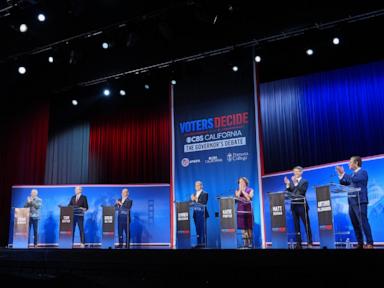
The California gubernatorial primary has shifted from a theoretical exercise into an operational race for market share. With mail ballots scheduled for distribution within days, the first televised debate functioned as a stress test for the candidates’ disparate logistical frameworks and ideological branding. In a state where the "top-two" primary system creates a distinct bottleneck, the strategic objective for each candidate was not universal persuasion, but the securing of a specific demographic floor required to survive the elimination round.
The Bottleneck Theory of the California Top Two Primary
The California primary system operates on a winner-take-all mathematical reality that differs fundamentally from traditional partisan primaries. Because the two candidates with the highest raw vote totals advance to the general election regardless of party affiliation, the debate was less a contest of ideas and more a fight for consolidation.
This creates a structural "spoiler effect" within the Democratic field. With four major Democrats competing for a roughly similar pool of progressive and moderate voters, the risk of a Republican—represented by Steve Garvey—consolidating the 30% to 35% GOP floor is significant. The debate revealed the Democratic candidates attempting to solve this variable through two distinct mechanisms:
- Differentiation through policy edge cases: Using specific, high-friction issues like reparations or retail theft to create clear blue water between themselves and their peers.
- The "Republican Wedge" Strategy: Strategically attacking or ignoring the Republican frontrunner to either elevate him (to ensure a Democratic victory in November) or suppress him (to ensure a Democrat-versus-Democrat runoff).
The Cost Function of California Governance
The debate prioritized three specific fiscal and social variables: the $22.2 billion budget deficit, the housing supply-demand imbalance, and the operational failure of public safety systems. Candidates moved beyond the "vague statements" of the campaign trail into a series of competing administrative theories.
The Deficit Mitigation Matrix
The state’s current fiscal position requires a choice between structural reform and short-term liquidity management. The candidates’ responses can be mapped onto a quadrant of Revenue Expansion vs. Expenditure Rationalization.
- The Structural Reformers: Positions here suggested that the current tax volatility—heavily dependent on high-earner capital gains—is a fundamental flaw. Logic dictates that until the tax base is broadened, the state will continue to face "whiplash" budgeting.
- The Status Quo Protectors: These arguments focused on protecting the social safety net by utilizing rainy-day funds, effectively betting that future GDP growth will outpace the debt service on current obligations.
The Housing Supply Constraint
The debate highlighted a sharp divide in how candidates perceive the "Housing First" model versus "Shelter First" mandates. The core logic of the California housing crisis is a supply-side failure compounded by high regulatory friction (CEQA).
- The Supply-Side Hawks: Candidates in this camp argued for the preemption of local zoning laws. The causal chain here is clear: decrease the cost of permitting and increase the speed of entitlement to lower the per-unit cost of development.
- The Social Safety Net Traditionalists: This logic focuses on the demand side, proposing subsidies and rent controls. However, this strategy often ignores the inflationary pressure that subsidies place on a fixed supply of housing units.
The debate failed to reconcile the reality that California needs approximately 2.5 million new homes by 2030 to achieve price stability. Instead, candidates retreated to the "mechanism" of homelessness, debating the legality of encampment sweeps. The strategic error in most of these arguments is treating homelessness as a discrete problem rather than a lagging indicator of the housing supply-demand gap.
Public Safety and the Pivot to Accountability
A significant portion of the debate focused on the perceived "lawlessness" in urban centers, specifically retail theft and the efficacy of Proposition 47. The candidates are operating under a shift in voter sentiment; the 2020-2022 era of criminal justice reform is being replaced by a demand for visible enforcement.
The Enforcement Calculus
The candidates were forced to choose between two operational models of public safety:
- Reactive Suppression: Increasing the severity of penalties for low-level crimes to deter repeat offenders. This relies on the "Certainty, Celerity, and Severity" theory of deterrence, though research suggests certainty of apprehension is a far more powerful driver than severity of punishment.
- Root-Cause Mitigation: Arguments focusing on mental health and drug rehabilitation. While logically sound in the long term, this model faces a "temporal gap" problem—it provides no immediate relief for current retail shrinkage or public safety concerns, making it a difficult sell to an electorate currently experiencing high levels of anxiety.
The exchange regarding the "Smash and Grab" phenomenon revealed a tactical divide. Candidates who favored modifying Prop 47 are attempting to capture the "security-conscious moderate" demographic, while those defending the measure are banking on the "progressive core" remaining loyal to the decarceration movement.
Logistics of the Mail-In Ballot Surge
The timing of this debate—occurring just as ballots hit mailboxes—changes the nature of political "momentum." In previous cycles, a candidate could wait for a late-stage surge. In the 2026 cycle, the "Early Vote Decay" is a critical variable.
As voters receive their ballots, the cost of a campaign's "Get Out The Vote" (GOTV) operation decreases for voters who have already made up their minds. Candidates who failed to land a "knockout" or a "viral moment" in this debate are now forced to spend significantly more on direct mail and digital targeting to reach the dwindling pool of undecided voters.
The Mathematics of Name Recognition
For lower-tier candidates, the debate was an attempt to break the "recognition ceiling." In a state as vast as California, television ad buys are prohibitively expensive. The debate provides "free" earned media.
- Candidate A (High Baseline): Played a defensive game, avoiding risks and adhering to a "frontrunner" script. The goal was to minimize "churn" (voters leaving their camp).
- Candidate B (Low Baseline): Adopted an aggressive, interruptive style. The logic here is that being "disliked" by some is better than being "unknown" by all. Negative attention is still a data point in a primary where you only need 18-20% of the vote to potentially reach the second spot.
The Transboundary Variables: Water and Energy
While much of the debate focused on urban social issues, the candidates’ stances on the "California Grid" and "Water Rights" reveal their long-term economic viability. California's move toward a 100% clean energy grid by 2045 creates a massive infrastructure bottleneck.
- The Reliability Gap: As the state retires gas plants, the intermittent nature of solar and wind requires a massive expansion of battery storage.
- The Transmission Hurdle: Building the actual lines to move power from the desert to the coast is stalled by the same regulatory hurdles that stop housing.
The candidates who spoke about "streamlining" these processes showed a higher level of operational literacy than those who spoke only in aspirational environmental terms. A governor cannot govern a state that is dark or dry, regardless of their social policy.
The Strategic Path Forward
The data from the debate suggests that the race is narrowing into three viable lanes: the Institutionalist (banking on labor and party machinery), the Populist (aiming at the GOP base and disillusioned independents), and the Reformist (targeting the professional class in the Bay Area and Orange County).
To win the primary, a candidate must now execute a two-part maneuver:
- Secure the Base: Use the debate clips to drive high-intent donations for a final three-week digital blitz.
- Target the "No Party Preference" (NPP) Voter: This is the largest growing segment of the California electorate. These voters are historically less interested in partisan bickering and more responsive to "functionalist" arguments regarding the cost of living and infrastructure.
The candidates who successfully pivoted from "policy theater" to "administrative competence" during the debate are the ones best positioned to capture this NPP bloc. The coming 14 days will determine if the Democratic field remains fractured enough to allow a Republican into the November runoff, or if the "Institutionalist" wing can consolidate the vote early and end the competitive phase of the election by June.
The final strategic move for any trailing candidate is not more debating—it is the aggressive deployment of "negative contrast" ads in the San Diego and Inland Empire markets, where the highest concentration of "undecided/swing" voters currently resides.