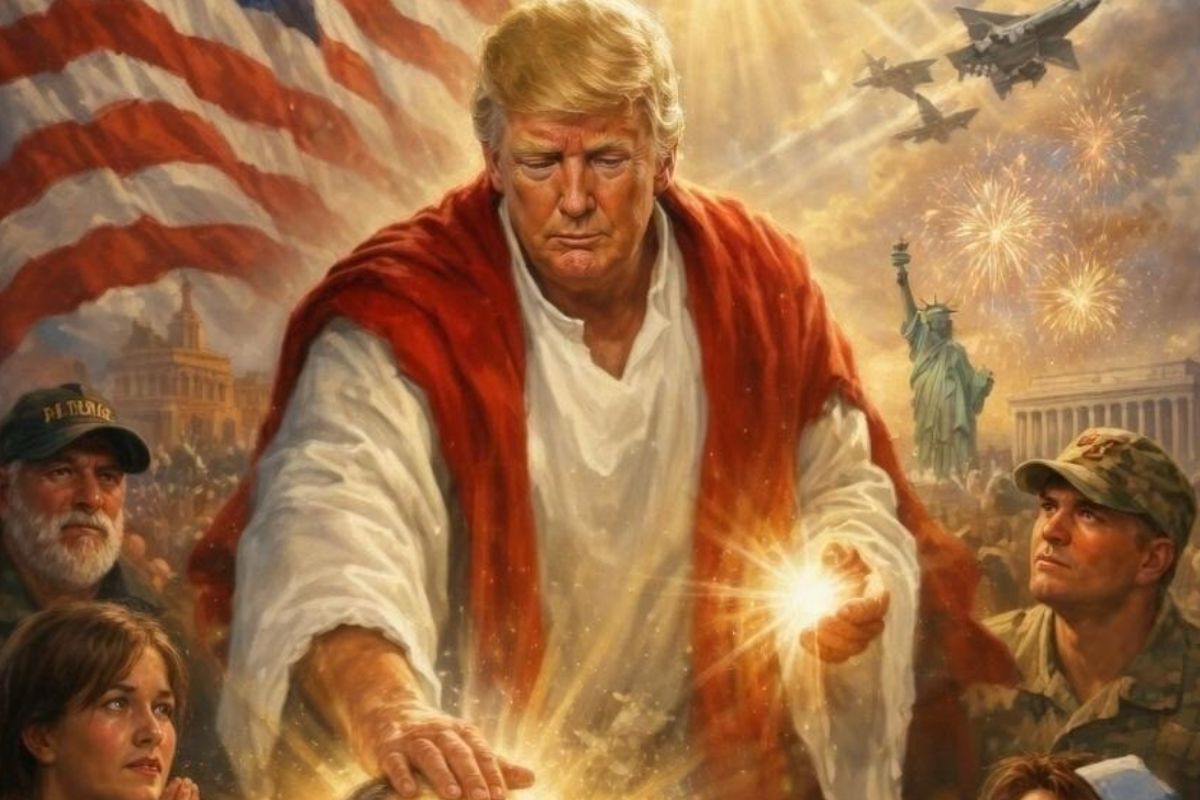
The digital screen flickers with a glow that feels more like a cathedral’s stained glass than a smartphone’s LCD. It is a Tuesday night, and the notification pings like a hammer against a bell. Donald Trump has posted again. But this isn't a policy brief or a campaign schedule. It is an image that halts the thumb mid-scroll.
In the picture, the former president stands in a robe of blinding white. His hands are outstretched, fingers grazing the forehead of a man slumped in a sickbed. The lighting is chiaroscuro, a dramatic play of shadows and divine radiance straight out of a Caravaggio masterpiece. He isn't just a candidate here; he is the Great Physician. He is the healer of the broken, the one who mends what the world has torn apart.
This isn't an accident. It is a deliberate, seismic shift in the language of American power.
To understand why this image matters—and why it feels like a lightning bolt to both his followers and his critics—you have to look back at the man he chose to tear down in the same breath. Trump didn't just share a digital icon of himself as a messianic figure. He took aim at Pope Leo. Not a living rival, but a ghost. A historical titan. He called him "weak."
Why attack a long-dead pontiff? Because the battle isn't over votes anymore. It is over the soul of authority.
The Weight of the Mitre
Pope Leo XIII sat on the throne of St. Peter during the twilight of the 19th century. He was the "Pope of the Working Man," the architect of Rerum Novarum, a document that tried to balance the scales between the crushing weight of the Industrial Revolution and the dignity of the individual. He was a man of nuance, of encyclicals, and of institutional grace. To the modern populist movement, nuance is the ultimate sin. Nuance is where strength goes to die.
By branding Leo as "weak," Trump is performing a kind of political exorcism. He is casting out the old guard of moral authority—the kind that relies on tradition, humility, and the slow turning of the wheels of the Church—and replacing it with something raw. Something immediate.
Imagine a steelworker in Ohio, sitting at a kitchen table that has seen better decades. He feels forgotten by the institutions Leo tried to protect. The union is a shadow. The church is a building he visits twice a year. Then, he sees the image. He sees a man who looks like the icons his grandmother kept on the mantel, but with a face he recognizes from the evening news.
It is a heady, dangerous cocktail.
The Iconography of the Ego
Art has always been the handmaiden of power. From the marble busts of Caesar to the sweeping canvases of Napoleon crossing the Alps, leaders have used imagery to bridge the gap between "man" and "myth." But those were paintings. They took months to cure. They were hung in galleries where only the elite could whisper about them.
The Jesus-Trump image is different. It is a meme. It is instantaneous. It is a visual shorthand that bypasses the logical brain and goes straight for the gut.
When Trump positions himself as the healer, he is making a claim that goes beyond the Constitution. He is suggesting that the "sickness" of the nation—the inflation, the border, the cultural rot—cannot be fixed by a bill in Congress or a ruling from a bench. It requires a miracle. And he is the only one holding the medicine.
Critics call it blasphemy. They point to the scriptures and find the irony in a man of such visible wealth and pride draping himself in the garments of the one who said the first shall be last. They see the "weakness" of Leo as actually being the strength of the cross—a willingness to suffer, to serve, and to yield.
But for the true believer, the irony doesn't exist. The image isn't a theological statement; it’s a combat uniform.
The Invisible Stakes
We are living in an era where the boundary between the sacred and the profane has been dissolved. In the past, a politician might claim God was on their side. Today, the politician claims to be the vessel through which the divine works, unmediated by priests or protocols.
The attack on Leo serves as a bridge to this new reality. By mocking the "weakness" of the historical papacy, Trump is telling his base that the old rules of decorum and religious hierarchy are obstacles. He is saying that the "strongman" is the only true shepherd left.
The stakes are invisible because they involve the quiet recalibration of what we consider "good." If strength is the only virtue, then empathy becomes a liability. If the leader is the healer, then the follower is forever the patient—dependent, grateful, and silent.
Consider the silence of the room after the image is viewed. There is no debate. There are only two reactions: a visceral "Amen" or a shudder of genuine fear. There is no middle ground in a miracle.
The Mirror of the Masses
Perhaps the most haunting aspect of this narrative isn't the man in the robe. It is the mirror he is holding up to us.
We live in a world so fractured, so devoid of shared truth, that we are desperate for a savior we can see. We have traded the slow, difficult work of community and policy for the instant gratification of the icon. We want the sick to be healed with a touch because we are tired of waiting for the system to care.
Leo XIII wrote about the "misery and wretchedness" pressing so unjustly on the majority of the working class. He wanted a structural solution. He wanted a world where the "weak" were protected by the law.
Trump’s post suggests the law is irrelevant. Only the Healer matters.
The image lingers long after the phone is put away. It is the white of the robe, the gold of the light, and the absolute certainty in the eyes of the man performing the miracle. It is a vision of a world where one man holds the power of life, death, and restoration in his palms.
Outside the window, the sun sets over a country that is still very much in pain. The hospitals are full. The bills are due. The sick are still waiting. And on the screen, the robe remains perfectly, impossibly white.