The Convergence of Massive Capital and Algorithmic Scarcity
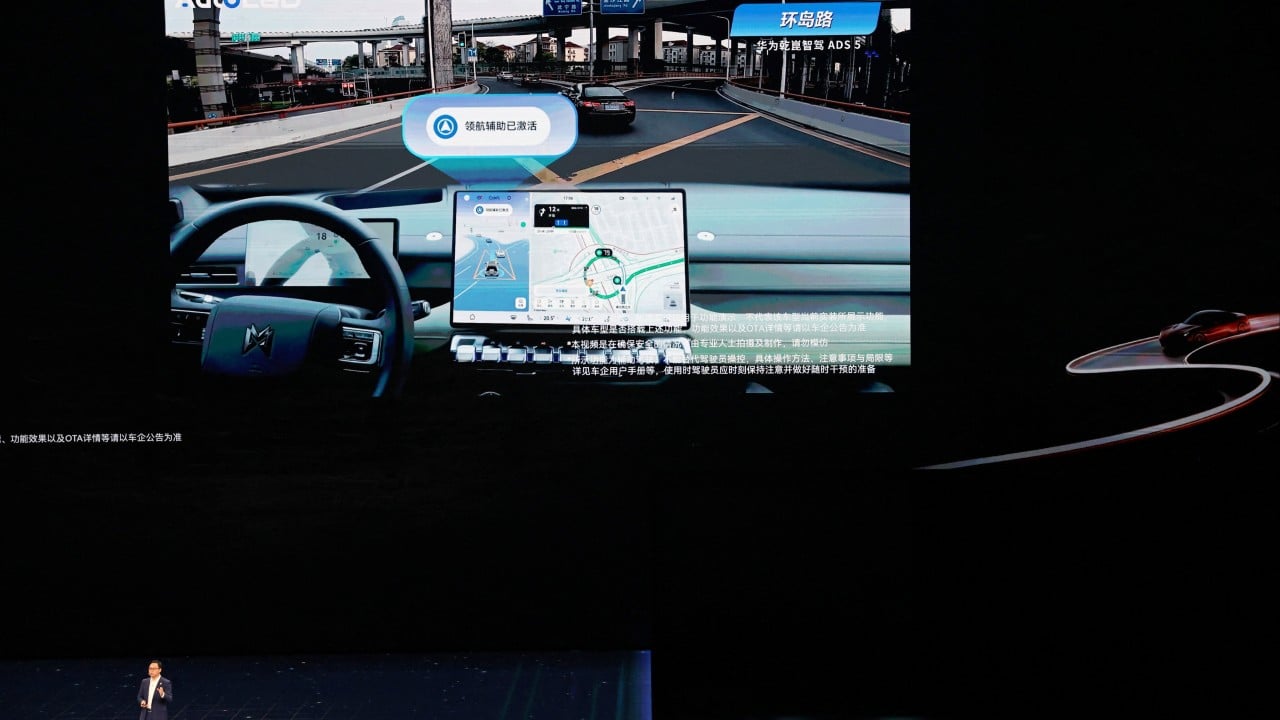
The transition from Level 2+ driver assistance to Level 4/5 autonomous driving is no longer a software engineering challenge; it has transformed into a high-stakes infrastructure and capital expenditure race. Huawei’s commitment of US$11.7 billion toward autopilot training signals a shift in the automotive industry’s value chain from mechanical integration to centralized compute supremacy. This investment represents more than a R&D budget—it is an acknowledgment that the "Long Tail" of driving edge cases cannot be solved through heuristic programming, but only through the brute-force processing of petabytes of real-world data within simulated environments.
The barrier to entry for full autonomy has shifted from "can the car see?" to "can the cloud learn fast enough?" By earmarking this specific capital, Huawei is attempting to compress the time-to-market for its Qiankun driving system, aiming to outscale competitors who lack the vertical integration of chip design, cloud infrastructure, and telecommunications hardware.
The Three Pillars of Autonomous Training Scalability
To understand why a figure like $11.7 billion is necessary, we must decompose the autonomous driving stack into its primary operational costs. The efficiency of an autonomous system is a function of three distinct, yet interdependent, variables.
1. Data Ingestion and Curation Latency
The raw volume of data generated by a fleet of sensor-heavy vehicles is overwhelming. A single test vehicle equipped with LiDAR, high-definition cameras, and ultrasonic sensors generates multiple terabytes of data per hour. The cost function here is not just storage; it is the "cleaning" of that data. Huawei’s strategy hinges on reducing the "noise-to-signal" ratio by using automated labeling systems. If 99% of driving data is mundane highway cruising, the value lies in the 0.1% of "disengagements" or near-misses. The capital is required to build the automated pipelines that identify these critical moments without manual human intervention.
2. Simulation Fidelity and Synthetic Data Generation
Physical road testing is inherently limited by geography, weather, and safety risks. To achieve billions of virtual miles, Huawei must invest in massive GPU/NPU (Neural Processing Unit) clusters that run high-fidelity simulations.
These simulations create "synthetic data" to fill gaps in the real-world dataset. For example, training a car to react to a pedestrian stepping out from behind a parked truck in a blizzard requires a simulated environment where physics and light behavior are rendered with absolute precision. The $11.7 billion serves as the fuel for these digital proving grounds.
3. Hardware-Software Vertical Co-optimization
Huawei occupies a unique position compared to traditional OEMs. By designing its own Kirin and Ascend chips, the company eliminates the "abstraction tax" paid when software is forced to run on generic third-party hardware. This vertical integration allows for a higher "performance per watt" in the vehicle’s onboard computer, which is critical for thermal management and battery range in electric vehicles (EVs).
The Economics of Compute Clusters
The "Cost of Intelligence" in the automotive sector follows a logarithmic scale. To achieve a 10% improvement in safety, a firm might need to 10x their training compute power. This creates a winner-take-all dynamic where only entities with massive balance sheets can participate.
The Ascend Architecture as a Strategic Asset
Huawei’s reliance on its internal Ascend AI chipsets serves as a hedge against external supply chain volatility. While Western competitors rely on Nvidia’s Blackwell or Hopper architectures, Huawei is forced to build a parallel ecosystem. The $11.7 billion investment likely covers the fabrication costs of these specialized chips and the construction of massive "Model Centers"—data warehouses dedicated solely to training the large language models (LLMs) and vision transformers that govern vehicle behavior.
The transition from traditional modular software (separate modules for perception, planning, and control) to "End-to-End" (E2E) neural networks has fundamentally changed the math. In an E2E system, sensor data goes in and steering/braking commands come out. This requires a much larger neural network, which in turn demands exponentially more FLOPS (Floating Point Operations Per Second) during the training phase.
Quantifying the Fleet Learning Loop
The value of the investment is realized through the "Fleet Learning Loop." As more vehicles equipped with Huawei’s ADS (Advanced Driving System) hit the road, the amount of incoming data increases.
- Stage 1: Data is uploaded via 5G/6G infrastructure.
- Stage 2: The centralized compute cluster identifies anomalies.
- Stage 3: The model is retrained to handle the new anomaly.
- Stage 4: An Over-The-Air (OTA) update is pushed back to the entire fleet.
This loop creates a "data moat." A competitor entering the market today does not just need a better car; they need a fleet that has already driven billions of miles and a compute cluster capable of processing those miles. By spending $11.7 billion now, Huawei is attempting to make the cost of entry for others prohibitively high.
Technical Constraints and Structural Risks
No amount of capital can bypass the fundamental laws of physics or the current limitations of AI. Investors and strategists must recognize the bottlenecks that remain even with massive funding.
The Power Consumption Wall
Training these models requires gigawatts of electricity. The operational expenditure (OPEX) of cooling and powering these data centers will consume a significant portion of the earmarked funds. Furthermore, the onboard inference—the actual "thinking" the car does while driving—must be efficient. If the autonomous system consumes 2kW of power just to process data, the vehicle’s range is reduced by 10-15%. Huawei’s challenge is to translate massive training-side compute into lean, efficient execution-side code.
The Regulatory and Edge-Case Paradox
The "99.9999%" problem remains. While an $11.7 billion investment can likely get a vehicle to 99% autonomy, the final "six nines" of reliability required for true driverless operation (L4) are where most projects fail. The problem is that edge cases are infinite. A kangaroo jumping onto an urban street in a city where kangaroos don't live, or a construction worker using non-standard hand signals, are events that even the most well-funded simulation may miss.
The strategy depends on "Model Generalization"—the ability of the AI to apply logic from one scenario to a completely different one it has never seen. If the system remains brittle and requires specific training for every possible scenario, even $100 billion would be insufficient.
Market Positioning and the "Huawei Inside" Model
Huawei has pivoted away from manufacturing its own cars to becoming the "Intel Inside" of the EV era. This is a deliberate move to avoid the low margins and high capital intensity of physical vehicle assembly, focusing instead on the high-margin software and hardware stack.
Tier 1 Supplier vs. OEM Partner
By partnering with manufacturers like Seres (Aito), Chery (Luxeed), and Changan (Avatr), Huawei distributes the risk of vehicle sales while centralizing the data collection. Each partner vehicle acts as a mobile data-gathering node for Huawei’s central brain.
- Risk Diversification: If one car brand fails, Huawei’s software ecosystem survives.
- Standardization: Huawei is effectively setting the technical standards for the Chinese autonomous driving market.
- Scale: The more brands that use the system, the faster the "Fleet Learning Loop" closes.
The Geopolitical Dimension of Autonomy
The $11.7 billion investment is also a statement of self-reliance. In an era of export controls and restricted access to advanced semiconductors, Huawei is building a closed-loop Chinese ecosystem. This domestic focus allows them to optimize their maps and driving logic for Chinese road conditions—which are significantly more complex than the wide, predictable suburbs often used for testing in the United States. The density of mopeds, pedestrians, and irregular traffic patterns in Chinese Tier-1 cities provides a "higher quality" of training data for stress-testing AI.
Strategic Recommendation for Industry Observers
The move by Huawei confirms that the automotive industry is bifurcating. One group will consist of "commodity assemblers" who build the chassis and interiors, while the other group—the "platform owners"—will control the operating system and the autonomous brain.
To compete with a $11.7 billion compute-first strategy, traditional OEMs must decide whether to:
- A: Attempt to build their own compute clusters (requiring similar levels of capital).
- B: Form a consortium to pool data and compute resources.
- C: Cede the software layer to a tech giant and focus on luxury, branding, or manufacturing efficiency.
The critical metric to watch over the next 24 months is not the number of cars sold, but the "Disengagement Rate" in urban environments. If Huawei's capital injection successfully drives this rate down faster than Tesla’s FSD (Full Self-Driving) or Alphabet’s Waymo, they will have successfully bought their way to the front of the next industrial revolution. The battle for autonomy will be won in the data center, not on the assembly line.