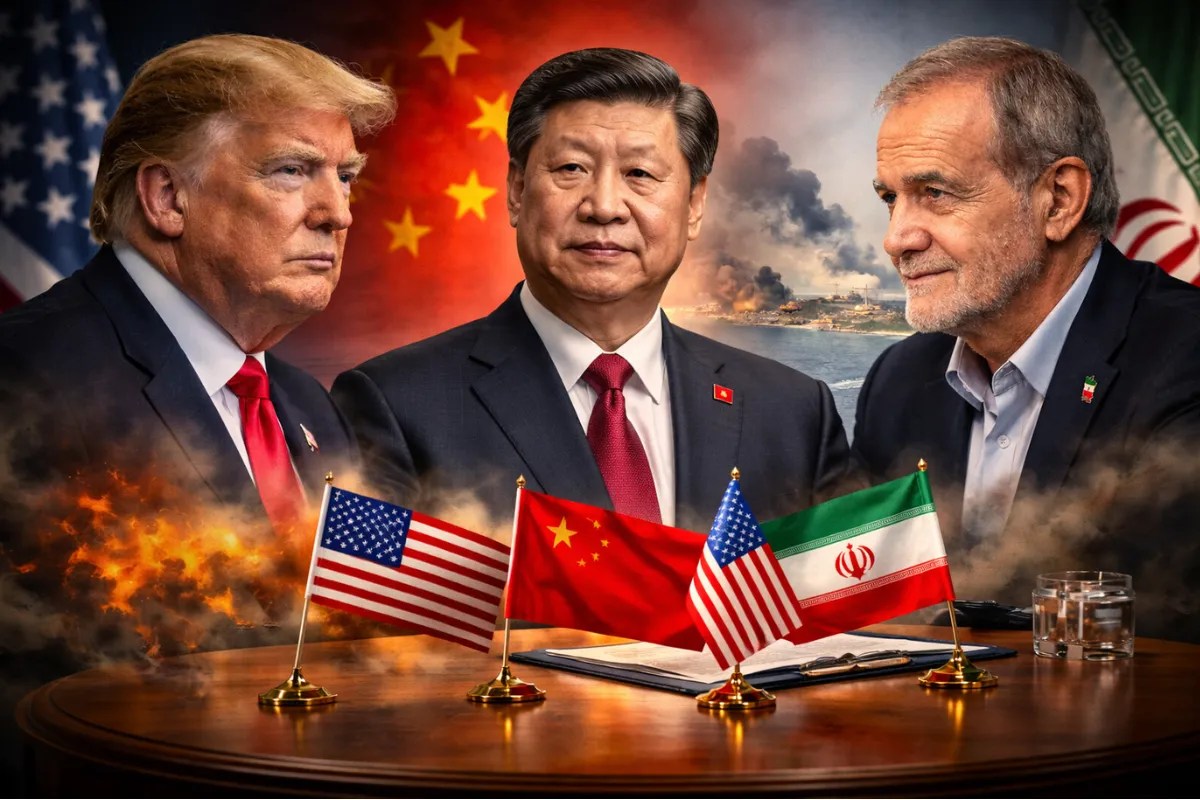
China’s recent diplomatic intervention in the escalating Middle East conflict—specifically the tension between the United States, Israel, and Iran—marks a shift from passive economic participation to active structural mediation. By proposing a "Four-Point Peace Formula," Beijing is not merely offering a ceasefire roadmap; it is asserting a specific geopolitical logic that challenges Western-led security frameworks. The central thesis of this doctrine rests on the absolute primacy of national sovereignty as the variable that determines regional stability, a direct counter-narrative to the "Rules-Based International Order" often championed by Washington.
The Structural Architecture of the Four-Point Formula
The Chinese proposal functions as a layered strategic framework designed to address immediate kinetic friction while simultaneously deconstructing the long-term drivers of instability. Understanding the efficacy of this formula requires breaking it down into its constituent logical parts:
- The Immediate Cessation of Hostilities: This is the functional baseline. Without a freeze in kinetic operations, no diplomatic leverage can be applied. Beijing views military escalation as a high-entropy state that disrupts the Belt and Road Initiative (BRI) logistics—specifically the maritime routes through the Red Sea and the Strait of Hormuz.
- The Humanitarian Mandate and Proportionality: This point addresses the "Cost Function" of the war. By emphasizing humanitarian aid, China positions itself as a rational actor interested in maintaining the social and demographic baseline of the region, which is essential for future infrastructure investment.
- The Sovereignty Constraint: This is the most critical analytical pivot. Xi Jinping’s explicit warning that "sovereignty is not a plaything" targets the practice of extraterritorial military strikes. From a Chinese perspective, if the sovereignty of one nation (e.g., Iran or Lebanon) is violated, the precedent threatens the security of all non-Western aligned states.
- The Two-State Resolution as a Final State: Beijing frames the Palestinian issue not as a localized grievance, but as the "root cause" variable. In mathematical terms, China argues that as long as this variable remains unsolved, the entire equation of Middle Eastern stability will yield a negative result regardless of other diplomatic inputs.
The Cost-Benefit Analysis of Chinese Neutrality
China’s entry into the US-Iran friction is not an act of altruism; it is an optimization of national interest. The "Cost of Involvement" for Beijing is significantly lower than for the United States due to the nature of their respective commitments.
The United States operates under a Security Guarantee Model. This requires massive capital expenditure, permanent military presence, and the political cost of being tethered to the actions of regional allies. Conversely, China operates under a Diplomatic Brokerage Model. This model minimizes physical risk while maximizing soft power. By acting as a mediator, China gains:
- Energy Security Insurance: Iran provides approximately 10% of China’s crude oil imports. Stability in Tehran is a direct input for Chinese industrial output.
- Strategic Distraction: Every hour the United States spends managing a Middle Eastern crisis is an hour not spent on the "Pivot to Asia" or reinforcing the First Island Chain.
- Moral High Ground in the Global South: By emphasizing "sovereignty" and "non-interference," Beijing appeals to a wide demographic of nations that view Western interventionism with historical skepticism.
The Mechanism of Sovereign Inviolability
The phrase "sovereignty is not to be toyed with" serves as a precise legal and tactical signal. In the context of the US-Iran-Israel triad, China is redefining the boundaries of "Self-Defense."
Under the traditional Westphalian system, a state has the monopoly on the use of force within its borders. China’s logic suggests that the recent cycle of retaliatory strikes—beginning with the targeting of diplomatic premises and extending to long-range missile exchanges—breaks the fundamental "Sovereignty Barrier." When this barrier is breached, the predictability of the international system collapses. For a state like China, which relies on long-term 30-year economic planning cycles, systemic unpredictability is the ultimate threat.
The Chinese doctrine posits that stability is a derivative of Mutual Recognition. If State A recognizes the absolute sovereignty of State B, the probability of asymmetric warfare (proxy groups, cyber sabotage, targeted assassinations) decreases. However, this logic ignores the reality of non-state actors (Hezbollah, Houthis), which do not fit neatly into the Westphalian sovereignty model. This represents the primary logical vulnerability in the Four-Point Formula.
Assessing the Logistical Bottlenecks of Mediation
While the rhetoric of the Four-Point Formula is structurally sound, its implementation faces significant friction. The primary bottleneck is the Enforcement Gap.
- The Absence of a Security Umbrella: Unlike the US, China lacks the power projection capabilities to enforce a ceasefire. Their influence is purely economic (the threat of withdrawing investment) or diplomatic (the power of the veto at the UN Security Council).
- The Proxy Variable: China’s formula assumes that the Iranian government has absolute control over its regional proxies. If the proxies operate outside the sovereignty-first framework, the Chinese model loses its predictive power.
- The Economic Interdependency Trap: China is the largest trading partner for both Iran and many of its rivals in the GCC (Gulf Cooperation Council). Any move that is perceived as too "Pro-Tehran" risks alienating Riyadh and Abu Dhabi, thereby devaluing China’s position as a neutral broker.
The Shift from Hegemony to Multipolar Brokerage
The entry of Xi Jinping into the US-Iran discourse signals the end of the unipolar era in Middle Eastern diplomacy. For decades, the United States was the "Indispensable Power." Today, we see a Bipolar Competitive Mediation environment.
In this environment, regional powers (Iran, Saudi Arabia, Israel) can "arbitrage" between the two superpowers. If the US demands democratic reforms or human rights concessions, a state can pivot to the Chinese framework, which demands only "Sovereignty and Stability."
This creates a competitive market for diplomacy. China’s Four-Point Formula is, in essence, a "Product Launch" in this market. It is a lower-cost, lower-requirement alternative to the Western security model. It does not ask for ideological alignment; it only asks for the maintenance of the status quo and the protection of trade routes.
Strategic Forecasting: The Three Likely Outcomes
Based on the current trajectory of Chinese involvement and the structural constraints of the Middle East, three distinct scenarios emerge:
Scenario A: The "Cold Peace" Equilibrium
China successfully leverages its economic influence over Tehran to limit the scale of Iranian retaliation, while the US restrains Israel. The Four-Point Formula serves as the rhetorical basis for a return to a "managed conflict" state. This preserves China’s energy interests without requiring a military commitment.
Scenario B: The Sovereignty Schism
Western powers reject the Four-Point Formula, viewing the "Sovereignty" argument as a shield for Iranian-backed militant activity. This leads to a bifurcated diplomatic landscape where China, Russia, and Iran form a "Sovereignty Bloc" in opposition to the Western-led "Rules-Based Bloc." The Middle East becomes a secondary theater for a new Cold War.
Scenario C: The Brokerage Success
Building on the success of the 2023 Saudi-Iran normalization, China hosts a high-level summit that produces a tangible, albeit limited, de-escalation agreement. This would solidify Beijing’s role as the primary "Security Architect" of the 21st-century Middle East, fundamentally displacing US influence.
The tactical move for regional players is to integrate Chinese mediation as a hedge against Western policy volatility. For the United States, the challenge is no longer just managing Iran; it is competing with a Chinese peace model that is increasingly attractive to states that prioritize regime survival and territorial integrity over liberal institutionalism. The Four-Point Formula is not a request for peace; it is a declaration of a new geopolitical operating system.