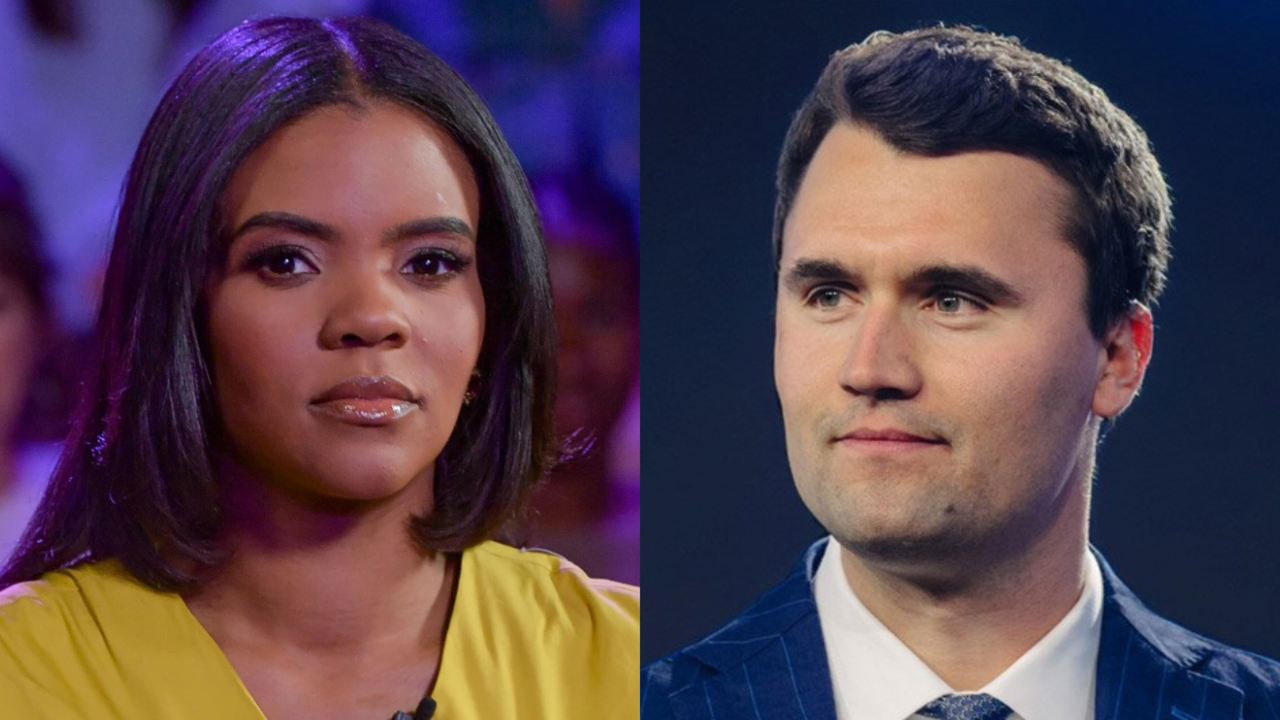
The foundation of the modern conservative media movement is currently undergoing a structural failure that no amount of slick production or venture capital can hide. What began as a unified front against mainstream institutionalism has devolved into a bitter, public, and ideological divorce between its two most recognizable figures. Candace Owens has openly signaled a breaking point with Charlie Kirk and Turning Point USA, the very apparatus that helped catapult her to the forefront of the American right. This is not a simple personality clash. It is a fundamental disagreement over the future of conservative identity, and the rift is growing wider by the hour.
The tension reached a boiling point when Owens publicly criticized the trajectory of Kirk’s programming. She claimed the platform now broadcasts beliefs that stand in direct opposition to her core convictions. For years, Owens and Kirk were the "power duo" of youth-oriented conservatism, presenting a polished, high-energy alternative to the aging GOP establishment. Now, that alliance is dead. The disagreement centers on a shift in focus at Turning Point, where Owens perceives a departure from the "America First" principles she champions in favor of a different, more neoconservative or establishment-adjacent agenda.
The Institutional Drift
When Turning Point USA started, it was a lean operation focused on college campuses. It was grassroots. It was gritty. It functioned as a counter-culture movement against what Kirk described as the leftist hegemony of academia. As the organization grew into a multi-million-dollar media empire, the stakes changed. Large-scale donors, corporate interests, and the need for broad-based Republican support began to shape the messaging.
Owens represents a faction of the right that views any compromise with the "establishment" as a betrayal. To her, the shift in Kirk’s content is not a strategic pivot but a total surrender. She has voiced her frustration with the perceived softening of certain stances, particularly regarding foreign policy and the prioritization of domestic issues. This isn't just about what is being said, but about what is being left out.
The Revenue Model Conflict
Media organizations are businesses first. The split highlights a massive problem in how conservative media is funded. Turning Point relies heavily on a non-profit model fueled by high-net-worth donors. Owens, conversely, has leaned into a direct-to-consumer model, leveraging her massive social media following to build a personal brand that isn't beholden to a board of directors or a donor list.
When a media personality becomes bigger than the platform that hosts them, friction is inevitable. Owens has reached a point where she no longer needs Kirk’s infrastructure. In fact, she likely views it as a tether. Kirk must maintain a delicate balance between being "edgy" enough to keep the youth engaged and "safe" enough to keep the checks from traditional GOP donors flowing. Owens has no such restriction. She is free to be as inflammatory or as specific as she wants, and that independence is driving the wedge deeper.
The Battle for the Base
The conservative audience is currently split into two camps. One side wants the tactical, organized approach represented by Kirk. They want big rallies, professional graphics, and a clear path to winning elections within the existing system. The other side—the one Owens speaks to—is exhausted by the system entirely. They want a scorched-earth approach to politics and culture. They aren't looking for a seat at the table; they want to flip the table over.
By calling out Kirk, Owens is forcing the audience to choose. This is a high-stakes gamble. If she can pull enough of the audience away from Turning Point, she effectively devalues Kirk’s primary asset: his reach. If she fails, she risks becoming a lone wolf without the institutional backing required to influence national policy.
The Silence of the Inner Circle
What is perhaps most telling is the lack of public mediation. Usually, when two stars of this magnitude clash, there is a frantic effort behind the scenes to issue a joint statement or a "unity" photograph. That hasn't happened. The silence from the rest of the Turning Point roster suggests that the internal divisions are just as deep as the public ones. Staffers and other influencers are being forced to pick sides in a cold war that could end with a complete realignment of the right-wing media landscape.
This isn't just a drama for the tabloids. It affects how millions of young voters perceive the Republican Party. If the most influential voices for Gen Z and Millennial conservatives cannot agree on basic principles, the movement risks fracturing into dozens of irrelevance-seeking sub-factions.
The Neoconservative Ghost
Owens has hinted that the "beliefs opposite to him" refers to a return to old-school neoconservatism within Kirk’s circle. This involves a focus on interventionist foreign policy and a brand of fiscal conservatism that many in the populist base find outdated. The populist wing of the party, led by figures like Owens, views the "forever wars" and the influence of the military-industrial complex as the primary enemies of the American worker. If Kirk is seen as drifting back toward the Dick Cheney era of Republicanism, he loses his grip on the MAGA base.
Kirk has attempted to bridge this gap by hosting a variety of voices, but Owens argues that the platforming itself is the problem. In the current climate of "purity politics" on the right, there is no room for a big tent. You are either with the populist movement or you are an enemy of it. There is no middle ground.
Data and Engagement Metrics
Looking at engagement trends across platforms, Owens consistently outperforms Kirk in terms of viral reach and sentiment among the most active segments of the base. Her videos garner higher watch times and more passionate commentary. Kirk has the volume—more shows, more guests, more events—but Owens has the intensity. In modern media, intensity is more valuable than volume. It leads to higher conversion rates for subscriptions and merchandise, and more importantly, it creates a more loyal following.
Turning Point is essentially a legacy media company disguised as a new media startup. It has the overhead of a large corporation. Owens is a lean, mean, digital-first operation. This fundamental difference in "how" they do business is what allowed the "why" to diverge so sharply. Kirk is building an institution; Owens is building a movement.
The Impact on 2024 and Beyond
With a major election cycle approaching, this infighting is a gift to the opposition. A divided right is a weak right. If the two most prominent voices for the youth are spending their energy litigating their personal and ideological differences, they aren't spending it on mobilizing voters. The "I want it to end" sentiment expressed by Owens suggests a level of exhaustion that precedes a total exit.
If Owens leaves the Turning Point orbit entirely, expect a massive migration of talent and audience. She is the gravity in that system. Without her, the slick stage productions and "student action summits" may find themselves playing to half-empty rooms of confused donors who thought they were buying a unified front.
The reality is that the conservative movement is outgrowing its current leadership. The old guard—even the "young" old guard like Kirk—is being challenged by a more radical, more independent faction that refuses to play by the rules of institutional politics. Owens isn't just calling out a show; she is calling out a business model that she believes has outlived its usefulness and its integrity.
Check the subscriber numbers on independent platforms over the next six months. That is where the real story will be told.