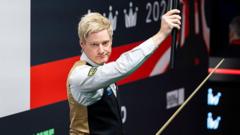
The floorboards of the Crucible Theatre are creaking under the weight of a shifting era. As Neil Robertson secured his place in the second round of the World Snooker Championship, he didn't just win a match; he helped slam the door on one of the most chaotic opening weeks in the history of the sport. We are witnessing a statistical anomaly that feels less like a fluke and more like a hostile takeover.
With Robertson’s progression, the 2024 World Championship has officially equaled a grim record for seeded players. Eight of the world's top 16 players fell in the first round. This isn't just a bad week at the office for the elite. It is a structural failure of the traditional hierarchy. When half of the protected seeds are sent packing before the tournament even hits its stride, the very concept of "ranking" begins to look like a relic of a different age. Meanwhile, you can explore other developments here: The Snooker Viewership Myth and Why the Zhao v Ding Peak Already Happened.
The Myth of the Safety Net
For decades, the top 16 enjoyed a level of security that bordered on the aristocratic. By virtue of their ranking, they avoided the grueling qualifying rounds at the English Institute of Sport, arriving at the Crucible fresh, rested, and arguably a bit insulated. That insulation has turned into a disadvantage.
The qualifiers are coming into the main draw battle-hardened. They have already played high-stakes matches under intense pressure just to get into the building. Meanwhile, the seeds have been practicing in quiet rooms, waiting for the circus to start. This year, the lack of match sharpness among the elite was exposed with surgical precision. Players like Mark Selby and Zhang Anda didn't just lose; they looked out of rhythm against opponents who had already found their flow in the qualifiers. To see the bigger picture, we recommend the recent report by Yahoo Sports.
The equality of the record—matching the 1992 and 2012 massacres—suggests a cyclical nature to these upsets, but the "how" is different this time. In 1992, the game was expanding. In 2024, the game is globalized and the technical gap between number 8 and number 48 has virtually vanished.
Robertson and the Survival Instinct
Neil Robertson’s victory over Ashley Hugill was a masterclass in professional composure, but it was also a desperate act of self-preservation. Robertson has spent the better part of the last year fighting his own form. He entered this tournament not as a dominant force, but as a man trying to remember how to win.
His 10-2 demolition of Hugill was necessary. Anything less would have signaled the total collapse of the 2010 champion’s status. Robertson utilized his scoring power to shut down the match early, but he was also beneficiary of the psychological wreckage left by the seeds who fell before him. He played with the ghost of other people’s failures over his shoulder. He knew that the Crucible was hungry for another upset, and he refused to be the meal.
The Australian's performance highlights a specific truth about modern snooker. Power scoring is no longer a luxury; it is a defensive requirement. If you cannot take a frame in one visit, you leave yourself open to the attritional warfare that defined the losses of the other seeds this week.
The Grinding Reality of the First Round
The first round at the Crucible is a best-of-19 format. It is long enough to be exhausting but short enough for a lower-ranked player to maintain a hot streak. This "dead zone" of length is where the seeds are most vulnerable.
- Physical Fatigue: The pressure of the Crucible environment drains energy faster than a standard tournament.
- Table Conditions: The two-table setup in the early rounds creates a unique acoustic and visual environment that can be distracting for those used to the isolation of a single-table final.
- The Weight of Expectation: A qualifier has everything to gain; a seed has everything to lose.
Why the Rankings are Lying to Us
The current ranking system rewards consistency over a two-year rolling period. While this provides stability, it also masks a decline in real-time performance. Several of the seeds who fell this week were carrying points from deep runs eighteen months ago, but their current technical data—potting percentages and break-building averages—showed a downward trend.
The "Seed Massacre" is the market correcting itself. The rankings said these players were the top 16 in the world, but the green baize said otherwise. We are seeing a younger, hungrier cohort of players who don't care about the history of the venue or the CV of the person sitting in the opposite chair. They see a veteran with a slow cue arm and they pounce.
Si Jiahui’s run last year was the warning shot. The results this week are the full-scale invasion. The technical standard of the "average" professional has risen so sharply that the elite can no longer rely on their reputation to win frames. You cannot intimidate a player who is capable of clearing the table from your mistake.
The Psychological Toll of the Crucible
Winning at the Crucible requires a specific kind of mental scar tissue. You have to be willing to suffer. This year, it appeared that many of the top seeds had forgotten how to bleed. When the matches turned into tactical scraps, the qualifiers—who live in the scrap—looked more comfortable.
Mark Selby’s post-match comments about his future in the sport were not just the words of a frustrated loser. They were the words of a man who realized that the mental price of staying at the top has become prohibitively expensive. When the "Jester from Leicester" questions his own desire to compete, the alarm bells should be ringing for every other veteran in the top 16.
The record-equalling eight seeds falling is a symptom of a wider exhaustion. The tour is demanding. The travel is relentless. The pressure to maintain a ranking is a 24/7 weight. For the qualifiers, the Crucible is a dream. For the seeds, it is increasingly becoming a nightmare where they are the hunted.
A New Hierarchy Emerges
As the tournament moves into the second round, the draw is lopsided and unpredictable. This is usually where the "big names" take control, but with half of them gone, the vacuum will be filled by the very people who caused the chaos.
We are moving toward a period of snooker where the "Big Three" or "Class of 92" era will finally give way to a more volatile, democratic landscape. The seeds who survived—like Robertson, Ronnie O'Sullivan, and Judd Trump—are now navigating a minefield. They aren't just playing against their opponents; they are playing against the momentum of an entire tournament that seems determined to crown a first-time champion or a long-shot outsider.
The Structural Shift
The authorities within the game have a decision to make. Do they continue to protect the top 16, or do they acknowledge that the gap has closed? There have been calls for a "flat draw" where everyone starts in the first round, similar to the UK Championship. The results of this week suggest that a flat draw might actually be safer for the top players than the current "cold start" they face at the Crucible.
If the seeds had to play through the qualifiers, they would arrive at the Crucible with the same match sharpness as their opponents. The current system, designed to protect the stars, is actually setting them up for an ambush. It is a gilded cage. They are protected until the moment they are most vulnerable, and by then, it is often too late to adjust.
The equaled record of eight seeds falling is not a one-off event. It is a data point in a clear trend line. The walls of the elite are crumbling, and the qualifiers are no longer knocking on the door—they have taken the keys and are moving the furniture.
Robertson’s win provided a brief moment of stability in a week of professional carnage. He proved that the elite can still dominate, but he had to work twice as hard to prove he still belonged. The second round will be a test of whether the remaining seeds can stop the bleeding or if 2024 will go down as the year the Crucible hierarchy was dismantled for good.
The table is open, the balls are spread, and the old guard is running out of time. Success at this level is no longer about who has the best legacy, but who has the most stamina for the fight that the rankings can no longer protect them from.
Watch the remaining matches not for the beauty of the breaks, but for the grit of the survival. Every frame now is a battle for the soul of the sport's ranking system. If another few favorites fall, the "Top 16" will be nothing more than a list of names on a piece of paper, irrelevant to the reality of the game.