The ground in South Texas does not just shake when a rocket fires. It groans. It is a deep, subsonic shudder that begins in the soles of your feet long before the sound wave actually hits your chest. Anyone who has stood on the salt marshes of Boca Chica during a launch will tell you that the noise isn't something you hear. It is something you swallow.
For decades, spaceflight was a precise, almost clinical affair. We became accustomed to the elegant, pencil-thin silhouettes of traditional rockets lifting off against a blue sky, carrying satellites the size of school buses. It felt manageable. It felt human.
Then came a machine that changed the scale of our ambition entirely.
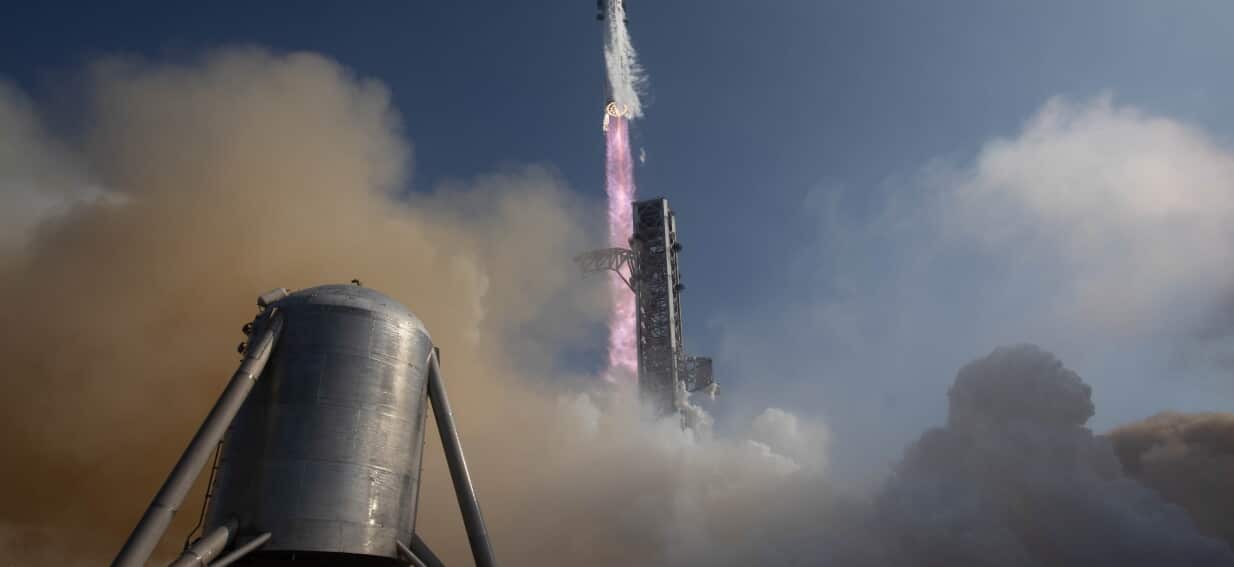
When the newest, largest iteration of SpaceX’s Starship lifted off from its Gulf Coast launchpad, it didn’t just break the atmosphere. It altered the math of what is possible. This wasn't just another routine launch to stitch another handful of internet satellites into low Earth orbit. This was a statement of intent, written in a pillar of fire five hundred feet tall.
To understand why this specific flight matters, you have to look past the press releases and the breathless social media updates. You have to look at the sheer, terrifying geometry of the thing.
Imagine standing at the base of a building. Not a modest office complex, but a towering, forty-story skyscraper made of polished, unpainted stainless steel. Now imagine that entire skyscraper lifting into the air on a column of thirty-three liquid oxygen and methane engines. The sheer mass is difficult for the human brain to process. Traditional rockets are mostly fuel tanks with a tiny, precious payload tucked away at the very tip. Starship is different. It is a cavernous, empty cathedral of steel designed to carry cargo—and eventually, people—by the hundreds of tons.
Metaphorically speaking, if the rockets of the past fifty years were ocean-going canoes, this new vessel is a galleon. It is designed not just to visit the far shore, but to colonize it.
The stakes on the ground during this specific launch were invisible but total. Behind the blast walls of the control center, hundreds of young engineers sat in silence, their faces illuminated by the cool glow of telemetry screens. They aren't just monitoring valves and pressures; they are betting their careers, and the trajectory of modern aerospace, on a radical philosophy of hardware development.
Most aerospace projects move at a glacial pace. They are governed by decades of bureaucratic caution, where a single change to a bolt requires three committees and a year of paperwork. The team in Boca Chica operates on a different rhythm. They build, they fly, they break things, and then they build again, faster.
Consider what happens next when that philosophy meets the reality of physics.
During the early test flights of the Starship system, success was measured in seconds. If the vehicle cleared the tower without exploding, it was a win. If the upper stage separated cleanly, it was a triumph. But as the iterations grew larger and the engines more refined, the goalposts moved. This latest flight wasn't just about surviving the ascent. It was about proving that a machine of this scale could be tamed during its return to Earth.
The real magic—and the real terror—of the Starship architecture lies in its bid for complete reusability.
When a standard rocket launches, the expensive components drop into the ocean, discarded like used tissues. It is an economic model that would ruin any airline on earth. Imagine flying a Boeing 747 from New York to London and then scrapping the airplane upon arrival. That is how we have reached space for sixty years.
To break that cycle, the massive booster stage of this mega-rocket must do something that looks entirely unnatural. After pushing the upper stage toward the stars, it reverses direction. It falls back through the atmosphere, intentionally steering itself back toward the precise patch of coast it just left.
Watching a steel tower the size of a municipal water tank fall out of the sky at supersonic speeds is an exercise in suspended animation. Your brain tells you it is going to crash. Every instinct refined by watching gravity work on Earth says that something that large cannot stop itself.
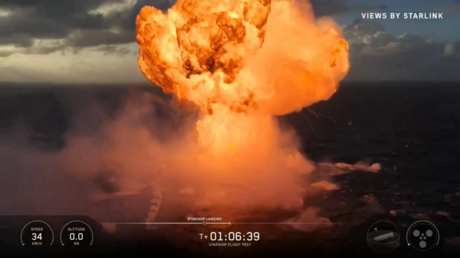
Then, seconds before impact, the engines reignite. The roar returns, a deafening crackle that rips through the humid coastal air, and the booster settles itself into the waiting arms of the launch tower. It is a feat of engineering that feels less like science and more like a magic trick performed with thousands of gallons of cryogenic fuel.
But the true significance of this larger model isn't found in the spectacle of the launchpad. It is found in the quiet, empty spaces of the upper stage as it coasts through the vacuum of space.
Space has always been a luxury item. Because every pound of cargo cost thousands of dollars to launch, everything we sent into orbit had to be miniaturized, delicate, and agonizingly expensive. Satellites were built like Swiss watches, using exotic materials and hyper-specialized components because there was no room for error and no room for weight.
This new scale of rocketry blows that paradigm apart. By providing a cargo bay that could comfortably swallow a house, the cost of entering space plummets.
Think of what this means for the people who will never see the launchpad in person. It means space-based telescopes with mirrors so large they can peer into the atmospheres of distant exoplanets, searching for the chemical signatures of life. It means constellations of communication satellites that can bring high-speed internet to the most isolated villages on earth, opening up education and medicine to millions who are currently cut off from the modern world. It means the possibility of manufacturing pristine materials, medicines, and semiconductors in zero gravity—things that are physically impossible to create within the heavy pull of Earth's shroud.
Yet, despite the triumphs of telemetry and the clean separation of stages, standing in the shadow of this machine brings a profound sense of vulnerability.
It is easy to get caught up in the techno-optimism of it all, to view the silver rocket as an inevitability of human progress. But it isn't. Space is an environment that does not forgive a single misplaced decimal point or a microscopic flaw in a weld. Every successful flight is a fragile truce struck with the laws of thermodynamics.
As the upper stage of the largest rocket ever built completed its arc and re-entered the atmosphere, enveloped in a pale violet envelope of superheated plasma, the cameras onboard broadcasted the image back to Earth in real-time. We watched the belly of the ship glow red, then orange, as it fought the friction of the air.
For a few moments, the signal wavered. The crowd held its breath.
In that silence, you realize that this entire endeavor isn't really about the steel, or the methane, or the millions of pounds of thrust. It is about our collective refusal to accept the horizon as a boundary. We are a species of travelers, bound for a brief moment to a blue rock, looking up at the black void and deciding that we belong there, too.
The signal returned. The ship held together.
The ocean swallowed the upper stage as planned, a final splash of white water against the blue expanse of the Indian Ocean. The test was over, but the air in South Texas still felt charged, vibrating with the residual energy of a future that had just moved a little bit closer.
On the launchpad, the smoke began to clear, revealing the charred, resilient skeleton of the gantry, already waiting for the next hull to be wheeled into place.