The zinc counter at Le Baratin was always supposed to be a sanctuary. For forty years, Jean-Pierre has wiped it down with the same gray rag, watching the afternoon light filter through the dust of Paris’s 20th arrondissement. He has watched marriages begin here. He has watched wakes dissolve into laughter here. And always, without exception, he has watched the crimson tide of Bordeaux glide across the metal.
Not anymore.
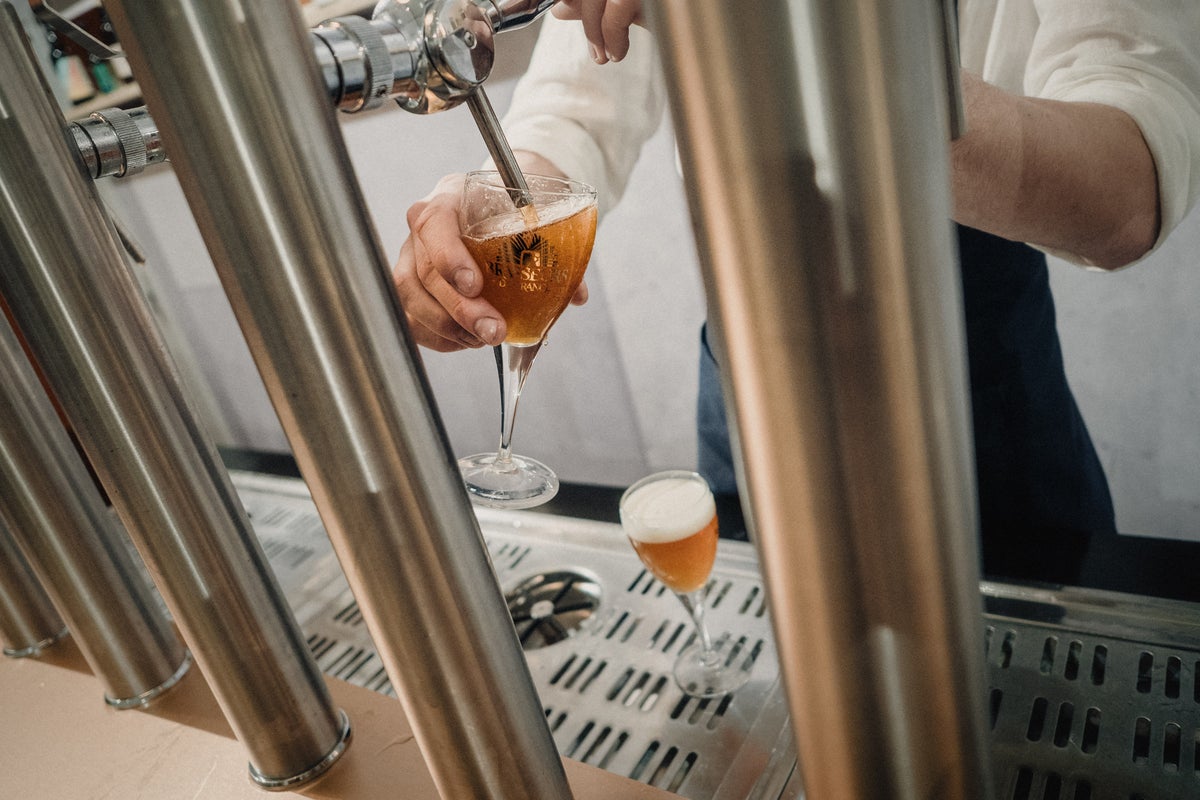
Last Thursday, a young man in a creased linen jacket sat where his father used to sit. He didn't ask for the house red. He didn't even look at the chalk board listing the Beaujolais villages. He ordered a blonde. A local craft beer, poured cold from a tap that Jean-Pierre installed last winter with a heavy heart and a sense of impending doom.
Something fundamental has broken in the French psyche. For the first time in recorded history, the people of France are buying more beer than wine.
This is not a mere shift in palate. It is an economic eviction. The romance of the vineyard is colliding hard with the brutal math of the supermarket aisle, and romance is losing.
The Arithmetic of an Empty Glass
To understand how a nation detaches itself from its literal lifeblood, you have to look at the grocery receipt.
France is suffocating under a quiet, relentless inflation. It is the kind of economic pressure that doesn't always result in protests or burning cars in the street, but rather manifests in the agonizing calculations made in front of a supermarket shelf. Rent is up. Electricity is staggering. The disposable income that once funded the casual, daily celebration of French gastronomy has evaporated.
Consider the baseline mathematics of a Friday night.
A decent, drinkable bottle of Côtes du Rhône now regularly pushes past the eight-euro mark in Parisian shops. For the same price, a consumer can walk out with a six-pack of industrial lager, or even four bottles of a high-quality, high-ABV Belgian style ale. The calculation is instant, subconscious, and devastating for the wine industry. Beer offers more volume, more reliable consistency, and crucially, more social mileage per euro.
Wine has become an event. Beer remains a habit.
The data from consumer tracking agencies reflects this shift with cold precision. Wine sales have been on a gentle downward slope for decades, mostly due to changing generational habits, but the recent cost of living crisis turned that slope into a cliff. Young consumers under thirty-five are not just drinking less wine; many are ignoring it entirely. They view it as their parents' drink—expensive, demanding, and tangled up in an exhausting web of rules.
The Tyranny of Expertise
There is a cultural self-sabotage at play here, too. Wine culture has spent a century building a fortress of exclusivity around itself.
To buy a bottle of wine, we are told, we must understand terroir. We must navigate the Byzantine classification systems of 1855. We must know our tannins from our acidity, and we must never, under any circumstances, serve the wrong grape with the wrong cheese. It is a beautiful tradition, but in a world where people are working two jobs just to cover their energy bills, it feels like homework.
Beer demands nothing from you.
You do not need to know the name of the soil where the hops were grown to enjoy an India Pale Ale. You do not need a special corkscrew, a specific glass shape, or a lecture from a sommelier. You crack the cap. You drink. It is inherently democratic, stubbornly unpretentious, and completely aligned with a generation that values immediacy over institutional heritage.
The craft beer explosion in France has weaponized this accessibility. Ten years ago, finding a microbrewery in the Loire Valley or the outskirts of Lille was an anomaly. Today, there are over two thousand independent breweries operating across the hexagone. They are branding themselves with bold, graphic labels, irreverent names, and flavor profiles that ignore tradition entirely. They are meeting consumers where they actually live, while the wine industry remains locked behind the heavy oak doors of the chateau.
The Vanishing Vineyard
The consequences of this shift are rolling across the countryside like a slow-moving storm.
In Bordeaux, the regional wine council has spent the last year subsidizing the uprooting of thousands of hectares of vines. Think about that image for a moment. Generations of agricultural labor, soil nurtured for centuries, ripped out by tractors because the liquid it produces can no longer find a buyer at a price that sustains human life. Winemakers are being paid by the government to destroy their own livelihood, converting historic vineyards into fields of sunflowers or leaving them fallow.
It is a tragedy hidden behind spreadsheets.
When a winery goes under, it isn't just a business failing. It is a lineage snapping. It is the loss of a specific, hyper-local knowledge of weather, earth, and time that cannot be recovered once it is gone. The small, independent vignerons—the ones who don't have luxury conglomerate backing—are the first to fall. They cannot compete with the massive marketing budgets of international beer conglomerates, nor can they absorb the rising costs of glass bottles, labels, and transport.
The modern French supermarket aisle tells the story better than any economic treatise. The wine section, once a sprawling, labyrinthine cathedral of green glass, is shrinking. The beer aisle is expanding, glowing with the bright, neon branding of modern IPAs, sours, and lagers. It is a hostile takeover of the French shelf.
The New Ritual
Back at Le Baratin, the sun has dipped below the roofline of the apartment buildings opposite. The zinc counter is cool to the touch.
Jean-Pierre watches the young man finish his beer. There is no lingering over the glass, no swirling of the liquid to catch the light, no deep inhalation of the aroma. It is just a drink. A good drink, thoroughly enjoyed at the end of a long week, but stripped of the secular mysticism that France used to pour into its stems.
We like to believe that culture is permanent. We comfort ourselves with the myth that certain nations possess an immutable DNA, that the French will always drink wine, the Italians will always eat pasta, the British will always drink tea. But culture is ultimately a luxury subsidized by stability. When stability vanishes, the habits of centuries can alter in the space of a single economic cycle.
The young man sets his empty bottle down on the counter with a sharp, clear click that echoes slightly in the small bar. He counts out his coins, adjusting for the price hike that Jean-Pierre had to implement last month. He nods a polite goodbye and steps out into the cool Parisian night.
Jean-Pierre picks up his rag. He reaches for the empty beer bottle, its label damp and peeling at the edges, and drops it into the recycling bin. The sound of breaking glass is loud, sudden, and final.