Sarah stood in front of her open refrigerator at 6:45 AM, holding a carton of milk. Her six-year-old son was already humming at the kitchen table, spoon poised over a bowl of dry cereal. She tilted the carton. The printed ink on the cardboard read Best if Used By October 12.
Today was October 14.
She opened the spout and sniffed. It smelled fine. Or did it? A tiny spike of cortisol hit her chest. If she poured this milk and it was spoiled, her son might get sick. If she threw it out, she was literally pouring money down the drain. She hesitated for ten seconds—a micro-drama played out in millions of American kitchens every single morning—before dumping the half-full carton into the sink.
Sarah didn't know that the date on the carton had absolutely nothing to do with food safety. She didn't know that the manufacturer had simply guessed when the milk would taste marginally less fresh. She just felt the familiar, low-grade anxiety of a system designed to make her doubt her own senses.
For decades, the grocery store has been a psychological minefield wrapped in plastic. We treat food labels like oracle text, assuming a team of government scientists meticulously calculated the exact second a chicken breast turns into a biohazard.
The truth is far messier, dictated by a chaotic patchwork of corporate marketing, state-level lobbying, and complete bureaucratic inertia. But a quiet legislative shift in California is about to dismantle this multi-billion-dollar guessing game, forcing the rest of the nation to finally look at what we are throwing away.
The Babel of the Grocery Aisle
To understand how we trapped ourselves in this cycle, you have to look at the sheer, absurd variety of phrases currently stamped onto American food packaging.
Sell by. Use by. Best by. Enjoy by. Expires on. Freshest before.
To the average consumer, these phrases are identical. They all translate to a single, urgent command: Throw this away before it hurts you.
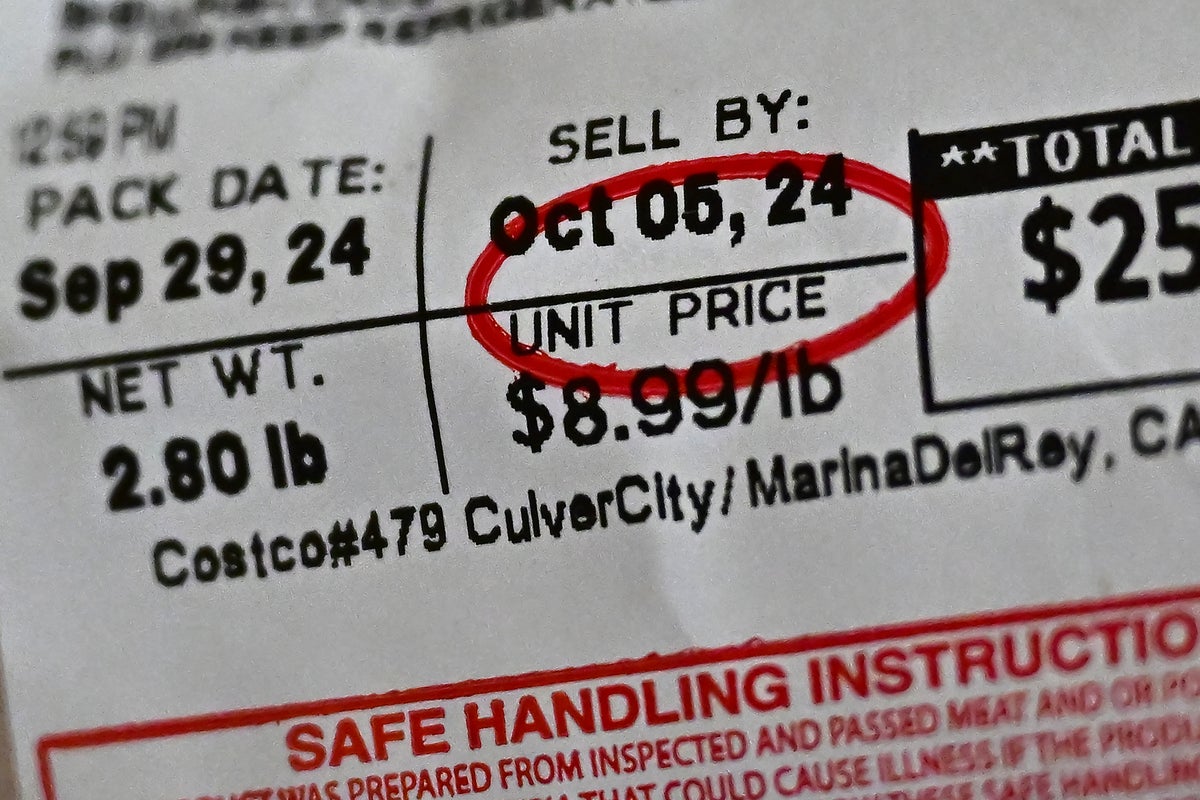
But in the boardroom of a food manufacturer, those words mean completely different things. A "Sell by" date is an internal logistical note meant for the grocery store stock clerk, signaling when to rotate the inventory. It has zero relevance to the person standing in their own kitchen. Yet, research shows that more than 80 percent of consumers routinely discard perfectly safe food because they mistake a merchandising deadline for a safety warning.
The federal government has historically looked the other way. Except for infant formula, the United States Food and Drug Administration (FDA) leaves expiration dating entirely up to the whims of the manufacturers. It is a system built on corporate self-regulation. If a chip company wants you to buy a new bag of tortilla chips every two weeks to ensure optimal crispness, they can print a conservative "Best by" date that triggers your anxiety, forcing a rebuy.
The result is a culture of engineered waste.
Consider the numbers. The average American family of four throws away roughly $1,500 worth of food every single year. Nationwide, we discard nearly 40 million tons of food annually. That is not just a statistical abstraction; it is mountains of perfectly edible produce, dairy, and meat rotting in landfills, producing methane gas while millions of families struggle to stretch their grocery budgets. And the primary driver of this economic and environmental disaster is a tiny, unregulated stamp of purple ink.
The Two-Phrase Solution
The fix is so blindingly simple that it makes the decades of inaction feel almost criminal.
California Assembly Bill 660, a piece of legislation that quietly fought its way through the state capital, cuts through the semantic noise with a chainsaw. The law outlaws the dizzying lexicon of freshness jargon. Starting in 2026, food manufacturers selling products in the most populous state in the nation are stripped of their creative license. They are allowed exactly two choices.
If a product is highly perishable and poses a genuine health risk after a certain window—think raw fish or pre-packaged deli meats—the label must read "Use by." This is the hard stop. The red light.
For everything else—the crackers that might lose their crunch, the soup that might lose a hint of its aroma—the label must read "Best if Used by." This is a quality indicator. A green light to use your nose, your tongue, and your common sense.
The brilliance of this binary system lies in its psychological clarity. It removes the burden of interpretation from the parent standing over the trash can. It replaces an ambiguous threat with a clear, standardized vocabulary.
When California passes a law of this magnitude, the geography of American capitalism ensures that the rest of the country follows. A grocery brand is not going to manufacture two entirely separate packaging runs—one for Los Angeles and one for Phoenix. The California standard becomes the de facto national standard. The corporate machinery adapts because uniformity is cheaper than defiance.
The Cost of Our Disconnection
But the law alone cannot undo decades of cultural conditioning. We have become a society terrified of our food.
There was a time when human beings relied on a sophisticated, evolutionary toolkit to determine if something was safe to eat. We looked for mold. We sniffed for sourness. We tasted a microscopic crumb. Our ancestors survived because their bodies were finely tuned instruments for detecting spoilage.
The rise of the industrial food system changed all of that. We stopped buying our food from the person who grew it. We started buying it in opaque boxes, sealed with plastic bladders, shipped from thousands of miles away. As we lost our connection to the origins of our food, we lost confidence in our own biological sensory equipment. We outsourced our survival instincts to a machine that stamps numbers on cardboard.
This learned helplessness has a steep price. When we throw away a gallon of milk, we aren't just wasting the four dollars it cost at checkout. We are wasting the water the cow drank, the fuel required to truck the feed to the dairy farm, the energy used to pasteurize the milk, and the diesel burned to transport that carton to our local store. Food waste is a compounding debt against the planet, paid in full by a consumer base that has been trained to fear its own refrigerators.
Change is always met with institutional resistance. Trade groups representing major food brands spent years arguing that federal guidelines were sufficient, or that state-level mandates would create logistical nightmares. They argued that consumers would be confused by a sudden shift in terminology.
But the real confusion is what we have right now: a system where an egg cartoned in one state is subject to entirely different labeling laws than an egg cartoned three miles away across a state line. The status quo is not an organized system; it is a profitable fog.
The transition won't happen overnight. The old labels will linger on back shelves for months as inventory clears. People will still hesitate. Old habits die hard, especially those rooted in the fear of making our children sick.
But picture that same kitchen a few years from now. Sarah picks up the milk. The carton reads Best if Used by October 12. She looks at the calendar. It is the fourteenth. She reads the words again: Best if Used by. It is an invitation, not a warning. She unscrews the cap, takes a quick sniff, and pours it into her son's bowl. The breakfast continues, the money stays in her bank account, and the landfill down the road remains just a little bit emptier.