The modern presidency has transitioned from a centralized communications model to a distributed, high-frequency digital engagement system. What superficial critics categorize as "unhinged" or "erratic" behavior on social media actually follows a distinct logic of narrative dominance and algorithmic exploitation. By examining the structural incentives of digital platforms—specifically the feedback loops between controversial content and visibility—we can map the mechanics of how presidential communication has moved from a gatekept press model to an unfiltered direct-to-consumer strategy. This shift is not a breakdown of discipline; it is an evolution of political leverage in a high-entropy information environment.
The Attention Extraction Model
Traditional political communication relied on the Gatekeeper Efficiency Ratio. Before social media, a president required the cooperation of televised networks and print editorial boards to reach a mass audience. This forced content into a moderate, standardized format to pass through various editorial filters. The advent of direct-to-consumer social platforms inverted this cost structure. For another view, consider: this related article.
The current presidential social media strategy operates on a Volume-to-Visibility Function. In this model, the objective is not necessarily the quality of the message but the total occupation of the news cycle. By posting high-variance content—ranging from the satirical to the inflammatory—the executive branch ensures that competitors and the press are permanently reactive. This creates an asymmetric information war where the president spends seconds generating content that requires hours or days of institutional analysis to debunk or contextualize.
The Three Pillars of Digital Narrative Dominance
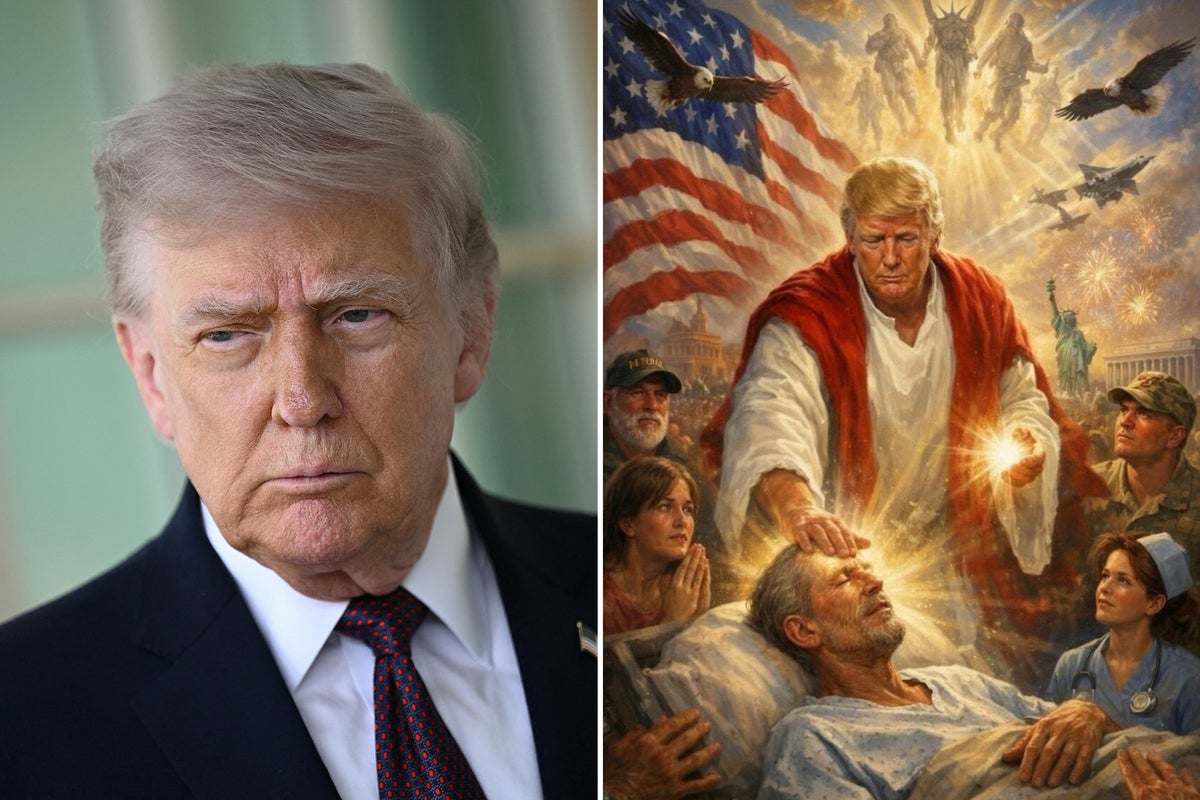
- Algorithmic Friction Reduction: Digital platforms prioritize "high-signal" content, which is mathematically defined by engagement metrics (likes, shares, vitriolic comments). Content that triggers a strong emotional response—whether through religious iconography (Trump-as-Jesus) or aggressive caricature (Obama-apes)—bypasses the standard visibility decay of digital posts.
- Strategic Ambiguity: By utilizing memes and informal language, the executive branch creates a "Schrödinger’s Policy" environment. Supporters view the content as authentic or humorous, while critics view it as a literal threat or a sign of decline. This ambiguity allows the administration to maintain a diverse coalition of supporters who each project their own values onto the vague, high-impact content.
- Disruption of the Fact-Checking Cycle: The speed of output intentionally outpaces the speed of verification. In a standard news cycle, a false claim can be corrected within 24 hours. In a high-frequency social media environment, the president can post twenty times in that same window, rendering the correction of any single post irrelevant to the broader narrative momentum.
The Cost Function of Political Polarization
The use of polarizing imagery is a calculated trade-off. While it alienates moderate swing voters, it significantly reduces the Cost of Base Mobilization. Mobilizing a political base traditionally requires expensive ad buys and ground operations. Social media reduces this cost to zero. Similar insight regarding this has been provided by The Washington Post.
The "rock bottom" often cited by observers is a misunderstanding of the floor. In a polarized system, there is no bottom because the objective is not to persuade the opposition, but to make the opposition's reaction so predictable that it becomes part of the entertainment for the base. When the president shares a meme depicting himself as a messianic figure, the goal is to trigger a specific, outraged response from the media. This reaction then validates the base's belief that the media is biased, creating a self-reinforcing loop of loyalty and distrust.
The Feedback Loop of Outrage and Reach
The mechanics of this can be broken down into a four-stage cycle:
- Stimulus: The president posts high-variance content (e.g., a racially charged or religiously provocative image).
- Aggregation: Traditional media outlets aggregate the post to capture a portion of the traffic, inadvertently amplifying the message to a wider audience.
- Counter-Reaction: Critics respond with moral condemnation, which the platform's algorithm reads as "high engagement," pushing the original post further into the feeds of neutral users.
- Monetization of Attention: The administration uses the resulting media firestorm to fundraise, framing the "attacks" as evidence of their effectiveness.
Quantifying the Disinhibition Effect
Psychologically, the "unhinged" nature of these posts is a manifestation of the Online Disinhibition Effect. When the barriers of physical presence and institutional review are removed, communication becomes more aggressive and less filtered. However, at the presidential level, this disinhibition is operationalized.
The lack of a traditional "floor" in behavior is due to the diminishing returns of decorum. In a legacy media environment, decorum was a currency used to buy credibility. In the current digital environment, credibility is derived from "authenticity"—which is frequently conflated with a lack of restraint. Therefore, the more "unhinged" a post appears to the institutional class, the more "authentic" it appears to a disillusioned electorate.
The Economic Incentive of Transgression
If we treat attention as a finite resource, the president is a market participant seeking to monopolize that resource. Decorous communication is a low-yield asset; it attracts little attention and is easily ignored. Transgressive communication is a high-yield asset.
The structural problem for a democracy is that this creates a Race to the Bottom in Signal Quality. If every political actor adopts the high-frequency, high-outrage model to stay relevant, the total information environment becomes saturated with noise. This leads to "atrophy of the public square," where complex policy debates are replaced by a permanent state of symbolic warfare.
The Institutional Failure to Pivot
The reason the "unhinged" social media habit persists is that external institutions—the press, the judiciary, and the legislature—have failed to adjust their response mechanisms.
- Media Dependency: News organizations are financially incentivized to cover the president's social media outbursts. These posts drive clicks, which drive ad revenue. This creates a parasitic relationship where the media needs the very "unhinged" behavior it purports to decry.
- Judicial Lag: Legal challenges to statements made on social media move at a glacial pace compared to the viral speed of the posts themselves. By the time a court rules on the legality or appropriateness of a statement, the political objective has already been achieved.
- Legislative Paralysis: In a polarized legislature, members of the president's own party are disincentivized from criticizing his social media conduct because they fear being targeted by his digital reach. This creates a "digital whip" effect, where a single post can threaten the primary prospects of a dissenting legislator.
Structural Risks and Systemic Vulnerabilities
While the strategy is effective for narrative dominance, it introduces significant Systemic Risk. The primary danger is the erosion of the "Symbolic Office." When the presidency is reduced to a social media handle, the institutional weight of the office is diminished. This has practical implications for international diplomacy, where nuances in language are critical for preventing conflict.
A second risk is the Desensitization Threshold. To maintain the same level of engagement, each subsequent post must be more extreme than the last. This creates an escalatory ladder with no clear exit strategy. Eventually, the shocks required to move the needle of public attention become so great that they threaten the stability of the social contract itself.
The Mechanism of Social Cohesion Decay
Social cohesion is maintained through shared facts and mutual respect for institutional norms. The high-frequency social media model actively works to dismantle both:
- Fragmentation of Reality: When the president uses social media to delegitimize other sources of information (the "fake news" tactic), it creates a bifurcated reality where different segments of the population no-longer share a common factual baseline.
- Normalization of Extremism: By consistently sharing fringe content, the executive branch moves the "Overton Window"—the range of ideas tolerated in public discourse. What was considered radical or unacceptable five years ago becomes a standard part of the daily news cycle.
Strategic Realignment for the Information Age
The belief that a president will eventually "find a rock bottom" is a fallacy based on an outdated understanding of political incentives. There is no moral or social floor in a digital economy that rewards engagement above all else. The strategy is not a bug in the president's personality; it is a feature of the modern political-technological interface.
To counter this, institutional actors must shift from a Reactive Model to a Containment Model.
- Starve the Algorithm: Media organizations must move away from the "aggregation of outrage." Instead of reporting on every post, they must apply a "threshold of significance," covering only those statements that have direct policy or legal implications.
- Platform Accountability: Social media companies must be treated as public utilities with a duty to prevent the intentional spread of disinformation, regardless of the user's status.
- Civic Decoupling: The electorate must be educated on the mechanics of digital manipulation. Understanding how these posts are designed to trigger emotional responses is the first step in neutralizing their impact.
The future of political communication will not return to the age of the fireside chat. The transition to high-frequency, unmediated digital engagement is permanent. The challenge lies in building new institutional guardrails that can withstand the pressure of a digital executive without collapsing into total informational chaos. The objective is to decouple the power of the presidency from the volatility of the feed. Failure to do so will result in a permanent state of crisis governance, where the "unhinged" post is not an anomaly, but the primary instrument of statecraft.