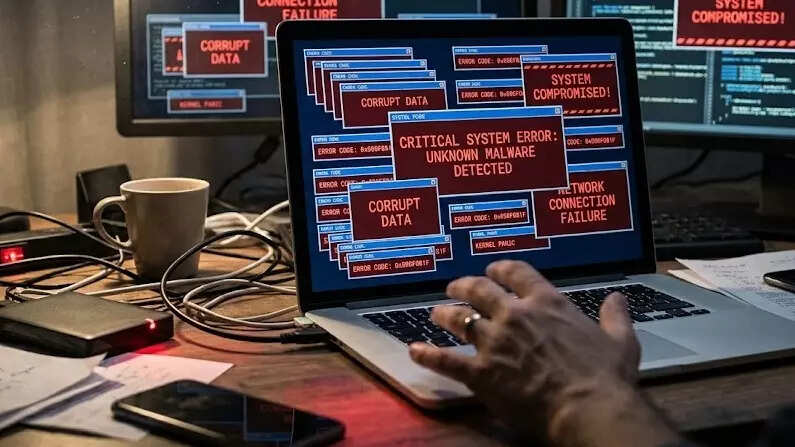
Imagine a quiet Tuesday morning in a glass-and-steel office in Dubai. The sun is just starting to bake the pavement outside, but inside, the air is crisp, and the only sound is the rhythmic clicking of mechanical keyboards. For Ahmed, a systems administrator at a mid-sized logistics firm, it’s a day for routine updates and lukewarm coffee.
He clicks a link in a standard-looking internal email. The screen flickers. Just once.
Ahmed doesn't know it yet, but his entire professional world has just been handed a death sentence. There is no ransom note. No countdown clock. No demand for Bitcoin. By the time he finishes his coffee, the servers responsible for tracking every shipment from Jebel Ali to the world will be nothing more than expensive space heaters.
This is the reality of Wiper malware, a digital predator that UAE cyber authorities are now calling one of the most destructive threats the region has ever faced.
The Evolution of Digital Spite
For years, we’ve been conditioned to think of cyberattacks as a form of high-stakes kidnapping. Ransomware—the most famous of the bunch—is a business transaction. The hackers take your data, you pay the fee, and, theoretically, you get your life back. It’s ugly, but there’s a logic to it. There is a way home.
Wiper malware has no such interest in your money.
Its sole purpose is the total, irreversible annihilation of data. It doesn't encrypt files to hold them for leverage; it overwrites them with gibberish or destroys the Master Boot Record—the very "map" a computer uses to find its own brain. When a Wiper finishes its work, the computer doesn't even know it’s a computer anymore. It is a brick of silicon and plastic.
The UAE’s Cyber Security Council has raised the alarm because the frequency of these attacks is no longer a "what if." It is a "when." The shift from financial greed to pure destruction marks a change in the temperature of global digital conflict.
Why the UAE is the Bulls-eye
The Emirates exist at a unique crossroads of rapid digitization and immense wealth. When a nation moves its entire infrastructure—from banking to DEWA payments to government services—into the cloud, it creates a masterpiece of efficiency. But to a Wiper, that masterpiece is just a very large, very fragile target.
Consider the ripple effect. If a Wiper hits a major hospital, it isn't just about lost billing records. It’s about the digital erasure of blood types, surgical schedules, and allergy histories. In a world where the "paper trail" has been burned to make room for the "digital twin," the loss of data is the loss of reality.
The authorities aren't just worried about the technical sophistication of these tools; they are worried about the motive. Wipers are frequently deployed not by lone teenagers in basements, but by state-sponsored actors or "hacktivists" looking to cause maximum geopolitical friction. In a region as strategically vital as the Gulf, a well-placed Wiper attack can do more damage than a physical strike, all while the attacker remains a shadow behind a VPN.
The Mechanics of Erasure
How does something so final get past the gate?
Usually, it starts with the most vulnerable part of any security system: the human being. It’s the "urgent" PDF that needs a signature. It’s the "mandatory" software patch that actually contains a payload of digital acid. Once the Wiper is inside, it often lies dormant. It waits. It spreads quietly through the network like a silent infection, ensuring that by the time it activates, it has compromised the backups too.
This is the most terrifying part of the "invisible stake." Most companies feel safe because they have a backup. But the modern Wiper is designed to find those backups and eat them first.
When the command is finally given to "wipe," the process is remarkably fast. Within minutes, terabytes of data—years of human labor, intellectual property, and historical records—simply cease to exist. There is no "undo" button. There is no specialized laboratory in California or Shenzhen that can piecing the bits back together.
Surviving the Unsurvivable
If the threat is so absolute, how does a person—or a nation—fight back?
It requires a shift in mindset. We have to stop thinking about "preventing" attacks and start thinking about "surviving" them. The UAE authorities are urging a move toward "Air-Gapped" backups. This is the digital equivalent of keeping a physical copy of your house keys in a safe that isn't even in the same neighborhood. If your backup is connected to your network, the Wiper will find it. If it’s on a physical drive, disconnected and locked away, you have a fighting chance.
But more than hardware, it requires a culture of skepticism.
Every employee, from the CEO to the intern, needs to understand that they are the front line. The "one of the most destructive" threats mentioned by officials isn't just a line in a press release; it's a warning that the era of the "polite" hacker is over. We are entering the age of the digital scorched-earth policy.
Ahmed, back in that hypothetical office, finally notices his screen has gone black. He tries to reboot. A simple, white-text error message appears: No bootable device found.
He tries his backup drive. It's empty.
He looks out the window at the Burj Khalifa, shimmering in the heat, a monument to human engineering and data-driven precision. He realizes that while the city looks the same, his entire world has been deleted.
The ghost has come and gone. It didn't take a single dirham. It took something much more valuable: the history of everything he had built.
Check your "disconnected" backups today. Tomorrow, the map might be gone.