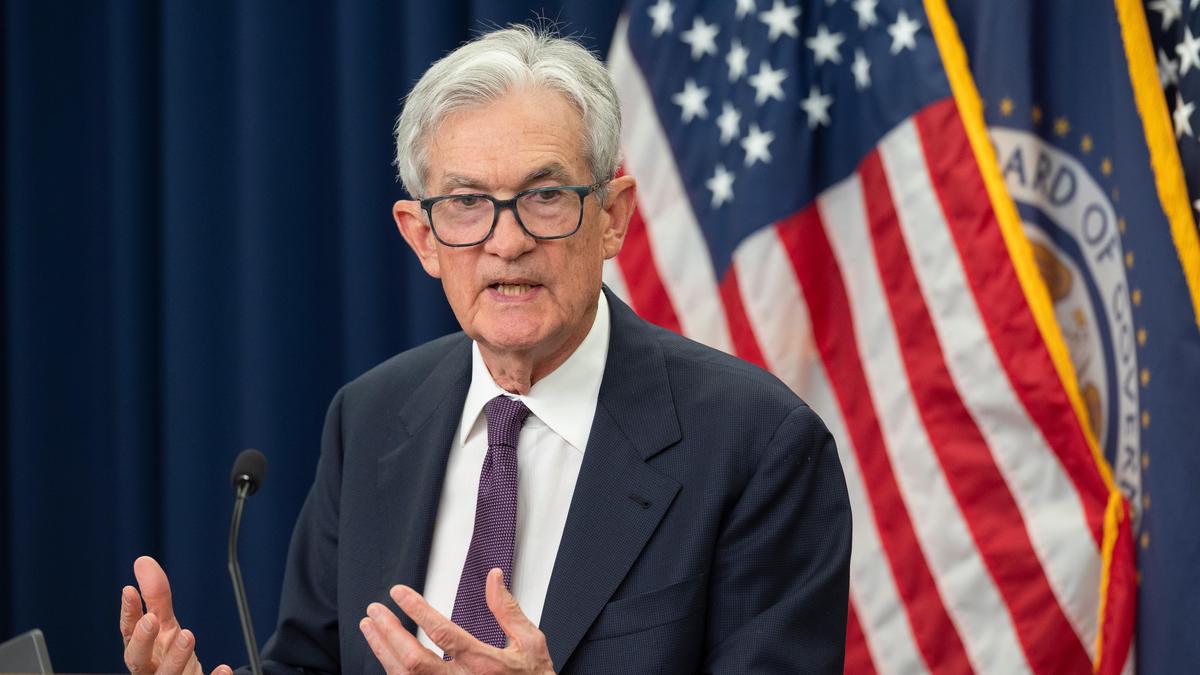
The tenure of Federal Reserve Chair Jerome Powell represents a fundamental decoupling between equity valuation and fixed-income stability. While traditional portfolio theory suggests a balanced relationship between these asset classes, the period from 2018 to early 2026 has functioned as a stress test that favored capital appreciation over yield preservation. The divergence is not a historical accident but the result of a specific hierarchy of monetary policy actions: the aggressive expansion of the central bank balance sheet, the delayed response to inflationary pressures, and the subsequent "higher for longer" interest rate regime.
The Mechanistic Advantage of Equities in Volatile Rate Environments
Equity markets under Powell outperformed bonds because the corporate sector successfully converted inflationary input costs into expanded nominal earnings. This transition illustrates the Inflation Pass-Through Mechanism. Unlike a bond, which is a contract for fixed nominal cash flows, a share of stock represents a claim on a company’s ability to adjust pricing dynamically.
During the post-2020 recovery, the S&P 500 benefited from a unique confluence of factors:
- Low Interest Expense Anchoring: Many large-cap firms refinanced their debt at historic lows in 2020 and 2021, effectively "locking in" low capital costs before the hiking cycle began.
- Margin Expansion through Productivity: While labor costs rose, the tech-heavy composition of the modern index allowed for scale without a linear increase in overhead.
- The Liquidity Floor: The "Powell Put"—the market’s belief that the Fed would intervene during systemic liquidity events (as seen in March 2020 and the 2023 regional banking crisis)—compressed risk premiums.
This environment created a paradox where stocks acted as a superior hedge against the very inflation that decimated bond portfolios. Investors shifted toward equities not necessarily because they were "cheap" on a Price-to-Earnings (P/E) basis, but because the alternative—holding duration—offered a guaranteed loss in real terms.
The Duration Trap and the Destruction of Fixed Income Wealth
The primary reason bond investors suffered is found in the mathematical reality of Modified Duration. Duration measures the sensitivity of a bond’s price to changes in interest rates. When Powell initiated the fastest tightening cycle in 40 years to combat the 2021-2022 inflation spike, the high-duration environment of the previous decade became a liability.
The destruction of bond value occurred in three distinct phases:
The Real Rate Compression
In the early part of Powell's term, real interest rates (nominal rates minus inflation) were deeply negative. This forced bondholders to accept yields that did not cover the eroding purchasing power of the dollar. This was a transfer of wealth from creditors (bondholders) to debtors (corporations and the government).
The Term Premium Re-pricing
For years, the term premium—the extra compensation investors demand for holding long-term debt—was nonexistent or negative due to heavy central bank intervention. As the Fed shifted toward Quantitative Tightening (QT), this artificial downward pressure evaporated. Long-term Treasury yields surged not just because of Fed hikes, but because the market began to demand a risk premium for the uncertainty of the debt-to-GDP trajectory.
The Correlation Breakdown
The "60/40" portfolio relies on the assumption that bonds will rise when stocks fall. However, in an inflation-driven downturn, both asset classes correlate positively. When Powell raised rates to stifle inflation, he simultaneously pressured equity valuations (via a higher discount rate) and crushed bond prices (via higher yields). Bondholders lost their primary defensive utility: the hedge.
The Three Pillars of the Powell Market Regime
To understand the disparity in returns, one must analyze the structural shift in how the Federal Reserve manages systemic risk versus price stability.
1. The Asymmetric Policy Response
The Powell Fed demonstrated a high sensitivity to financial market instability but a delayed sensitivity to consumer price indices. The 2018 "Pivot" and the 2020 "Unlimited QE" established a precedent: the Fed would provide liquidity to prevent a market crash (benefiting equity holders) but would allow inflation to run above target for a period (punishing bondholders). This asymmetry effectively socialized the downside risk for equities while leaving bondholders exposed to the resulting inflationary heat.
2. The Weight of Fiscal-Monetary Coordination
Under Powell, the line between fiscal policy and monetary policy blurred. Massive government spending packages required a compliant central bank to keep the Treasury market functioning. This coordination led to a massive expansion of the M2 money supply. Equities, as a "hard" financial asset, absorbed this excess liquidity. Bonds, meanwhile, were issued in such volume that the supply-demand imbalance naturally pushed prices down once the Fed stopped being the primary buyer.
3. The Revaluation of the Discount Factor
The fundamental equation for valuing any asset is the present value of future cash flows:
$$PV = \sum \frac{CF_t}{(1 + r)^t}$$
For growth stocks, the numerator ($CF_t$) grew rapidly due to the post-pandemic digital acceleration. For bonds, the numerator is fixed. Therefore, when the denominator ($r$) rose under Powell’s tightening, the bond's value had no way to compensate. Equities had an "escape hatch" in the form of earnings growth; bonds were trapped by the contract.
Capital Allocation Logic in a Persistent High-Yield Era
The transition from a zero-interest-rate policy (ZIRP) to a 5%+ environment creates a new hierarchy of asset performance. The strategy for the next cycle requires a departure from the "buy the dip" mentality that defined the early Powell years.
The Primacy of Free Cash Flow Yield
In a high-rate environment, companies that rely on external financing are at a structural disadvantage. The "equity winners" will be those with high internal rates of return (IRR) that can fund their own growth. This shifts the focus from "Growth at Any Price" to "Quality Growth."
The Death of Passive Duration
The era of buying a 10-year Treasury and forgetting about it is over. Fixed-income strategy must now prioritize Active Convexity Management. This involves using shorter-duration instruments to capture yield while avoiding the price volatility of the long end of the curve.
The Role of Real Assets
If the Fed continues to prioritize financial stability over a hard 2% inflation target, the terminal rate of inflation will likely settle higher than the previous decade’s average. This favors commodities, infrastructure, and real estate with floating-rate debt or CPI-linked leases over traditional nominal bonds.
Strategic Execution for the Current Macro Variable
Investors must recognize that the "Powell Era" has permanently altered the risk-free rate's role in portfolio construction. The risk-free rate is no longer a static benchmark; it is a volatile variable.
To navigate this, the tactical play is a Barbell Approach to Liquidity:
- The Short End: Maintain high exposure to T-Bills and money market instruments to capture the 5% nominal yield with zero duration risk.
- The Risk End: Allocate to high-margin, low-leverage equities that function as "inflation synthetics," capable of raising prices without losing volume.
- The Avoidance Zone: Steer clear of "The Middle"—mid-duration bonds (5-10 years) and "zombie" companies with looming debt maturities that cannot survive a sustained cost of capital above 4%.
The divergence between stock and bond performance was not a failure of the markets, but a success of equities in adapting to a regime where "paper money" lost its stability. The strategic imperative is to stop treating bonds as a safety net and start treating them as a specific tool for interest-rate speculation, while treating equities as the primary engine for real wealth preservation.