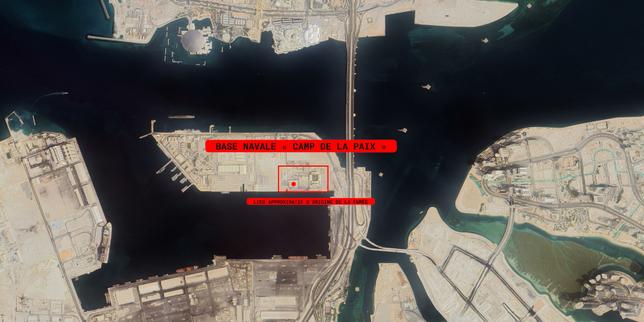
The security architecture of the Persian Gulf shifted under the cover of darkness. While the Emirati Ministry of Defense claims that French naval assets in Abu Dhabi were struck by Iranian-manufactured drones, the implications go far beyond a few charred hulls or cracked concrete. This is not just another skirmish in the long-standing "shadow war" between Tehran and the West. It is a direct challenge to France’s ability to project power in a region that is rapidly outgrowing its traditional security guarantees.
For decades, the French presence at Camp de la Paix—the "Peace Camp" in Abu Dhabi—served as a symbol of European strategic autonomy. It was meant to show that Paris didn’t need to hide behind the American umbrella to protect its interests. But if cheap, mass-produced loitering munitions can penetrate the defenses of one of the world’s most sophisticated militaries, the symbol has become a target.
The Failure of Traditional Air Defense
Military analysts have long warned that the current generation of air defense is ill-equipped for the "drone swarm" era. Systems like the Aster 15 or the Crotale NG, while formidable against supersonic jets or cruise missiles, face a math problem they cannot solve.
When a drone costs $20,000 and the missile used to intercept it costs $1 million, the defender is losing the war of attrition before the first shot is even fired. This economic asymmetry is the primary driver of the current crisis. Iran has mastered the art of "low-slow-small" (LSS) threats. These drones fly at altitudes and speeds that often fall within the "clutter" filters of traditional radar systems, which are designed to ignore birds or weather patterns.
By the time a radar operator distinguishes a Shahed-style drone from a large pelican, the window for engagement has closed. The UAE’s report suggests that multiple units reached their targets, indicating a saturation of the local sensor network. It wasn’t a lack of firepower that led to the breach; it was a lack of visibility.
Why France is the Target Now
Paris has been increasingly assertive in the Red Sea and the Strait of Hormuz. Through Operation Agénor, the French-led maritime awareness mission, France has attempted to act as a neutral arbiter, keeping trade lanes open without adopting the overtly "maximum pressure" stance of the United States.
Tehran sees this "middle way" as a weakness to be exploited. By striking a French base on Emirati soil, Iran sends two messages at once:
- To France: Your presence here is a liability, not an asset.
- To the UAE: Your European allies cannot protect you, and hosting them only invites more fire.
This is a classic "de-coupling" strategy. It aims to drive a wedge between the Gulf monarchies and their Western security partners. If the UAE decides that the French presence brings more risk than stability, the "Peace Camp" could find its lease in jeopardy.
The Architecture of the Shahed 136
The hardware involved in these strikes is deceptively simple. The Shahed 136, or its regional variants, utilizes a "flying wing" design that is inherently difficult to track via radar. It uses off-the-shelf civilian GPS components and small, noisy piston engines that sound like lawnmowers.
The technical genius of these machines isn't in their sophistication; it's in their expendability.
"In a conventional conflict, you protect your billion-dollar carrier. In a drone conflict, you throw 50 drones at the carrier until one gets lucky."
The French Ministry of Armed Forces has remained largely silent on the specific damage, likely to avoid giving Tehran a "battle damage assessment" (BDA). However, sources within the Emirati defense community suggest that the drones targeted fuel storage and maintenance hangars—infrastructure that is expensive to replace but doesn't necessarily result in high-profile casualties that would force a full-scale declaration of war.
The Electronic Warfare Blind Spot
One of the most overlooked factors in this incident is the failure of electronic warfare (EW) countermeasures. Standard jamming techniques work by cutting the link between the drone and its pilot. However, the latest iterations of these drones are increasingly autonomous.
They use inertial navigation systems (INS) that don't rely on a constant GPS signal. Once the coordinates are locked in at launch, the drone is "dark." It doesn't broadcast a signal, and it doesn't listen for one. This makes standard "soft-kill" options—like signal jammers—completely useless.
To stop an autonomous drone, you need a "hard-kill": a bullet, a missile, or a high-energy laser. France has been developing the HELIOS laser system and rapid-fire cannons like the RAPIDFire 40mm, but these are not yet deployed in sufficient numbers to create a persistent protective dome over overseas bases.
The Geopolitical Ripple Effect
This strike complicates the delicate negotiations surrounding the regional nuclear file. If France retaliates directly, it risks a wider escalation that could shutter the Strait of Hormuz, through which 20% of the world's oil passes. If it does nothing, it signals that its bases are "fair game."
Furthermore, this incident puts the UAE in a precarious position. Abu Dhabi has spent the last three years trying to de-escalate with Iran through diplomacy and trade. A kinetic strike on its soil—even if the target was a foreign base—shatters the illusion of safety that the UAE uses to attract global investment.
Modern Warfare is a Software Problem
The defense of Camp de la Paix failed because it was relying on 20th-century hardware to fight 21st-century software. The future of base defense lies in AI-driven sensor fusion. This involves linking every camera, microphone, and radar unit into a single network that can identify the specific "acoustic signature" of a drone engine long before it appears on radar.
France is now forced to accelerate its "Projet 2030" military modernization. They need more than just tanks and jets; they need millions of rounds of cheap, programmable ammunition and a network of low-cost interceptors.
The era of the "safe" overseas base is over. From now on, every hangar and barracks in the Middle East is on the front line. The French military must now decide if the cost of maintaining a footprint in the Gulf is worth the price of the metal and blood it will take to defend it.
Check the readiness of your local rapid-response units and verify the hardening of fuel infrastructure before the next swarm arrives.