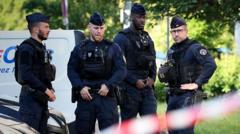
France is waking up to a nightmare that used to feel like a distant movie plot. A 15-year-old boy is dead in Poitiers. He didn't just die; he was caught in the middle of a massive shootout that looked more like a battlefield than a quiet French square. It's time to stop calling these "isolated incidents." When dozens of people are firing weapons in a public space and a teenager ends up with a bullet in his head, the system has failed. This isn't just about crime. It's about a total loss of control in neighborhoods that the state has seemingly abandoned to narco-traffickers.
The reality on the ground is terrifying. Local prosecutors are pointing the finger directly at the escalating drug war between rival gangs. We aren't talking about small-time dealers on street corners anymore. We're talking about organized cartels using heavy weaponry to settle scores in broad daylight. The victim in Poitiers was standing outside a restaurant when the chaos broke out. He wasn't a kingpin. He was a kid.
Why the French Drug War is Spiraling Now
The violence in Poitiers didn't happen in a vacuum. If you look at the map of France lately, the "Marseille-style" hits are spreading to mid-sized cities that used to be considered safe. Local authorities in Poitiers reported that between 40 and 60 people were involved in the brawl and shooting. Think about that number for a second. That is a small army.
Drug trafficking in France has shifted. The profits are higher, the stakes are deadlier, and the age of the "soldiers" is dropping. Gangs are recruiting minors because they're cheaper and face lighter legal consequences if they're caught. This creates a cycle where 15-year-olds are carrying out hits or standing guard in high-risk zones. The Poitiers shooting shows that the barrier between gang life and civilian life has completely dissolved. If you’re in the wrong place at 10 PM, you’re a target.
Interior Minister Bruno Retailleau hasn't minced words about this. He’s warned that France is at a "tipping point." He’s right. When the state can't guarantee that a teenager can stand outside a kebab shop without getting shot, the social contract is broken. We’re seeing a "Mexicanization" of the crime landscape in Europe, where the sheer brutality of the tactics is meant to intimidate not just rivals, but the police and the public too.
The Failure of Current Policing Tactics
Sending in the CRS (riot police) after a shooting is like putting a band-aid on a severed limb. It looks good for the cameras. It calms the neighbors for a week. But the dealers just wait. They know the police can't stay on one block forever. The "harassment" strategy—where police constantly bust small dealers to disrupt the market—isn't working against the big players.
The money behind these gangs is astronomical. We're talking about billions of euros flowing through neighborhoods where the average income is below the poverty line. You can't out-police that kind of financial incentive without systemic changes. Prosecutors are struggling because witnesses are too scared to talk. Who can blame them? When you see 50 people start shooting in the street, you don't call the cops. You hide.
We need to look at how these weapons are getting into the country. The Balkan route remains a massive problem. Modern handguns and assault rifles are flooding into Western Europe, and they’re easier to buy than ever. If the government doesn't choke off the supply of guns and the ability to launder drug money through "legitimate" front businesses, more 15-year-olds will die. It's that simple.
The Human Cost Behind the Headlines
It’s easy to get lost in the statistics. We talk about "youth violence" or "urban unrest." But there's a family in Poitiers today planning a funeral for a boy who hadn't even finished high school. Two other teenagers, both 16, were also wounded in the same incident. This isn't a statistic. It’s a generation being hollowed out.
Living in these "quartiers" means living in a constant state of hyper-vigilance. Parents keep their kids inside after dark. Business owners pay "protection" money or close early to avoid the crossfire. The psychological toll is massive. When the drug war becomes the primary employer and the primary source of authority in a neighborhood, the republic has lost its grip.
What Needs to Change Immediately
The French government loves a good "plan," but we don't need more paperwork. We need action that actually hurts the cartels. Here is the reality of what it takes to flip the script.
- Intelligence over Muscle: Stop focusing only on the "runners" and start using financial intelligence to freeze the assets of the heads of these networks. Follow the money, not just the smell of cannabis.
- Protection for Minors: There needs to be a massive, aggressive intervention for kids identified as being at risk of recruitment. This isn't just social work; it's a security necessity.
- Judicial Reform: The courts are backlogged and overwhelmed. Faster trials and more specialized prosecutors who handle nothing but organized crime are the only way to keep these shooters off the streets.
- International Cooperation: This isn't just a French problem. The drugs coming into Marseille and Le Havre are part of a global supply chain. If France doesn't lead a coordinated European effort to secure ports and borders, the violence will keep migrating inland to cities like Poitiers and Rennes.
Don't let the news cycle move on from this. If we accept that 15-year-olds dying in drug wars is just "part of modern life," we've already lost. Demand better from the local prefecture. Support community programs that actually have a track record of pulling kids away from gangs. Most importantly, stop ignoring the fact that these "no-go zones" are expanding. The shooting in Poitiers is a final warning. Pay attention before the next city on the list is yours.