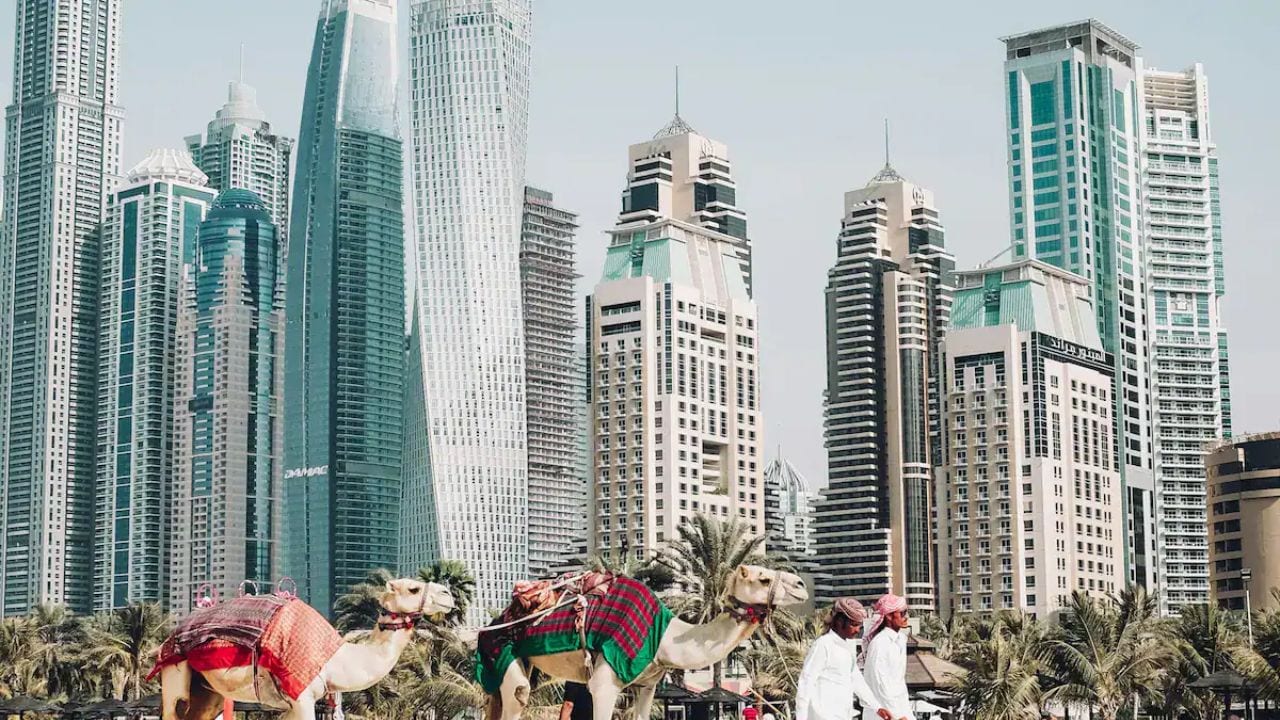
Move fast. Build beautifully. Refuse to wait.
The media is currently tripping over itself to praise "Dubai-it," the newly launched official campaign codifying the emirate's hyper-speed, results-driven philosophy. Corporate cheerleaders call it a blueprint for the future of global business. They look at the Burj Al Arab, the driverless metro tracks, and the artificial palm fronds slicing into the Persian Gulf, and they declare that execution solves everything. Building on this topic, you can find more in: The Invisible Grip on the Microchip.
They are completely wrong.
The lazy consensus treats "Dubai-it" as an unmitigated triumph of pure will over physics and economics. It assumes that compressing decades of development into a fiscal quarter is a viable long-term strategy for institutions and companies worldwide. Observers at CNBC have shared their thoughts on this matter.
It is not. This obsession with blinding speed and physical scale obscures a fragile truth.
Velocity is not a substitute for stability. When you build a system where momentum is the only thing preventing collapse, you have not created a resilient model. You have built a speed trap.
I have seen companies blow millions trying to copy this exact hyper-acceleration playbook. Executives fly into DXB, look at the shiny infrastructure, and return to their boardrooms demanding their teams "Dubai-it." They slash planning cycles, ignore market feedback, and mistake rapid capital expenditure for genuine asset creation. The results are almost universally disastrous.
The Fatal Flaw of Hyper-Acceleration
The core tenant of the "Dubai-it" ideology is that speed does not mean haste, and quality does not mean slowness. It sounds brilliant on a corporate slide deck. In the real world, physics and economics eventually demand their tax.
When a city or a company prioritizes pure speed above all else, it creates structural debt. In urban planning, this manifests as immense infrastructural vulnerabilities. Take the massive storm floods that repeatedly paralyze hyper-developed desert cities. When you build a metropolis at breakneck speed, underground drainage networks and long-term environmental safety measures are often treated as secondary concerns compared to the visible, above-ground spectacles that attract immediate foreign investment.
In corporate governance, "Dubai-it" translates to the elimination of critical friction. Friction is frequently viewed as the enemy of execution. Bureaucracy is hated. Compliance is simplified.
However, corporate friction exists for a reason. It prevents catastrophic risk exposure. Consider the difference between velocity and acceleration:
- Velocity is speed with a clear direction.
- Acceleration is merely the rate of change of speed.
When an organization accelerates continuously without deeply rooted institutional structures, it loses control. The decision-making process becomes top-heavy, relying entirely on a tiny circle of elite planners rather than distributed, resilient systems. If those planners miscalculate, the entire structure fractures.
The Mirage of Transferable Soft Power
The official narrative claims that "Dubai-it" is a transferable philosophy, a form of soft power that other global capitals can easily export and adopt. This is a profound misunderstanding of economic geography.
Dubai’s model did not succeed merely because people worked harder or faster. It succeeded due to an exceptional, highly specific alignment of geopolitical positioning, absolute governance, and a massive influx of external wealth seeking a low-tax sanctuary.
Imagine a scenario where a standard multinational corporation tries to implement this philosophy without those exact conditions. The corporation does not possess absolute sovereign power. It cannot rewrite local labor laws overnight. It cannot subsidize loss-leading infrastructure projects with sovereign wealth funds.
When an ordinary business tries to "Dubai-it," it ends up burning through its cash reserves to hit artificial deadlines, sacrificing product integrity to satisfy a culture obsessed with optical output. The spectacle replaces the substance.
The Hidden Cost of the Spectacle
To understand why this philosophy fails under replication, look at the numbers beneath the landmarks. The competitor articles point to record passenger numbers at airports and soaring airline profitability. They rarely mention the intense capital concentration required to maintain these operations during global downturns.
True resilience is not demonstrated when the global economy is booming and cash flows freely into real estate. True resilience is tested during systemic shocks. When a system built on perpetual growth faces a sudden halt, the cracks show instantly. The velocity model requires a constant injection of new capital, new residents, and new projects just to service the debt of the old ones. It functions less like a sustainable economic engine and more like a high-stakes financial chain letter.
Furthermore, this philosophy treats human talent as an input to be consumed rapidly rather than sustained. The high-burn, high-reward culture attracts the hungry and the temporary. But a city or a company cannot build deep, generational institutional memory when its core workforce views their tenure as a brief, lucrative stint before returning home. You get execution, yes, but you do not get loyalty, deep innovation, or cultural continuity.
Re-Engineering the Execution Framework
If you want to build an organization that survives the century, you must reject the superficial speed of the "Dubai-it" mentality and focus on deliberate velocity.
Prioritize Subterranean Infrastructure First
Do not build the tower before you have secured the foundation. In business, this means investing heavily in your core architecture—your compliance frameworks, your data security, and your middle management. These are not glamorous. They do not make for great press releases. But when the economic weather turns, they are the only things that keep the roof from caving in.
Build for Friction, Not Just Speed
Create intentional checkpoints in your decision-making process. If a project cannot survive a brutal internal audit or a highly skeptical peer review, it should not be accelerated. Eliminating all bureaucracy looks efficient on paper, but it removes the early warning systems that prevent catastrophic failure.
Accept the Limits of Absolute Will
Acknowledge that some problems cannot be solved simply by throwing capital and compressed timelines at them. Complex systems—whether they are global supply chains, deep tech innovations, or stable communities—require time to mature. Forcing them to grow prematurely results in a hollow product.
The corporate world does not need more impatient acceleration. It needs institutional depth. Stop trying to outrun economic realities with relentless optics and unsustainable speed. Build something that can stand completely still and still survive.