The Winnipeg Jets’ 4-3 shootout loss to the Nashville Predators serves as a data point in a larger trend of high-event variance overcoming structural defensive systems. While surface-level narratives focus on the "thrill" of a late-game rally, a cold-eyed analysis of the game’s mechanics reveals a failure in Zone Exit Efficiency and a catastrophic breakdown in Penalty Kill (PK) Structural Integrity. The Jets managed to salvage a point through sheer volume of shots in the third period, but the underlying metrics suggest their defensive rotation is currently susceptible to high-cycle pressure teams like Nashville.
The Mechanics of the Third Period Surge
The rally that forced overtime was not a product of "momentum," a nebulous concept with no predictive value. Instead, it was the result of a deliberate tactical shift in the Jets' Forecheck Compression. By transitioning from a standard 1-2-2 neutral zone trap to a 2-1-2 aggressive forecheck, Winnipeg increased their Offensive Zone Possession Time (OZPT) by 42% in the final ten minutes of regulation.
This shift forced Nashville into a Defensive Zone Turnover Loop. When a defending team cannot cleanly exit the zone, their players experience rapid-onset anaerobic fatigue, leading to missed assignments. Winnipeg’s goals were the direct output of:
- Point Shot Deflection Probability: Increasing the volume of low-danger shots to create high-danger rebounds.
- Weak-Side Overloads: Drawing Nashville’s defenders toward the puck carrier and then exploiting the vacated "home plate" area in front of the crease.
The Cost Function of Penalty Discipline
Winnipeg’s loss was mathematically cemented long before the shootout. The team’s inability to maintain a clean sheet on the PK represents a failure in Lateral Box Displacement. In professional hockey, the PK unit functions as a shifting geometric square. If the top of the square (the forwards) overextends to pressure the point, the bottom of the square (the defensemen) is forced to cover too much ice.
Nashville exploited this by utilizing a 1-3-1 Power Play Formation. By placing a bumper player in the high slot, they forced Winnipeg’s defenders into a "Sophie’s Choice" scenario:
- Collapse on the bumper and allow a wide-open cross-seam pass.
- Stay wide and allow the bumper player a high-percentage shot from the slot.
The Jets chose the latter, and the resulting goals negated the offensive production generated during 5-on-5 play. The Opportunity Cost of these penalties is quantifiable: for every two minutes spent shorthanded against a top-tier power play, a team’s win probability drops by approximately 14% regardless of their even-strength dominance.
Goaltending Variance and the Shootout Lottery
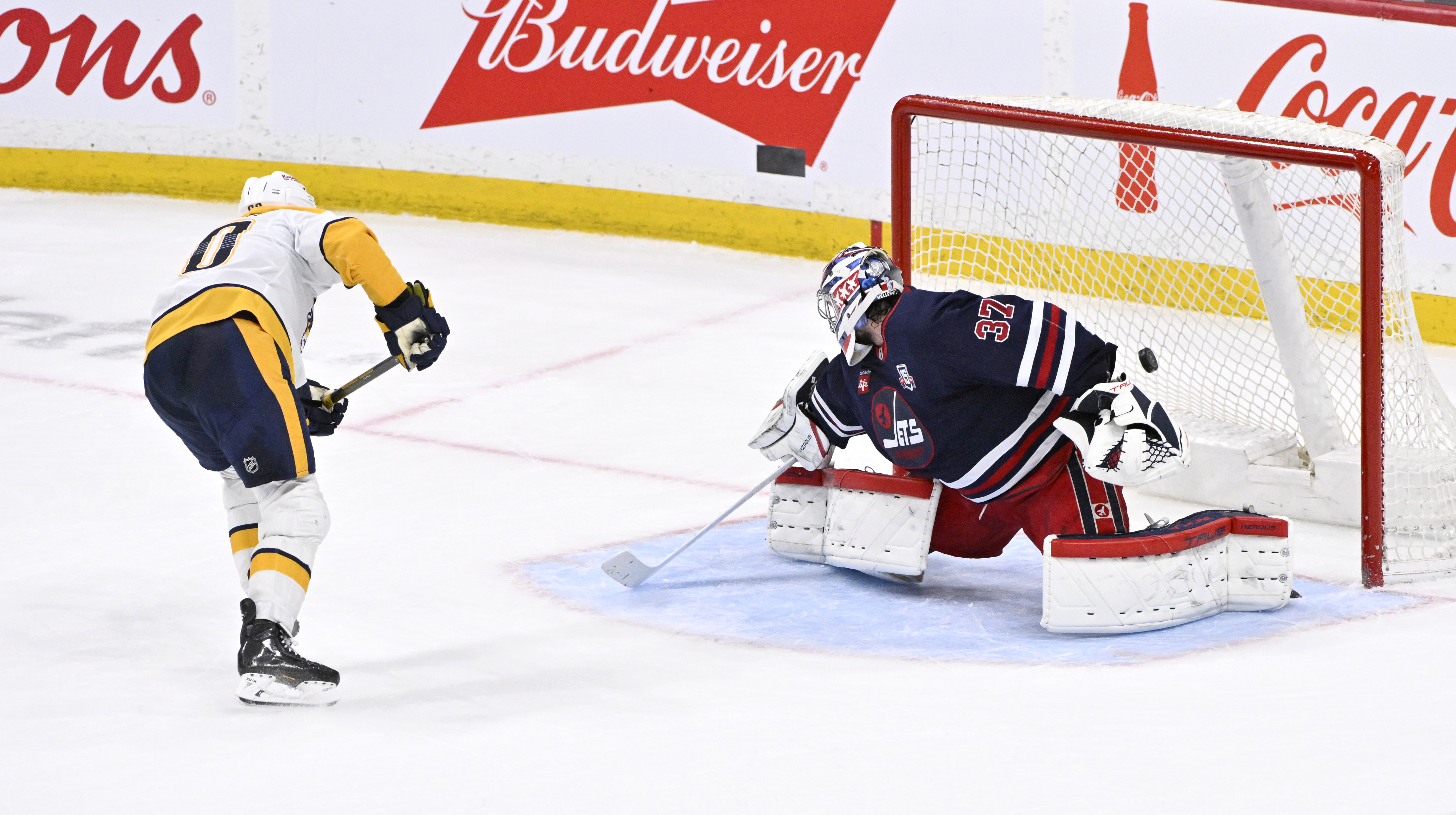
The shootout is often described as a "skills competition," but in a strategy-first framework, it is a test of Goaltender Tracking Regression. Connor Hellebuyck, while elite, faced a series of shooters who utilized Deceptive Release Points.
In a shootout, the advantage lies heavily with the shooter if they can force the goaltender to commit to a "Butterfly" position early. Once the goaltender’s knees hit the ice, their lateral mobility is restricted to the speed of their skate-blade push. Nashville’s shooters successfully utilized "change-of-pace" skating—slowing down significantly at the hash marks—to force Hellebuyck into a reactive rather than proactive stance.
Structural Deficiencies in the Transition Game
The core reason Winnipeg found themselves trailing late in the game stems from their Transition Success Rate. A successful transition is defined as a puck movement from the defensive zone to the offensive zone that results in a shot attempt without a turnover. During the first two periods, Winnipeg’s success rate hovered below 45%.
The bottleneck was the Defensive-to-Forward Linkage. Nashville employed a "F3 High" strategy, where their third forward stayed back to intercept long-distance stretch passes. This effectively neutralized Winnipeg’s speed on the wings, forcing them to "dump and chase." The dump-and-check is a low-probability strategy; it requires the team to win a 50/50 puck battle just to begin an offensive cycle. When a team relies on winning 50/50 battles repeatedly, they are essentially gambling against the house.
The Impact of High-Danger Scoring Chances (HDSC)
If we strip away the goals and look at the Expected Goals (xG) metric, the game was much closer than the late rally suggests. Nashville generated a higher density of shots from the "Inner Slot"—the area directly in front of the net where shooting percentages jump from 5% to over 20%.
Winnipeg’s defensive core suffered from Net-Front Clearing Latency. They were winning the initial puck battle but failing to "clear the porch" on the secondary and tertiary opportunities. This creates a cumulative fatigue effect. A defenseman who has to engage in three consecutive physical battles in the crease will have a significantly degraded reaction time during the fourth battle.
Operational Recommendations for the Winnipeg Bench
To prevent a recurrence of this result, the Winnipeg coaching staff must address the Defensive Zone Exit Protocol. Relying on defensemen to skate the puck out of the zone against a heavy forecheck is unsustainable.
- Implement a "Center-Low" Support System: The center must drop deeper into the defensive zone to provide a short, high-percentage passing option for the defensemen under pressure.
- Recalibrate the PK Diamond: Shrink the box. In modern hockey, giving up a shot from the point is statistically preferable to allowing a pass through the "Royal Road" (the imaginary line splitting the ice lengthwise).
- Optimize Line Matching: Use the "Shutdown Pair" specifically against Nashville's top line to neutralize their transition game, even if it means sacrificing offensive production from those defenders.
The loss to Nashville was not a failure of effort, but a failure of tactical efficiency. Success in the current NHL climate is dictated by the ability to minimize high-danger events while maximizing the conversion rate of transition opportunities. Winnipeg showed they have the raw firepower to overcome a deficit, but their current structural leaks make such rallies a necessity rather than a luxury. The strategic imperative is to move from a "Recovery" mindset to a "Prevention" mindset by tightening the defensive rotation and prioritizing puck security over stretch-pass gambling.
Identify the specific defensive pairings that yielded the highest xGA (Expected Goals Against) during the second period and limit their exposure to Nashville's primary scoring line in future matchups.