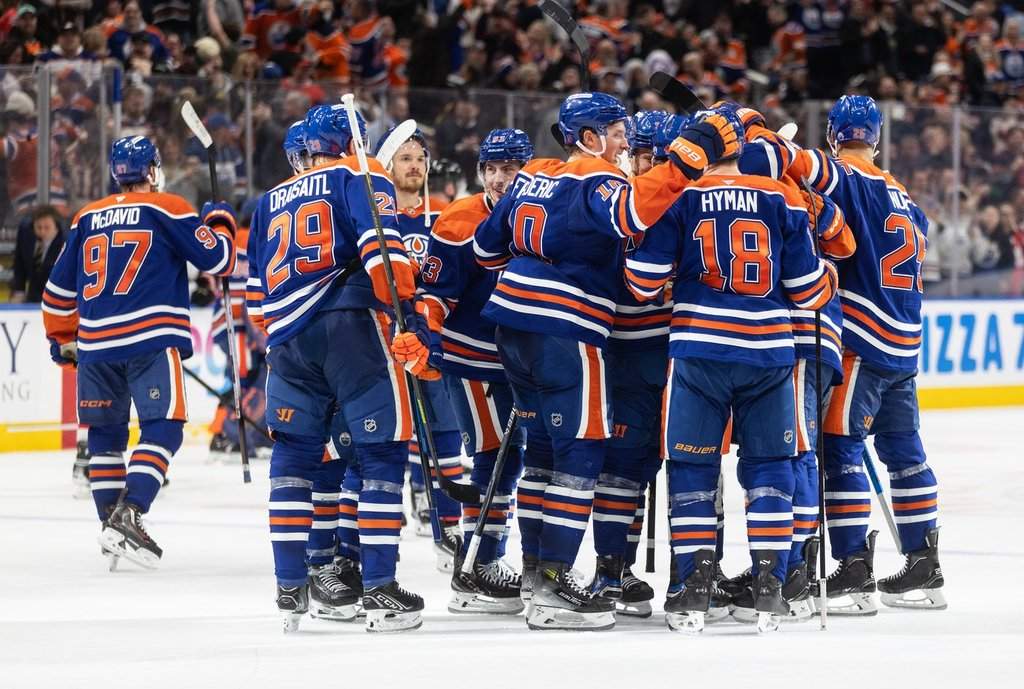
The reliance on third-period comebacks and "clutch" scoring is a statistical trap that masks systemic inefficiencies in a hockey team’s deployment and defensive structure. While late-game heroics generate high emotional engagement and positive media narratives, they represent a failure of the primary game plan. For an elite roster like the Edmonton Oilers, the frequency of these high-leverage situations indicates a breakdown in 60-minute puck management and an over-reliance on individual talent to overcome tactical deficits.
To achieve sustainable championship-level performance, a team must move from a volatility-based model—where outcomes are decided by high-variance sequences in the final five minutes—to an efficiency-based model characterized by early-lead insulation and neutral-zone suppression.
The Mathematical Instability of the Comeback
Winning games from behind in the third period is a low-probability strategy that ignores the compounding nature of fatigue and luck. In the NHL, the "trailing team" effect often creates a false sense of dominance; a team down by two goals will naturally see an uptick in shot attempts (Corsi) as the leading team shifts into a defensive shell. However, this volume is rarely synonymous with quality.
The cost of chasing a game includes:
- Condensed Minutes for Elite Assets: To bridge a gap, coaching staffs are forced to double-shift top-tier players. This creates a diminishing return on physical output and increases the risk of soft-tissue injuries or mental fatigue in subsequent games.
- Defensive Exposure: Pushing defensemen deeper into the offensive zone to facilitate scoring creates high-danger counter-attack opportunities for the opponent.
- The Luck Factor: Late-game goals often rely on "puck luck"—deflections, screened shots, or goalie errors. Banking on these variables is a poor long-term strategy compared to controlled, high-danger scoring chances generated during even-strength play in the first 40 minutes.
The Three Pillars of Sustainable Game Control
To mitigate the need for "heroics," a team must optimize three specific phases of play that dictate the scoreboard long before the final horn.
1. The Early-Lead Insulation Phase
Statistics show that the team scoring first wins approximately 70% of NHL games. This is not merely a psychological advantage; it is a tactical one. When a team leads early, they dictate the pace of the game. They can force the opponent to take risks, leading to power-play opportunities or odd-man rushes.
The "Oilers' Paradox" often involves a slow start followed by a frantic finish. This suggests a failure in the pre-game tactical calibration. High-level analysis indicates that teams that struggle with early-game deficits often have an inefficient "breakout" strategy, where defensemen fail to clear the zone under pressure, leading to extended defensive zone time and early goals against.
2. The Neutral Zone Bottleneck
A team that avoids late-game chaos is usually one that masters the neutral zone. By implementing a 1-3-1 or a heavy mid-ice press, a team can prevent the opponent from gaining the zone with speed.
- Entry Denial: Forcing the opponent to dump the puck rather than carry it in reduces their scoring chance probability by over 50%.
- Transition Speed: Recovering the puck in the neutral zone allows for immediate counter-attacks against a disorganized defense.
3. High-Danger Suppression (HDS)
The most critical metric for a team trying to avoid the "comeback" trap is not total shots against, but the location of those shots. A structured defense forces play to the perimeter, allowing the goaltender to see the puck clearly. Late-game heroics are often required because the team allowed too many "Grade A" chances early, putting their own goaltender in a position where every mistake is catastrophic.
The Cost Function of High-Leverage Minutes
The physical and psychological toll of playing from behind cannot be overstated. We can view this through the lens of a Fatigue-to-Output Ratio.
As the game progresses, the quality of a player’s decision-making degrades. In a "heroics" scenario, the players on the ice are typically those with the highest Time On Ice (TOI). By the 55th minute, their ability to execute a perfect cross-seam pass or a precise backcheck is compromised.
If a team frequently finds itself needing a goal in the final three minutes, they are essentially betting their season on the least reliable version of their best players. Structural dominance in the first and second periods allows for a load-management approach within the game itself, where fourth-line grinders can take defensive zone draws, preserving the stars for offensive zone starts and power plays.
Identifying the Bottleneck: Why "Heroics" Happen
When a team as talented as the Oilers relies on late surges, the bottleneck is usually found in one of two areas:
Personnel Misalignment
If the bottom-six forwards cannot maintain puck possession or "bleed" goals against, the top-six are forced into a deficit before they even find their rhythm. This creates a "chase" mentality from the opening puck drop.
Tactical Rigidity
Often, coaching staffs rely on a "stretch pass" system that looks brilliant when it works but leads to frequent turnovers when opponents stack the blue line. A more "north-south" game—focused on short, high-percentage passes—reduces the turnover rate and prevents the transition goals that force a team into a trailing position.
The Variance of the Power Play
The Oilers have historically possessed a historically efficient power play. While a weapon, this creates a dangerous dependency. If the officiating "tightens up" in the third period or during the playoffs, a team that relies on the man-advantage to bail them out of poor 5-on-5 play will find their primary path to victory blocked.
True championship contenders are built on 5-on-5 Goal Differential. This is the most accurate predictor of playoff success because it measures a team's ability to control play without the artificial advantage of a power play.
Strategic Transition: From Drama to Dominance
To shift the culture from "heroic" to "dominant," the organization must prioritize the following operational changes:
- Prioritize Zone Exit Efficiency: Invest in mobile defensemen who can move the puck under duress. The faster the puck leaves the defensive zone, the less "wear and tear" the team sustains.
- Enforce a "Lead-Protecting" Structure: Instead of "playing not to lose," which involves retreating too deep, a dominant team uses a "forecheck-heavy" lead protection. By keeping the puck in the offensive zone, they ensure the opponent cannot pull their goalie or set up an attack.
- Define Success by Process, Not Outcome: A win earned through a chaotic 6-5 comeback should be reviewed with the same scrutiny as a loss. The focus must be on why the five goals were surrendered, rather than the "grit" required to score six.
The objective is to make the game "boring" by the middle of the third period. A team that doesn't need heroics is a team that has already won the tactical battle. The move toward structural stability requires a rejection of the "comeback" narrative in favor of a clinical, systematic dismantling of the opponent over the full 60 minutes.
Execute a tactical shift toward a 2-1-2 heavy forecheck in the first ten minutes of every game to establish a possession floor. This immediate physical and positional pressure forces opponents into early defensive rotations, increasing the likelihood of an early lead and eliminating the high-variance environment of the third-period chase.