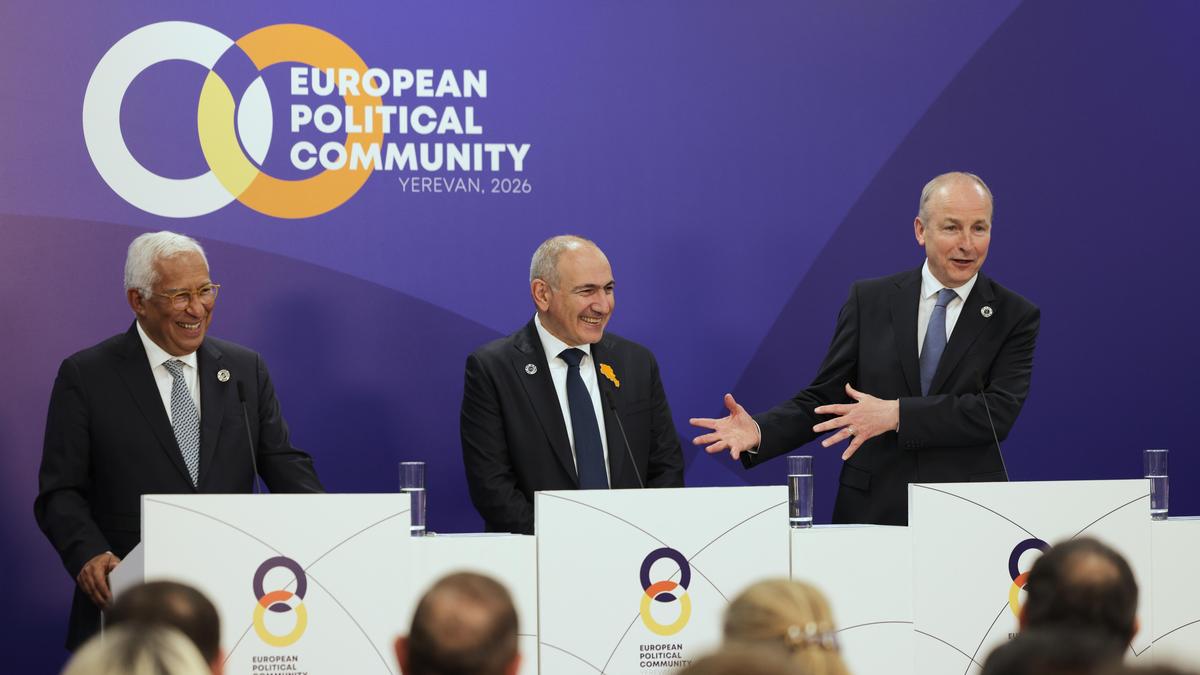
The eighth European Political Community (EPC) summit in Yerevan was supposed to be a regional dialogue about Armenia’s shift away from Moscow. Instead, it became the funeral for the traditional transatlantic order. For the first time in the group’s history, a non-European leader sat at the table—Canadian Prime Minister Mark Carney. His presence was not a mere diplomatic courtesy. It was a calculated move by middle powers to build a defensive wall against the increasingly transactional and isolationist policies of Washington.
Europe and Canada are no longer just allies; they are survivors of a fractured relationship with the United States. As President Donald Trump threatens to withdraw more troops from Germany and imposes sweeping tariffs that ignore decades of trade precedent, the leaders gathered in Armenia have reached a blunt conclusion. The U.S. is no longer a reliable guarantor of security or economic stability. In the shadow of Mt. Ararat, the narrative has shifted from "waiting for the storm to pass" to "building a house without America."
The Carney Doctrine and the European Pivot
Mark Carney’s arrival in Yerevan signals a fundamental change in how middle powers view their role in the world. As a former Governor of both the Bank of Canada and the Bank of England, Carney speaks the language of capital and risk. He isn't interested in the flowery rhetoric of "shared values" that usually dominates these summits. He is looking at the balance sheet of global security.
By joining the EU’s defense financing scheme—the first non-European country to do so—Canada is effectively placing a hedge against the U.S. security umbrella. This is a practical response to the announcement that 5,000 U.S. troops are being pulled from Germany. When Chancellor Friedrich Merz sparred with Trump over the U.S.-Israeli war on Iran, the fallout wasn't just rhetorical. It resulted in a physical reduction of the American footprint in Europe.
The "Carney Doctrine" argues that in a world defined by great power competition, middle powers must pool their resources or face irrelevance. This isn't about creating a third superpower; it’s about creating a "resilience bloc" that can withstand shocks from both the East and the West.
Security Without the Superpower
The most telling moment in Yerevan wasn't a public speech, but the quiet acknowledgment among NATO members that the alliance's center of gravity is moving. NATO Secretary General Mark Rutte’s admission that Europe has "heard the message" regarding U.S. frustration over the Iran conflict is a polite way of saying the divorce is finalized.
Europeans are now pre-positioning assets and increasing defense spending not because they want to, but because they have no choice. The war in Ukraine is entering its fifth year. Russian President Vladimir Putin is watching the cracks in the West with focused intent. If the U.S. reduces its commitment to Ukraine as part of a "transactional" peace deal, Europe and Canada will be the ones left to manage the aftermath.
The Cost of Independence
The shift toward strategic autonomy is expensive. It requires a complete overhaul of procurement, logistics, and intelligence sharing.
- Defense Spending: Nations like Germany and Canada are being forced to hit the 2% GDP target immediately, with most of that money now staying within European and Canadian defense firms rather than going to U.S. contractors.
- Industrial Integration: Canada’s $270 million pledge for Ukrainian military capabilities, announced at the summit, is being routed through European-led procurement lists.
- Intelligence Sovereignty: There is a growing movement to reduce reliance on the "Five Eyes" framework where it overlaps with U.S. political interests, favoring internal European-Canadian data sharing.
Armenia as the New Frontier
Holding this summit in Yerevan was a masterstroke of symbolism and risk. Armenia, a country traditionally locked in Russia’s orbit, is trying to perform a high-wire act. Prime Minister Nikol Pashinyan is attempting to diversify his country’s security away from a distracted Moscow while avoiding the wrath of a transactional Washington that might trade Armenian interests for Turkish or Azerbaijani cooperation.
For the EU, Armenia represents the success of its "Crossroads of Peace" initiative. For Canada, it is a chance to prove that its foreign policy isn't just an extension of the State Department. The inaugural EU-Armenia bilateral summit following the EPC event is a clear signal: the Caucasus is no longer a "no-go" zone for Western influence, even if that influence is now coming from Brussels and Ottawa rather than D.C.
The Trade War Front
The economic fallout of the U.S. war on Iran has sent energy prices soaring and disrupted supply chains that were already fragile. Trump’s tariffs have hit Canada and the EU equally hard. In Yerevan, the conversation around the table was about "strategic diversification."
This is code for moving supply chains out of the reach of U.S. executive orders. Canada is positioning itself as the primary provider of critical minerals and energy to Europe, bypassing the volatility of U.S. trade policy. The trade between the EU and Canada reached $178.6 billion in 2025, and the Yerevan talks suggest that number is merely a floor.
Critical Mineral Pipelines
The focus is now on three specific areas:
- Lithium and Rare Earths: Establishing a direct pipeline from Canadian mines to European battery gigafactories.
- Hydrogen Technology: Collaborative R&D to replace LNG imports that are subject to U.S. political whims.
- Digital Infrastructure: Building a "privacy-first" tech corridor that resists both Chinese surveillance and U.S. data harvesting.
The Reality of a Brutal World
There is a sense of weariness among the leaders in Yerevan. They are tired of the unpredictability. The "rules-based order" that defined the post-1945 era is fading, replaced by a world where might and leverage are the only currencies that matter.
Mark Carney’s statement that "we are not destined to submit to a more transactional, insular, and brutal world" was a rallying cry, but it also highlighted the fear that they might be. The EPC was once a club to keep Putin out. Now, it is a lifeboat to keep the concept of the West alive while its former leader heads in a different direction.
The Yerevan summit proves that the "shadow of Trump" isn't just a metaphor; it is a catalyst. It has forced Europe to grow up and Canada to look East. The Atlantic is getting wider, and for the first time in eighty years, the people on either side of it are okay with that.
The immediate next step is the formalization of the EU-Canada Defense Partnership, which will move beyond financing into joint command structures for non-NATO missions. This is the practical architecture of a world without a superpower leader. Those waiting for a return to "normalcy" are looking at a horizon that no longer exists.