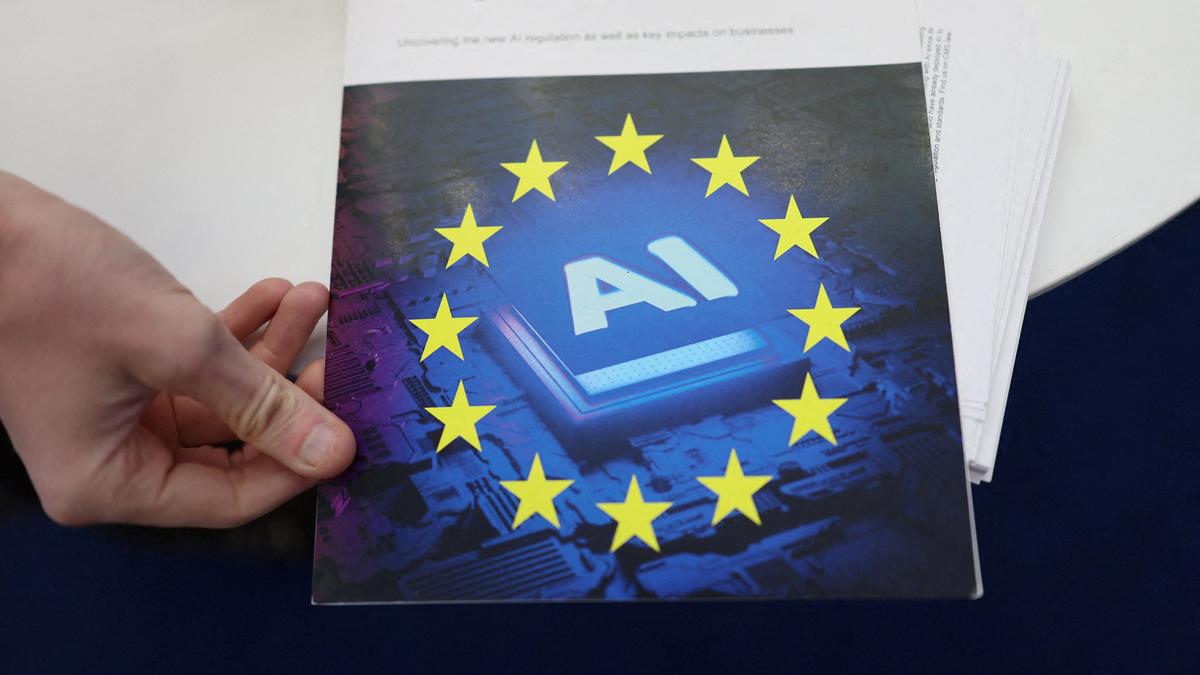
The European Union has finally reached a political consensus to criminalize the creation and distribution of non-consensual AI-generated sexual imagery. This landmark agreement, tucked within the broader Directive on Combating Violence Against Women and Domestic Violence, marks the first time the bloc has established a unified legal standard for "image-based sexual abuse." While the headlines celebrate a win for digital safety, the reality on the ground is far more complex. Law enforcement agencies across the continent are currently ill-equipped to police a technology that moves faster than a court summons.
The deal targets the specific weaponization of synthetic media. It mandates that member states treat the sharing of deepfake pornography as a criminal offense, punishable by prison time. This is not just about protecting public figures; it is a desperate attempt to curb a predatory industry that primarily targets private citizens. Despite the clear legal language, the technical hurdles to actual prosecution are immense.
The Architecture of Digital Victimization
Deepfakes are no longer the playthings of academic researchers or high-budget visual effects houses. The democratization of generative adversarial networks (GANs) and diffusion models means that anyone with a consumer-grade graphics card can produce convincing, explicit content using nothing more than a handful of social media photos.
European lawmakers have spent months debating where the line should be drawn. The final text focuses on intent and consent. By criminalizing the "non-consensual sharing or production" of these materials, the EU is attempting to move the burden of proof away from the technical nuances of how the image was made and onto the harm it causes.
The strategy is sound on paper. In practice, the decentralized nature of the internet makes this a jurisdictional nightmare. If a deepfake is generated by a user in France, hosted on a server in the British Virgin Islands, and viewed by users in Germany, the "unified" European approach hits a wall. The directive pushes for better cooperation between national police forces, but it does little to address the anonymity baked into the platforms where these images proliferate.
Why Technical Detection is a Losing Battle
There is a persistent myth that "AI watermarking" or "detection tools" will save us. They won't.
Metadata can be stripped in seconds. Digital watermarks are easily bypassed by slightly altering pixels or re-encoding the file. While the EU agreement encourages platforms to implement better detection, it cannot mandate a technology that does not yet exist in a foolproof form. We are locked in an arms race where the offensive side—the creators of malicious AI—has every advantage.
The current detection software frequently produces false positives or fails to identify sophisticated "hybrid" images where only parts of the body are synthetic. For a prosecutor, this creates "reasonable doubt" by the bucketload. If a defense attorney can argue that a detection tool is only 85% accurate, a criminal conviction becomes nearly impossible to secure in many European jurisdictions.
The Platform Accountability Deficit
The new rules place significant pressure on social media companies and hosting providers to remove reported deepfakes quickly. However, the "Notice and Action" mechanisms currently in place are notoriously slow. By the time a deepfake is removed from a major platform, it has often been mirrored across dozens of smaller, unmoderated forums.
The Ghost Site Problem
Most of the damage isn't happening on Instagram or X. It is happening on niche "deepfake-on-demand" websites that operate in the shadows of the open web. These sites often ignore DMCA takedowns and European legal threats entirely.
The EU’s new directive gives victims the right to seek the removal of content, but it lacks the teeth to go after the infrastructure providers who hide behind shell companies. Without a mechanism to seize domains or block financial flows to these sites, the ban remains a localized solution to a global contagion.
The Missing Piece in the Legislative Puzzle
What is conspicuously absent from the EU’s deal is a clear mandate for "Safety by Design" at the model level. Most of the open-source AI models used to create deepfakes are trained on datasets that contain billions of images scraped without consent.
We are treating the symptom—the image—rather than the source—the unrestricted model.
A hard-hitting investigative look at the supply chain of these models reveals a disturbing lack of oversight. Companies that release "base models" often include disclaimers against illegal use, but they provide no technical barriers to prevent a user from fine-tuning that model for sexualized content. The EU agreement focuses on the end-user, the person who hits "share." It largely ignores the developers who provide the tools and the data-scraping firms that provide the ammunition.
Judicial Readiness and the Training Gap
Ask a typical prosecutor in a mid-sized European city about AI forensics, and you will likely get a blank stare. The legal system is built on physical evidence and eyewitness testimony. Deepfakes negate both.
To make this ban effective, member states must invest millions in specialized training for the judiciary. Judges need to understand that a deepfake isn't just a "fake photo"—it is a form of identity theft and psychological battery. Without specialized digital forensics units in every major police department, the new law will be nothing more than a symbolic gesture.
We have seen this before with cyberstalking and online harassment laws. Passing the law is the easy part. Building the technical infrastructure to find a masked IP address and link it to a physical human being is where the system usually breaks down.
The Victim’s Burden
Under the new directive, victims are promised support and legal recourse. But the process of reporting is often as traumatizing as the initial violation. Victims are forced to view and "verify" the explicit content, provide original "clean" photos for comparison, and navigate a bureaucracy that is often dismissive of digital crimes.
The EU needs to establish a "fast-track" judicial process for image-based abuse. The window of time to prevent a deepfake from going viral is measured in minutes, not months. A court order that takes three weeks to process is useless when the content has already been downloaded ten thousand times.
Funding the Resistance
If the European Union is serious about this ban, it needs to stop looking at it as a legal issue and start looking at it as a security issue. This requires:
- Bounties for Detection: Funding independent research into non-bypassable detection methods.
- Domain Seizure Task Forces: A centralized EU body with the power to coordinate with ISPs to black-hole sites dedicated to non-consensual deepfakes.
- Mandatory Model Filtering: Requiring any AI company doing business in the EU to prove their models have "guardrails" that prevent the generation of recognizable human likenesses in sexual contexts.
The deal is a step toward recognizing digital dignity, but it is not a solution. It provides a legal framework for a fight that is currently being fought with sticks and stones against a high-tech adversary.
Lawmakers have patted themselves on the back for "banning" deepfakes. Now they have to figure out how to actually find them. The success of this directive won't be measured by the press releases issued in Brussels, but by the number of successful prosecutions in local courts and the speed at which illicit content is scrubbed from the dark corners of the web. Until the cost of creation exceeds the ease of distribution, the victims will continue to pay the price.
The era of digital impunity must end, but a law without an enforcement mechanism is just a polite request to a criminal.