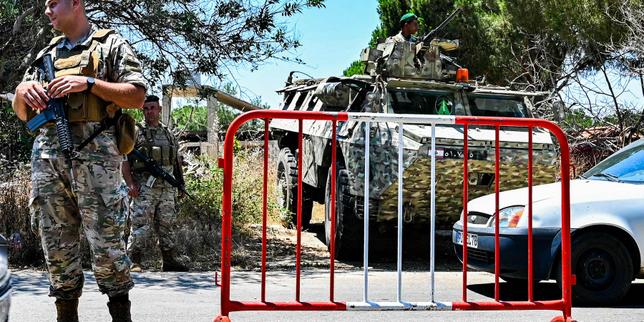
The narrative surrounding South Lebanon's "pilot zones" is running on pure sentimental noise. Mainstream coverage focuses entirely on the personal heartbreaks: displaced residents begging the Lebanese Armed Forces (LAF) for a sixty-minute window to inspect their ruined homes. They frame these zones as a tragic administrative failure, a cruel bureaucratic hurdle keeping civilians from their land under the pretense of a fragile framework agreement with Israel.
That perspective is lazy, short-sighted, and fundamentally misunderstands how post-conflict security architecture actually works.
What the media calls an administrative tragedy is, in reality, the only rational mechanism left to prevent an immediate relapse into total war. The controlled, agonizingly slow re-entry of civilians into border territory is not a bug of the framework agreement. It is its most critical feature.
The Lazy Consensus on the Border
The prevailing sentiment demands an immediate, unrestricted return of border populations to signal normalisation and sovereignty. The argument goes like this: if the LAF is truly in control, it should grant its own citizens instant access to their property without enforcing restrictive checkpoints or clearance windows.
This argument ignores basic military reality.
When combatants withdraw from a deeply fortified tactical environment, they do not leave behind clean pavement. They leave behind unexploded ordnance, booby-trapped infrastructure, covert weapons caches, and an immense intelligence vacuum. Allowing thousands of civilians to flood back into these zones prematurely accomplishes exactly two things: it guarantees civilian casualties from unexploded munitions, and it provides immediate human shields for irregular forces attempting to re-establish covert positions before state forces can secure the grid.
I have tracked regional security transitions across the Middle East for over fifteen years. Every single time a state actor attempts to rush civilian return to appease public sentiment, the result is identical: armed non-state actors re-embed themselves under the cover of civilian movement, the opposing military responds with kinetic force, and the entire framework collapses within weeks.
The Pilot Zone Mechanism Is Not About Permission
Let us dismantle the core emotional anchor of the media coverage: the image of a citizen asking their own military for "one hour" of access.
Framing this as a humiliation misses the operational intent. A pilot zone is a micro-test of command and control. When the LAF enforces strict, timed access, they are not humiliating the population; they are establishing a verifiable baseline of control over territory that was previously a sovereign black hole.
For the framework agreement to hold, three conditions must be proven simultaneously:
- The state army can exercise exclusive physical authority over movement within designated sectors.
- Irregular units cannot exploit civilian corridors to move equipment or re-occupy tactical positions.
- Incidents of cross-border friction can be isolated to specific grid coordinates rather than triggering a full-front escalation.
If the LAF allows unrestricted access today, they lose the ability to verify any of these conditions. The moment an unvetted column of vehicles moves into a sensitive border sector, target acquisition systems across the line go hot. In a high-stakes tactical buffer, ambiguity is lethal. Timed access removes ambiguity.
The Real Risk Nobody Wants to Admit
There is a major drawback to this approach, and it is vital to be transparent about it.
Enforcing pilot zones places an impossible psychological burden on a displaced population that has already lost everything. It creates a friction point between the civilian population and the national military—the very institution that needs civilian trust to operate effectively. If the LAF is perceived as acting as an external power's gatekeeper rather than the sovereign protector, its authority erodes from the inside.
Furthermore, these temporary zones carry a dangerous history of becoming permanent fixtures. Security arrangements built as short-term containment measures have a habit of calcifying into decades-long status quos. That risk is real, and the military leadership knows it.
Yet, weighed against the alternative—a rapid descent back into direct, uncontained kinetic exchange—the tactical containment of pilot zones is the only viable path forward.
Stop Asking When the Border Will Open
The public debate is focused on the wrong question. People keep asking, "When will the military let us go back?"
The question you should be asking is: "Why are political leaders pretending a border region can be restored without a rigorous, phase-by-phase military clearance protocol?"
Demanding an immediate return to status-quo-ante is a fantasy sold by commentators who do not have to clear a mined perimeter or manage a live firing corridor. The hard truth is that sovereignty is not restored through emotional declarations or immediate repopulation. It is rebuilt grid by grid, hour by hour, under uncomfortable, restrictive control.
If you want South Lebanon to remain intact six months from now, stop demanding the immediate dismantling of the pilot zones. The slow, painful, one-hour visits are not a failure of the agreement—they are the only reason the agreement is still breathing.