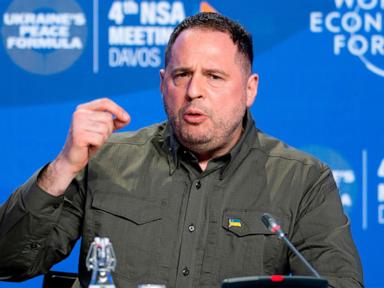
The pursuit of corruption in a nation fighting for its survival is never just about the money. It is about the legitimacy of the state itself. When Ukrainian authorities officially named the former chief of staff to President Volodymyr Zelenskyy as a primary suspect in a sophisticated money-laundering investigation, they didn't just file a legal brief. They ignited a political firestorm that threatens to reshape the internal power dynamics of Kyiv. This move marks the most significant internal legal action against a member of the President’s inner circle since the 2022 invasion began. It signals that the "untouchable" status of the old guard is evaporating under the heat of Western scrutiny and the internal demand for a cleaner government.
The suspect at the center of this storm isn't a minor bureaucrat. We are talking about an individual who held the keys to the kingdom, overseeing the administrative machinery that funnels policy from the President’s desk to the front lines. The allegations involve the illicit movement of funds through a web of offshore accounts and shell companies, a classic blueprint for hiding the proceeds of state-level graft. While the specific dollar amounts are still being tallied by investigators from the National Anti-Corruption Bureau of Ukraine (NABU), the symbolic cost is already clear.
The Anatomy of the Laundromat
Money laundering in Eastern Europe often follows a predictable, if complex, path. It starts with the diversion of state resources or the extraction of "rents" from state-owned enterprises. In this specific case, investigators are looking at a series of contracts tied to infrastructure and energy—sectors that have seen massive influxes of capital despite, or perhaps because of, the ongoing conflict.
The mechanism used was a "layering" process. This involves moving funds through multiple transactions to distance them from their source.
- Initial Acquisition: Funds are siphoned from contracts through inflated pricing.
- The Shell Game: The excess cash is moved to companies registered in jurisdictions with minimal oversight, often using proxies as directors.
- Integration: The "cleaned" money is then reinvested into legitimate assets, such as high-end real estate in Western Europe or stakes in international businesses.
What makes this investigation different is the timing. Ukraine is currently under a microscope. The flow of billions in foreign aid and military support comes with strings attached, primarily the requirement that Kyiv proves it can police its own house. The naming of a former top official serves as a high-stakes demonstration of that capability. It is a message to Washington and Brussels: no one is too close to the sun to be burned.
Beyond the Official Narrative
The official statements from the Specialized Anti-Corruption Prosecutor's Office (SAPO) focus on the technical violations of the criminal code. However, the reality on the ground in Kyiv is more nuanced. There is a deep-seated tension between the need for wartime efficiency—which often consolidates power in a few hands—and the democratic necessity of oversight.
For years, the Office of the President has been criticized for being a "black box." Decisions are made quickly, often bypassing the traditional parliamentary hurdles. While this speed is necessary for a nation at war, it creates the perfect environment for the shadow economy to thrive. The former chief of staff was the architect of much of this centralized control. By targeting him, the judicial system is effectively putting the entire administrative structure on notice.
Critics argue that these types of investigations can be used as political weapons. It is a valid concern in any post-Soviet democracy. If the evidence is thin, it looks like a purge. If the evidence is overwhelming, it raises uncomfortable questions about who else knew what was happening while the money was moving. The burden of proof now rests entirely on NABU and SAPO to show that this is a matter of law, not a reshuffling of the political deck.
The International Pressure Cooker
Ukraine’s path to European Union membership is paved with anti-corruption reforms. This isn't just a suggestion; it is a hard requirement. The EU’s recent reports on Ukraine’s progress have consistently highlighted the need for "tangible results" in high-level graft cases. Convicting a low-level customs official won't cut it anymore.
International donors are also weary. While the moral case for supporting Ukraine remains absolute, the political case becomes harder to sell to domestic audiences in the US and Europe when headlines are dominated by missing millions. The "Trust but Verify" era of 2022 has transitioned into a "Prove It" era in 2026. This investigation is the primary exhibit in that proof.
The Risks of a Failed Prosecution
If this case falls apart in court due to procedural errors or political interference, the damage will be catastrophic. A failed prosecution of a figure this prominent would confirm the fears of skeptics who believe Ukraine’s anti-corruption drive is merely "performance art" for the West.
The judicial system in Ukraine is still undergoing its own painful reform. Many judges from the previous era remain on the bench, and the resistance to change is systemic. For a case of this magnitude to succeed, it requires more than just a dedicated prosecutor; it requires a judiciary that is willing to stand up to the executive branch. This is the ultimate test of Ukraine's institutional maturity.
The Hidden Impact on the Front Lines
Every dollar lost to a laundering scheme is a dollar that doesn't buy a drone, a medical kit, or a generator. The soldiers in the trenches of the Donbas are keenly aware of this math. There is a growing intolerance within the military for "business as usual" in Kyiv.
Early in the war, the national mood was one of total unity, where internal critiques were often silenced in the name of the common defense. That period has ended. The public is now demanding accountability as a form of respect for the sacrifices being made. A government that cannot protect its treasury from its own officials cannot be expected to protect its borders indefinitely.
Redefining the Role of the Chief of Staff
In the Ukrainian system, the Chief of Staff (or Head of the Presidential Office) often holds more functional power than the Prime Minister. They control access to the President, manage the governors, and oversee the security services. This concentration of power is a historical relic that has persisted because it provides stability.
However, the current investigation suggests that this model is inherently flawed. When one office holds so much leverage without direct electoral accountability, the temptation for enrichment becomes a systemic risk. We are seeing the beginning of a debate about "de-officalizing" the presidency—moving power back toward the Cabinet of Ministers and the Parliament where it can be properly checked.
Mapping the Offshore Trail
Investigators are currently tracing transactions through at least four different countries. This is where the investigation gets difficult. It requires international legal assistance (MLATs) and the cooperation of foreign banks that are often slow to respond.
- Cyprus and the British Virgin Islands: Traditional hubs for Ukrainian capital flight.
- The Baltic States: Often used as the first "European" entry point for funds.
- London and Dubai: The ultimate destinations for luxury asset acquisition.
The complexity of these trails suggests that the former chief of staff wasn't acting alone. Laundering on this scale requires a professional class of enablers—lawyers, accountants, and bankers—who specialize in making the dirty appear clean. The scope of the probe is likely to expand to these facilitators, potentially implicating individuals outside of Ukraine’s borders.
The Political Future of Zelenskyy
President Zelenskyy finds himself in a precarious position. The suspect was a close ally and a key part of his original team. To support the investigation is to admit that he had a wolf in the fold. To hinder it is to betray his primary campaign promise of "breaking the system."
So far, the President has maintained a distance, allowing the legal process to play out. This "arms-length" approach is a calculated risk. It allows him to claim credit if the prosecution is successful while shielding him from the fallout if the suspect decides to "talk" in exchange for a lighter sentence. In the high-stakes world of Kyiv politics, loyalty is often the first casualty of a criminal indictment.
The Reality of Modern Graft
Modern money laundering doesn't involve suitcases of cash. It involves digital transfers, complex derivatives, and the manipulation of trade invoices. It is "cleaner" and much harder to detect than the crude theft of the 1990s. The investigators at NABU have had to evolve, hiring forensic data analysts and crypto-experts to keep pace with the sophisticated methods used by the political elite.
The fact that they were able to build a case against a former chief of staff suggests that the technical gap is closing. It shows that the state's "immune system" is finally starting to recognize the virus of corruption, even when it is dressed in the uniform of the administration.
The Path of No Return
There is no going back from this. Once you indict the person who sat in the room where every major decision was made, the "omerta" of the political class is broken. Others will start to look at their own exposure. Deals will be made. More names will likely surface in the coming months as the pressure of the investigation forces others to choose between their associates and their freedom.
The true success of this case won't be measured by a single conviction. It will be measured by whether it fundamentally changes the cost-benefit analysis for those in power. If the risk of being caught is high enough, and the consequences severe enough, the culture of graft might finally begin to wither.
Ukraine is fighting two wars simultaneously. One is against a foreign invader, and the other is against a domestic legacy of corruption. Winning the first without winning the second would be a hollow victory. The indictment of the former chief of staff is a signal that the second war is entering its most intense phase. The world is watching to see if the Ukrainian justice system has the stomach to finish what it started.
The era of the "protected circle" is over; the era of the rule of law must now begin.