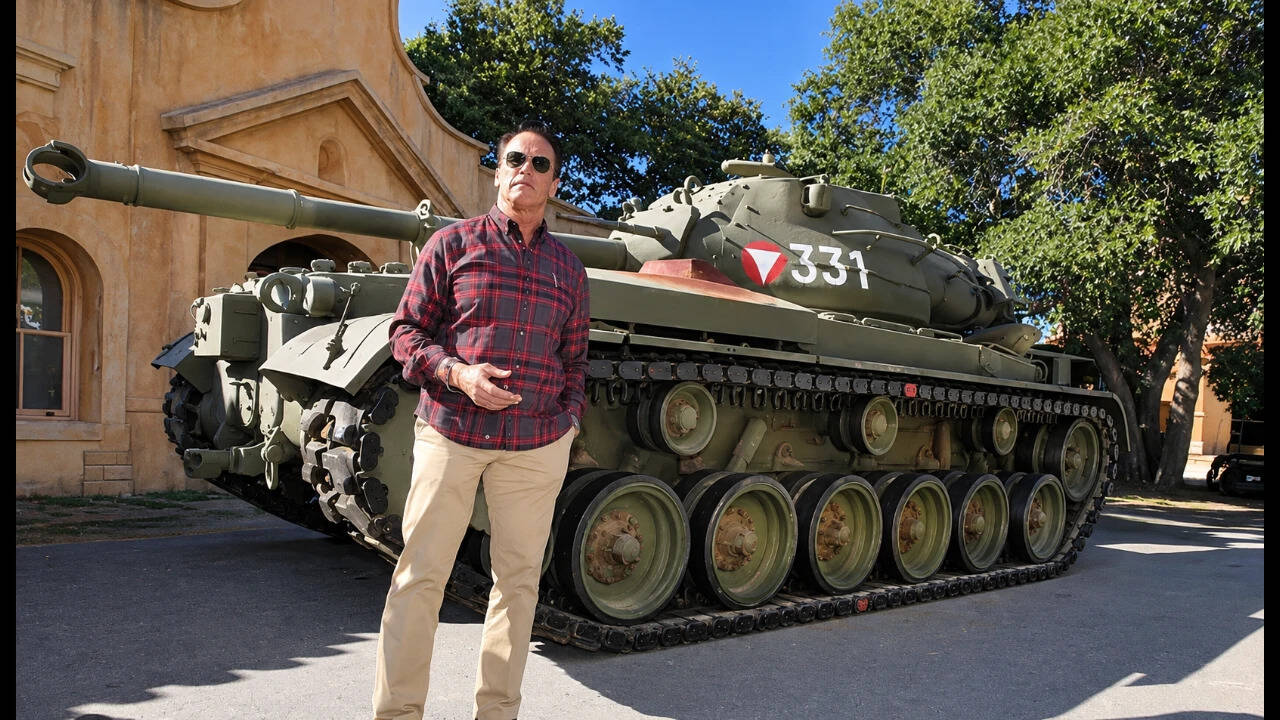
Steel.
That is the first thing you notice when you stand next to an M47 Patton tank. Not the cannon, not the olive-drab paint, not even the sheer, absurd scale of a machine designed to survive an artillery strike—it is the smell of old grease baking in the California sun and the radiating, indifferent heat of fifty tons of cast armor. Also making headlines lately: Why the Thomas Markle Police Report Proves Celebrity Legal Coverage is Broken.
In 1965, an eighteen-year-old kid from Thal, Austria, climbed inside one of these beasts. His name was Arnold Schwarzenegger. At the time, he wasn't a movie star, a governor, or a global punchline delivered in a thick Styrian accent. He was a mandatory conscript in the Austrian Armed Forces, a gangly teenager with big dreams and a habit of sneaking off base to compete in junior bodybuilding contests. His job was simple: drive the M47 Patton, designated tank number 331.
Decades later, the internet would treat the reunion of Arnold and tank 331 as a piece of disposable viral candy—a rich guy buying an eccentric toy and using it to flatten a Mercedes-Benz for a Netflix promo. On the surface, it looks like pure Hollywood excess. Look closer, though, and you find something entirely different. You find a story about memory, the terrifying weight of our past, and what happens when a human being decides to physically conquer the very thing that once held him captive. Further insights into this topic are explored by Associated Press.
The Architecture of Escape
To understand why a multi-millionaire would spend tens of thousands of dollars to track down, purchase, and ship a decommissioned Cold War relic across the Atlantic Ocean, you have to understand what Austria felt like in 1965.
Post-war Europe was gray. For a young man bursting with restless ambition, mandatory military service wasn't a noble rite of passage; it was a cage. Picture a hypothetical eighteen-year-old recruit named Lukas sitting in the barracks of Graz that same autumn. Lukas stares at the concrete walls, listens to the barked orders of drill sergeants, and feels the suffocating weight of a predetermined life—factory work, a quiet marriage, a slow fade into obscurity. That was the air Arnold breathed. The M47 Patton wasn't just a vehicle to him; it was the physical manifestation of state control, heavy and immovable.
Yet, inside that steel box, something shifted.
Operating a 1950s main battle tank requires a strange intimacy with violence and power. The V-12 Continental engine roars with 810 horsepower right behind your spine. When you pull the steering levers, the earth doesn't just move; it surrenders. For a kid who had spent his adolescence lifting iron weights in a freezing gym to escape his father’s shadow, the tank offered a terrifying revelation. Power wasn't something that happened to you. Power was something you could steer.
Still, the military didn't care about his bodybuilding trophies. When Arnold went AWOL to win the Junior Mr. Europe title in Stuttgart, they threw him in military prison. He spent a week in a cell, eating cold rations, realizing that if he wanted true freedom, he couldn't just break the rules of the system. He had to outgrow the system entirely.
Hunting a Ghost in the Scrapyards
Fast forward to the early 1990s. Arnold Schwarzenegger is the biggest box-office draw on the planet. He has conquered Venice Beach, Hollywood, and the American dream. Most people, having escaped a past that constricted them, burn the bridge behind them. They buy sleek Italian sports cars and pretend the mud never existed.
Arnold went looking for tank 331.
Tracking down a specific Cold War tank isn't like looking up a VIN number on Carfax. Military hardware disappears into bureaucratic black holes, gets sold to foreign allies, or gets melted down into rebar. It took years of quiet detective work, leveraging diplomatic backchannels and persistent researchers digging through Austrian defense ministry archives.
Consider what happens next: they actually found it.
Sitting in a quiet storage depot in Austria, rusting gently under decades of dust, was the exact M47 Patton he had driven as a teenager. The serial numbers matched. The scarred hull was the same one he had scrubbed with wire brushes while dreaming of California.
In 1991, Arnold paid roughly $20,000—a sum that barely registered against his Terminator 2 paycheck—to buy his old cage. Getting it out of Europe required navigating a labyrinth of international arms-export treaties, demilitarization protocols, and customs inspections. The main 90mm cannon had to be permanently disabled, rendered harmless before it could cross the ocean. Finally, loaded onto a massive flatbed truck, tank 331 rolled onto the grounds of his estate in Brentwood, California.
Why do it? Why haul fifty tons of obsolete warfare halfway around the world?
Think of it like keeping the cast from a broken bone, or framing the rejection letter that nearly broke your spirit. When you keep the artifact of your struggle, you strip it of its power over you. Every morning Arnold walked past that Patton parked on his property, the dynamic was reversed. The machine no longer owned the boy. The man owned the machine.
The Theatre of Destruction
Which brings us to the summer of 2023, and a dusty lot outside Los Angeles where a gleaming, silver Mercedes-Benz E-Class sat waiting to die.
Netflix needed a promotional stunt for FUBAR, Arnold’s debut television series, and his simultaneous appointment as the streamer’s "Chief Action Officer." In the marketing boardrooms, the pitch was probably effortless: put the action legend back in his famous tank and let him run things over. Give the algorithm what it wants.
If you watch the footage, the visual comedy is undeniable. Arnold, now in his mid-seventies, with silver hair and a cigar clenched between his teeth, climbs effortlessly up the treads and drops into the driver’s hatch. He looks entirely at home. Beside him sits a stunned guest, clinging to the steel rails as the massive V-12 coughs to life, belching blue exhaust smoke into the clear sky.
Then, the tank moves forward.
There is a visceral, almost shocking difference between seeing a car crash in a movie and watching a fifty-ton armored vehicle roll over a modern luxury sedan. In cinema, explosions are choreographed; metal bends gracefully for the cameras. In reality, when the steel tracks of an M47 Patton make contact with the hood of a Mercedes, there is no drama. There is only physics.
Crunch.
The windshield doesn't shatter outward; it collapses inward like wet paper. The reinforced steel roof pillars—engineered to protect human life in high-speed collisions—fold flat in less than two seconds. The suspension doesn't bounce; it simply ceases to exist, pressed into the asphalt under the relentless, rhythmic clatter of eighty-two-pound track shoes. Within four seconds, a feat of modern German automotive engineering is reduced to a jagged pancake of torn aluminum and shattered safety glass, no thicker than a mattress.
On screen, Arnold grins. He makes a joke about parking tickets. Millions of viewers share the clip, laugh at the absurdity, and scroll on to the next distraction.
What the Camera Missed
I have stood near heavy armor during live demonstrations, and the sensation is something a smartphone screen can never translate. You don't hear the engine with your ears; you feel it in your teeth. The ground beneath your boots vibrates with a low, ominous hum that triggers an ancient, primal alarm in your nervous system. Everything inside you screams to get out of the way.
Watching Arnold pilot that machine at seventy-five years old, I couldn't stop thinking about the sheer physicality of the moment. Operating an M47 Patton is not like driving a modern Humvee with power steering and air conditioning. It is brutal, mechanical labor. You are pulling heavy steel rods connected directly to massive transmission brakes. It requires grip strength, shoulder endurance, and spatial awareness in a vehicle with terrible visibility.
Most men his age are worried about hip replacements and blood pressure medication. Arnold was wrestling fifty tons of 1950s iron just to make people smile.
There is a quiet vulnerability hidden beneath the bravado of that Netflix stunt. Aging, especially for a man whose entire identity was built on physical invincibility, is a slow, relentless siege. The muscles soften. The heart requires surgery—Arnold has undergone three open-heart procedures, staring down his own mortality in sterile hospital rooms far removed from the cheering crowds of Venice Beach. You cannot out-lift time. You cannot flex your way out of a failing valve.
When you understand that, the Mercedes-Benz beneath the treads stops looking like a prop. It starts looking like a metaphor.
We all carry things that threaten to flatten us—expectations, past failures, the creeping dread of irrelevance as the years stack up. Most of us try to outrun them. We build delicate, comfortable lives designed to cushion the blow, hoping the heavy machinery of the world never rolls down our street.
Arnold took a different route. He went back to the barracks in Graz. He found the heaviest, most intimidating piece of iron from his youth, brought it home, and learned how to drive it with one hand while smoking a cigar. And he didn't even keep the thrill entirely to himself; for years, he used tank 331 to raise millions of dollars for After-School All-Stars, inviting inner-city kids to climb aboard and crush things alongside him, letting them feel, even for five minutes, what it’s like to be unstoppable.
The Echo of the Treads
The cameras eventually stopped rolling on that dusty lot in California. The crew swept up the safety glass, a tow truck hauled away the mangled remains of the Mercedes, and the Netflix marketing cycle moved on to the next show, the next trailer, the next fleeting spike in engagement metrics.
Tank 331 was loaded back onto its transport and returned to its quiet corner in Brentwood.
It sits there still, silent and cold under the California sun, its 90mm barrel pointing harmlessly toward the Pacific. To a passerby, it is just an eccentric billionaire’s lawn ornament, a relic of a forgotten war parked next to a swimming pool.
Inside the hull, though, the air still smells faintly of old grease, hot iron, and the ghost of an eighteen-year-old boy who refused to stay inside the box they built for him.