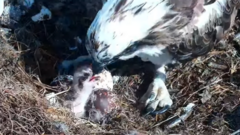
The wait is over. The year's first osprey chick has finally broken through its shell. For weeks, wildlife watchers have stared at grainy webcam feeds, tracking every shift of the parents and every crack in the mottled eggs. It happens every spring. Yet, the excitement never really fades.
Wildlife reserves across the UK and North America celebrate this moment like clockwork. But let's be honest. This isn't just a feel-good nature story for your morning feed. The arrival of the first osprey chick is a brutal, fascinating test of survival that tells us exactly how our ecosystems are holding up. You might also find this related coverage insightful: Inside the Anti-Weaponization Fund Crisis Nobody is Talking About.
If you think it's just about a cute bird, you're missing the bigger picture.
The Brutal Reality Inside the Osprey Nest
We love to romanticize nature. We watch live streams of nests at famous sites like the Loch Garten Nature Centre or the Rutland Water Nature Reserve and sigh at the beautiful family dynamic. As extensively documented in recent articles by BBC News, the effects are significant.
The reality is incredibly harsh.
Osprey eggs don't hatch all at once. They hatch sequentially, usually one to three days apart. That means the first chick to emerge gets a massive head start. It's bigger. It's stronger. When the parents bring back a fresh trout or pike, that firstborn chick aggressively dominates the food supply.
Conservationists call this resource competition. In years when fish are scarce, the youngest chicks simply don't survive. The oldest sibling will actively push them aside or attack them. It sounds cruel, but it's an evolutionary strategy that ensures at least one strong chick makes it to fledging rather than three weak ones starving.
When you look at that tiny, wet blob in the nest today, you're looking at the ultimate survivalist. It has to grow from a few ounces to a fully fledged apex predator with a nearly six-foot wingspan in just about seven to eight weeks. The clock is ticking immediately.
Why Tracking the Exact Hatch Date Changes Everything for Scientists
Biologists don't just celebrate the first hatch because they like birds. They track these dates with obsessive precision because raptors are environmental sentinels.
The timing of the first hatch tells us volumes about climate shifts and food availability. Ospreys are migratory birds. They spend their winters in West Africa or South America, flying thousands of miles back to their specific ancestral nesting sites every spring.
- The Migration Factor: If a breeding pair arrives late due to severe weather patterns along their migratory route, their laying date gets pushed back.
- The Incubation Window: Osprey eggs require roughly 35 to 42 days of constant incubation. Both parents share the duty, though the female does the heavy lifting.
- The Food Match: Ideally, the hatch date aligns perfectly with the peak availability of surface-swimming fish in local lakes and rivers.
If the chicks hatch too early or too late, the parents face a massive challenge in finding enough food. A shifting hatch date across consecutive years gives scientists early warnings about broader environmental disruptions long before they show up in other data.
The Conservation Miracle We Take for Granted
It is easy to forget that seeing an osprey in the wild was once an impossibility in many parts of the world. In the UK, heavy persecution by egg collectors and gamekeepers wiped out breeding ospreys entirely by 1916.
Their return is one of the greatest success stories in modern wildlife conservation. It started with a single pair returning to Loch Garten in 1954. Later, pioneering reintroduction programs, like the one spearheaded by the Leicestershire and Rutland Wildlife Trust in 1996, helped re-establish populations in areas where they had been absent for generations.
In North America, the story was different but equally grim. The widespread use of the pesticide DDT caused widespread eggshell thinning. The shells would literally crush under the weight of the incubating parents. By the time DDT was banned in 1972, osprey populations were devastated.
Today's thriving populations aren't an accident. They are the direct result of strict legal protections, massive habitat restoration efforts, and the installation of thousands of artificial nesting platforms. When a chick hatches today, it stands on the shoulders of decades of intense field conservation work.
How to Get Involved and What to Watch For Next
The story doesn't end with the hatch. The next few weeks are the most action-packed window for wildlife enthusiasts. If you are watching a local nest camera or visiting a viewing viewpoint, you need to know what you are actually looking at.
Watch the feeding dynamics closely. The male does almost all the hunting during this phase. He will bring a fish to the nest, and the female will carefully tear off tiny, easily digestible pieces of flesh to feed the chick. If you see the female feeding the chick while the male stands guard on a nearby branch, the nest is functioning exactly as it should.
You can directly support these conservation efforts without being a scientist. Most nesting sites are run by local wildlife trusts or non-profits that rely entirely on public donations to maintain their tracking equipment, protect nest sites from poachers, and fund ongoing research.
Find a local raptor monitoring group or a wildlife trust monitoring a nest near you. Check if they need volunteers for nest protection watches or look into donating to keep their live streaming feeds online. The data gathered from these public streams feeds directly into global migratory bird databases, helping protect these incredible predators for the next generation.