The Bronze Doors of St. Peter’s
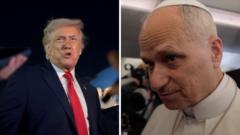
The air inside the Vatican always smells of cold stone and centuries of incense. It is a heavy, silent weight that presses against your chest, reminding you that you are standing in a place that measures time in millennia, not news cycles. For a politician, this can be a terrifying realization. Politicians live in the now. They live for the next poll, the next rally, the next four years. But when Donald Trump stepped into that space, he wasn’t just meeting a world leader. He was meeting a ghost of an idea—the concept that power might actually belong to the poor, the weak, and the invisible.
Outside, the sun bakes the Roman pavement. Inside, the chill is absolute.
For decades, the American conservative movement enjoyed a comfortable, if sometimes strained, marriage with the Catholic Church. They agreed on the sanctity of life. They agreed on the importance of tradition. It was a partnership of convenience and shared values that seemed unbreakable. Then came the collision. It wasn't just a disagreement over policy; it was a head-on crash between two diametrically opposed views of what it means to be a human being in the modern world.
Consider a hypothetical voter named Maria. She lives in a small, dusty town in eastern Pennsylvania. She prays the Rosary every morning before her shift at the nursing home. For years, her vote was simple. She voted for the party that promised to protect the unborn. But lately, she sits in her kitchen, looking at a photo of her nephew who is struggling to get his visa, and she hears the Pope’s voice on the radio. He isn’t talking about tax cuts or border walls. He is talking about the "globalization of indifference." He is talking about her.
Maria is the invisible stake in this high-stakes game of political chess. She is the person the polls are starting to lose.
The Wall and the Bridge
The friction started with a single word: walls.
In the heat of the 2016 campaign, Pope Francis was asked about the plan to build a massive barrier along the U.S.-Mexico border. His response was a lightning bolt. "A person who thinks only about building walls, wherever they may be, and not building bridges, is not Christian," he said. It was a direct hit. It wasn't a nuanced theological debate; it was a moral indictment delivered in plain language.
Trump’s response was equally blunt. He called the Pope’s comments "disgraceful." He suggested that if ISIS ever attacked the Vatican, the Pope would have wished Trump were President because he would have prevented it. This wasn't just a spat between two men with big egos. It was the moment the fracture began to spider-web through the bedrock of the American electorate.
When a political leader fights with the head of a global faith, they aren't just fighting a person. They are fighting a narrative. Trump’s narrative is one of strength, exclusion, and "America First." The Pope’s narrative is one of vulnerability, inclusion, and "The World Together." For the millions of Catholics who populate the "Blue Wall" states of Michigan, Wisconsin, and Pennsylvania, this creates a profound, quiet crisis of identity.
Do you follow the man who promises to protect your job and your borders? Or do you follow the man who tells you that your soul depends on how you treat the stranger at your gate?
The Arithmetic of the Pew
Politics is ultimately a game of math, even if we dress it up in the finery of philosophy. In the United States, Catholics make up about 22 percent of the population. They are not a monolith. They are a sprawling, messy, diverse group of people who don't agree on much. But they are concentrated in the exact places that decide who sits in the Oval Office.
If you lose five percent of the Catholic vote in a suburb of Milwaukee, you lose the state. If you lose the state, you lose the election.
The rift isn't just about the border. It’s about the very soul of what the Church calls "Social Teaching." While Trump’s base cheered for deregulation and the dismantling of environmental protections, Pope Francis was writing Laudato si’, a massive encyclical that called the protection of the environment a moral imperative. He linked the "cry of the earth" to the "cry of the poor."
To the traditional Republican strategist, this felt like an intrusion. To the voter in the pew, it felt like a complication. It made it harder to be a "good Catholic" and a "loyal partisan" at the same time. The friction generates heat, and that heat is melting the margins of support that Trump once relied upon.
The Ghost at the Table
Imagine a dinner table in a middle-class home in Ohio. There is a crucifix on the wall and a "Make America Great Again" hat on the sideboard. The father, a retired steelworker, sees the Pope as a "leftist" who doesn't understand the reality of the American economy. His daughter, a schoolteacher, sees the Pope as a moral compass pointing away from the harsh rhetoric she hears on the news.
This is where the support is being lost. Not in the grand halls of the Vatican, but in the awkward silences between the salad and the main course.
The Pope has a way of making the comfortable feel deeply uncomfortable. He doesn't speak in the polished soundbites of a D.C. consultant. He speaks in parables. When he washes the feet of refugees or embraces a man with a disfiguring skin disease, he is sending a message that transcends policy papers. He is defining what it means to have power.
Trump’s brand of power is centered on the person at the top. It is the power of the CEO, the commander, the builder. The Pope’s brand of power is centered on the person at the bottom. It is the power of the fisherman. These two versions of authority cannot coexist without one eventually eroding the other.
The Cost of the Long Game
We often talk about "Vatican diplomacy" as if it were a matter of ambassadors and communiqués. It’s more subtle than that. It’s the slow, steady drip of influence through the Sunday homily and the parish bulletin. It’s the way a grandmother looks at her grandson and wonders if the language he’s learning from political rallies is the language of their faith.
The cost isn't always a sudden defection to the other side. Often, the cost is apathy. It’s the Catholic voter who decides to stay home because they no longer feel represented by either the secular progressivism of the Left or the nationalist populism of the Right. This "exhausted middle" is where the election will be won or lost, and right now, the Pope is giving them permission to look elsewhere.
The irony is that Trump has delivered on many things the Church traditionally wants. He appointed conservative judges. He championed religious liberty. In a vacuum, he should be the hero of the Catholic world. But he forgot that for many believers, the "how" matters as much as the "what."
If you achieve your goals through vitriol and the demonization of the weak, you are asking the faithful to make a bargain that many are starting to find too expensive. The "valuable support" mentioned in dry news reports isn't just a number on a spreadsheet. It is the trust of people like Maria, who are starting to realize that the builder’s walls might be keeping out the very people her faith tells her to welcome.
The Unfinished Cathedral
Faith is a long-term investment. It survives empires and ideologies. It has seen men like Trump come and go, and it has seen Popes come and go. But the current tension is unique because it is happening in an era of instant, total communication. Every tweet is seen in Rome; every papal address is analyzed in Mar-a-Lago.
The rift is no longer a private disagreement between two world leaders. It is a public divorce playing out in the hearts of voters who are tired of being told they have to choose between their country and their conscience.
As the sun sets over St. Peter’s Square, the shadows of the statues of the apostles stretch long across the stones. They have seen centuries of kings and conquerors try to bend the moral arc of the universe to their will. Most of those names are forgotten now, carved into tombs that no one visits. The Church remains. The people in the pews remain. And as they look toward the next election, many are beginning to wonder if the builder they chose is actually tearing down the very things they spent their lives trying to protect.
The real loss isn't a headline or a poll number. It’s the quiet sound of a church door closing as a voter walks away, feeling that they no longer belong to the world the politician is trying to build.