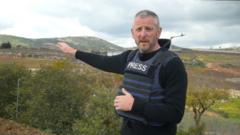
The displacement of civilian populations in southern Lebanon has transitioned from a tactical byproduct of border skirmishes into a calculated instrument of regional warfare. When the Israeli military issues evacuation orders for dozens of villages across the Litani River, it is not merely a humanitarian warning. It is the physical manifestation of a "buffer zone" policy that seeks to decouple the civilian population from the political and military infrastructure of Hezbollah. By ordering hundreds of thousands of residents to move north of the Awali River—well beyond the traditional UN-mandated zones—the IDF is effectively redrawing the demographic map of Lebanon to ensure that the status quo of the last two decades cannot be restored.
This is the grim reality of modern siege mechanics. It functions through the weaponization of geography. For a different look, consider: this related article.
The Geography of Empty Spaces
The immediate goal of these evacuation notices is to strip the Lebanese south of its human shield, according to Israeli military doctrine. However, the operational reality goes much deeper. By emptying these towns, the military creates a "kill zone" where any remaining movement is classified as hostile. This simplifies the rules of engagement for drone operators and artillery batteries, but it simultaneously triggers a massive internal crisis for the Lebanese state.
Lebanon is already a fractured entity. Its economy is a ghost, and its infrastructure is held together by little more than historical grit and international aid. When 25% of the country is told to flee their homes overnight, the pressure does not stay in the south. It flows into Beirut, Sidon, and Tripoli, straining sectarian balances and exhausting the few resources left in the central government’s coffers. The objective here is twofold: military freedom of movement in the south and intense political pressure on the central government in Beirut to reel in Hezbollah’s autonomy. Related coverage on this matter has been published by BBC News.
Logistics of the Awali Line
Historically, the Litani River was the benchmark for security. It sits roughly 18 miles from the Israeli border and was the centerpiece of UN Resolution 1701. But current orders have pushed the evacuation line to the Awali River, significantly further north. This shift is a tacit admission that the old security paradigms are dead.
The movement of people on this scale is a logistical nightmare that serves a specific tactical purpose. When a population is in transit, the road networks become clogged. This congestion inhibits the movement of mobile rocket launchers and logistics convoys that Hezbollah relies on. In the chaos of a mass exodus, the ability to hide military assets among civilian traffic diminishes. The Israeli Air Force monitors these corridors with a persistence that was impossible in previous conflicts, using high-altitude surveillance to pick apart the difference between a family sedan and a munitions transport.
The Failure of International Oversight
We have to look at why these orders are being issued through social media and localized leaflets rather than through established diplomatic channels. It is because the United Nations Interim Force in Lebanon (UNIFIL) has been effectively sidelined. For years, the international community relied on a "monitor and report" system that failed to prevent the fortification of southern Lebanese villages.
Now, the "Blue Line" is a memory. The failure of the UN to enforce the demilitarization of the south created a vacuum that is now being filled by high-explosive ordnance. Analysts who have spent decades watching this border recognize that the current evacuation orders are an indictment of twenty years of failed diplomacy. If the international community cannot keep the peace, the parties involved will simply remove the people who are in the way of the war.
Hezbollah’s Impossible Choice
Hezbollah faces a strategic paradox. Their legitimacy is rooted in their identity as the "Protectors of Lebanon." When the very people they claim to protect are forced into a permanent state of displacement, that narrative begins to fray. The group is forced to decide between maintaining their firing positions within these villages—thereby ensuring the total destruction of the community’s physical assets—or retreating further north and abandoning the very territory they spent twenty years "fortifying."
The IDF understands this pressure point. By making the cost of Hezbollah’s presence in the south the literal erasure of southern Lebanese village life, they are trying to force a domestic uprising against the militia. Yet, history suggests that displacement often radicalizes rather than pacifies. A farmer who loses his ancestral olive grove to a targeted strike is more likely to seek retribution than he is to blame the political party that was hiding in his shed.
The Economic Burn
Lebanon's southern economy is built on tobacco, citrus, and olives. These are not industries that can be packed into a suitcase and moved to a shelter in Beirut. The abandonment of the land during peak harvest or planting seasons represents a multi-generational economic hit.
Even if the fighting stopped tomorrow, the presence of unexploded ordnance and the destruction of irrigation systems mean that "going home" is a hollow promise. We are seeing the creation of a "no-man's land" that serves as a permanent strategic depth for Israel, but at the cost of turning southern Lebanon into a subsidized dependency for the rest of an already bankrupt nation.
Intelligence and the Leaflet War
The "why" behind the specific timing of these orders often stems from signals intelligence. When the IDF identifies a shift in Hezbollah’s defensive posture—perhaps the movement of short-range ballistic missiles into residential garages—the evacuation order is triggered. It serves as a legal "clearing of the throat" before a massive kinetic event.
However, the efficacy of these warnings is increasingly debated. When the window between a social media post and a missile strike is less than thirty minutes, the "humanitarian" aspect of the warning becomes a secondary concern to the psychological warfare of the act. The goal is to induce a state of constant, low-level panic that prevents any organized resistance or civil administration from taking root.
Regional Repercussions
This isn't just a Lebanese story. The displacement of the south is being watched closely in Tehran and Riyadh. For Iran, the displacement of their primary proxy’s base is a test of their commitment to the "Unity of Fronts." If they allow the south to be emptied without a significant escalation, the deterrence value of Hezbollah is halved.
Conversely, for the Gulf states, the deepening crisis in Lebanon is a cautionary tale of what happens when a non-state actor is allowed to dictate the national security of a sovereign country. The refugees moving north are not just moving toward safety; they are moving toward a future where the Lebanese state may no longer exist in its current form.
Tactical Realism
The brutal truth is that once a population is moved, they are rarely allowed to return in the same numbers or with the same level of autonomy. If Israel succeeds in establishing a de facto buffer zone by depopulating the south, they will have achieved a tactical goal that has eluded them since 1982. But they will also have inherited a border of bitterness that no amount of concrete or sensors can fully mitigate.
War is often described as politics by other means, but in southern Lebanon, war is now urban planning by other means. The map is being scrubbed clean of its inhabitants to make room for a new, colder logic of security.
Monitor the movement of the heavy engineering units behind the initial combat teams. If the IDF begins constructing permanent fortifications and paved roads where villages once stood, the "temporary" nature of these evacuation orders will be revealed as a permanent relocation. Watch the flow of people at the Awali River crossing; that is where the real future of the Levant is being decided.