The air outside the courthouse did not smell like victory. It smelled like burning rubber, cheap lighter fluid, and the sharp, metallic tang of sweat pushed past the point of exhaustion.
When the gavel finally fell inside Room 302, sealing the fate of the man who took Piotr Nowak’s life, nobody cheered. A heavy, suffocating silence gripped the gallery for three seconds. Then, the world broke apart.
To understand the smoke rising over the city square tonight, you have to understand the math of grief. In the standard ledger of the legal system, a life taken equals a set number of years behind bars. It is a sterile equation scribbled in black ink on legal pads. But to the community standing on the pavement outside, that equation felt like a betrayal. They did not see a balanced scale. They saw a discount on human life.
The sentence was read. The van pulled away. And that was the exact moment the collective restraint of a neighborhood snapped.
The Weight of the Gavel
Step inside the shoes of Miriam, a hypothetical composite of the dozens of local shopkeepers who watched the trial unfold from behind their counters. For months, Miriam kept a faded photograph of Piotr taped next to her cash register. He was the kid who fixed her broken awning, the one who checked on the elderly when the winter freezes hit.
To the prosecution, Piotr was Exhibit A—a catalog of trauma, a medical examiner’s report, a timeline of a Tuesday night gone horribly wrong. To the neighborhood, he was the connective tissue of a fading community.
When the judge announced the sentence—a number that felt shockingly brief to those who loved the victim—Miriam felt a physical sickness in her throat. The legal system had done its job. It had followed the guidelines, weighed the mitigating factors, and adhered strictly to the statute. Yet, the result felt entirely devoid of justice.
This is the invisible canyon that separates statutory law from human morality. The law demands objectivity. The human heart demands proportion. When the gap between the two becomes too wide to bridge, the frustration doesn't just evaporate. It searches for an exit.
Consider what happens next: the crowd doesn't disperse. They gather at the intersection where Piotr used to stand. Someone throws a brick. Not at a person, but at the abstract concept of a system that just told them their neighbor’s life was worth less than a decade of a killer's time.
When the Street Becomes the Courtroom
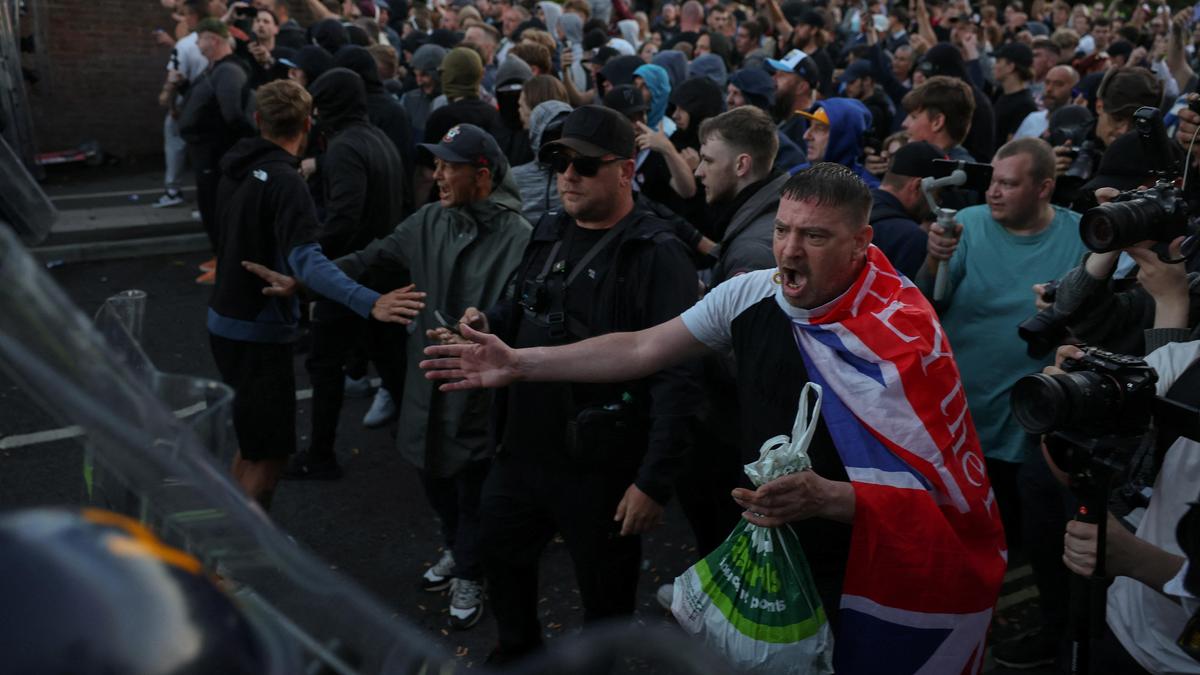
The escalation was entirely predictable, yet entirely terrifying. By nightfall, the peaceful vigil had devolved into a chaotic mosaic of shattered glass and flashing blue lights.
Sirens wailed in a continuous, agonizing loop. It was the sound of a city arguing with itself. On one side stood the riot police, shields locked, representing the thin, rigid line of order. On the other side stood young men and women, some crying, some screaming, throwing whatever their hands could find against those plexiglass barriers.
It is easy to watch the television footage and condemn the chaos. It is simple to look at a burning dumpster and write off the crowd as opportunists or criminals. But if you look closer, past the smoke, you see something much more tragic. You see a profound, desperate desire to be heard by a system that closed its doors at 5:00 PM.
The anger isn't just about the Nowak case anymore. The verdict was merely the spark that fell into a warehouse full of dry tinder. For years, this neighborhood felt ignored, over-policed yet under-protected, viewed through the lens of statistics rather than humanity. Piotr's murder was the ultimate violation; the sentence was the final insult.
Let us be completely honest about the terror of a riot. It is loud. It is indiscriminate. The smell of tear gas tears at your lungs until you think you can never breathe clean air again. It leaves small business owners—the very people who loved Piotr—boarding up their windows in fear. It is a self-inflicted wound born of a madness that takes over when logic fails.
But the real problem lies elsewhere. The fire on the asphalt is just a symptom. The disease is the absolute erosion of trust.
The Illusion of a Resolution
We are conditioned to believe that a trial brings closure. We watch televised dramas where the guilty party is led away, the music swells, and the family walks down the courthouse steps into a bright, redemptive future.
Real life offers no such luxury.
The sentencing of Nowak’s killer solved nothing. It did not bring Piotr back to the community. It did not soothe the raw, bleeding ache in his mother’s chest. And, most damagingly of all, it did not answer the question that has been echoing through these streets for months: How do we stop this from happening again?
The legal system is designed to look backward. It reconstructs a crime, assigns blame, and doles out punishment based on past precedents. But communities have to live forward. They have to walk the same dark alleys tomorrow. They have to send their children to the same schools. When the court refuses to look at the environment that bred the violence in the first place, the sentence feels less like justice and more like a bureaucratic clean-up crew.
The city is left with two distinct realities that cannot coexist. In the official record, the case is closed. The paperwork is filed. The state has moved on to the next docket. But on the cracked pavement of the avenue, the trial has only just begun, and the jury is furious.
The Cost of the Silence
By midnight, the worst of the clashes had moved to the perimeter of the precinct. A line of vehicles sat charred and hollowed out, looking like metallic carcasses under the amber glow of the streetlights.
The true cost of this night won't be measured in the thousands of dollars needed to replace broken storefront glass or repair city property. The true cost is measured in the silence that will follow. The silence of a community that has decided, once and for all, that the institutions built to protect them are entirely indifferent to their pain.
It is a terrifying realization when a populace loses faith in the law. Without that faith, the social contract dissolves. The rule of law is replaced by the rule of the loudest voice, the heaviest rock, the quickest fist. We are seeing the fragile scaffolding of our society splinter in real-time on these streets.
The politicians will issue statements tomorrow. They will call for calm. They will promise reviews and panels and community forums. They will use clinical, safe language to describe a situation that is fundamentally raw and dangerous. They will try to sanitize the rage.
But they won't look at the photograph next to Miriam's register. They won't understand that the broken glass on the avenue is the exact shape of a neighborhood's broken heart.
A lone figure stays near the edge of the police cordon long after the crowds have been pushed back. It is an older woman, wrapped in a dark shawl, kneeling on the cold concrete. She isn't shouting. She isn't throwing stones. She is carefully placing a single, unlit candle into a crack in the pavement, shielding the wick from the wind with a trembling hand that has ran out of tears.