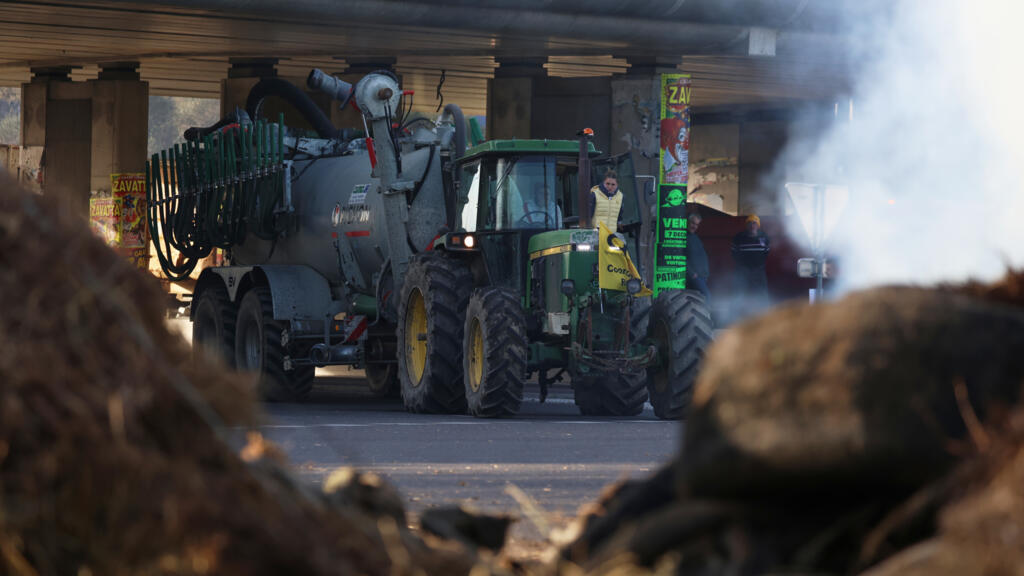
The French government is currently deploying a massive wave of sanitary and quality inspections on food imports to prove a point to its angry agricultural sector. By flooding ports and distribution hubs with inspectors, Paris is attempting to demonstrate that it can enforce "mirror clauses" which require foreign producers to meet the same stringent environmental and chemical standards as European farmers. This sudden administrative surge serves as a direct response to the massive protests blocking highways across France, where farmers argue that the proposed trade deal between the European Union and the Mercosur bloc—comprising Brazil, Argentina, Uruguay, and Paraguay—represents an existential threat to their livelihoods.
The strategy is simple but desperate. Prime Minister Michel Barnier knows that the French rural heartland feels betrayed by a Brussels bureaucracy that demands high-cost ecological transitions while simultaneously opening the gates to cheap, mass-produced South American beef and poultry. By tightening the screws on current imports, the government hopes to show that even if a deal is signed, it will not be a free-for-all. However, this regulatory offensive ignores the deeper structural reality that no amount of border inspections can fully bridge the massive price gap between a family-run farm in Brittany and a 50,000-acre industrial cattle operation in the Mato Grosso. For a different view, read: this related article.
The Illusion of Mirror Clauses
For years, the French political establishment has championed the idea of mirror clauses as the "silver bullet" for international trade. The theory suggests that if a pesticide is banned in the EU, any product treated with it cannot be sold in the EU. It sounds fair. It sounds logical. In practice, it is a logistical nightmare that borders on the impossible.
When a shipment of frozen beef arrives at Le Havre, inspectors can check for certain residues, but they cannot reconstruct the entire lifecycle of the animal through a lab test. They cannot easily verify if the soy used to feed that cattle was grown on recently deforested land or if the labor practices used on a distant ranch would pass a European audit. The current "tightening" of checks is largely a performance of sovereignty. It is meant to soothe the optics of the crisis rather than fundamentally alter the economics of global meat production. Further insight on the subject has been shared by Forbes.
French farmers are not fooled by the sudden appearance of clipboards at the border. They understand that the Mercosur deal, as currently drafted, would eliminate tariffs on 99,000 tons of beef annually. When that volume of product enters the market, the price discovery mechanism shifts. Even if every ounce of that beef is "compliant," its sheer scale will drive down the market price, making the thin margins of French producers disappear entirely.
The Cost of Compliance Gap
The French agricultural model is one of the most regulated in the world. Between the EU’s Common Agricultural Policy (CAP) and France’s own domestic "EGalim" laws, farmers are squeezed by rising costs for fuel, fertilizer, and labor.
Consider the following comparison of production constraints:
| Regulatory Factor | French Producer Standards | Mercosur Producer Standards |
|---|---|---|
| Antibiotics | Prohibited as growth promoters; strict veterinary oversight. | Variable; use of growth stimulants remains common in some regions. |
| Pesticides | Hundreds of active substances banned (e.g., neonicotinoids). | Many EU-banned substances remain legal for export crops. |
| Labor | Minimum wage, social charges, 35-hour week. | Significantly lower labor costs; varying worker protections. |
| Traceability | Individual ear tags and digital passports for every bovine. | Herd-level tracking with inconsistent individual history. |
This isn't a level playing field. It is a race where one participant is wearing lead boots and the other is on a motorbike. By focusing on "checks" at the border, the French government is treating the symptoms of an allergy while the patient is still eating the allergen.
Why Macron is Cornered
President Emmanuel Macron finds himself in a diplomatic cul-de-sac. On one hand, he needs the Mercosur deal to satisfy German industrial interests. Germany wants the deal because it would lower tariffs on European cars and machinery being exported to South America. For Berlin, the trade-off—sacrificing a bit of the agricultural market to save the automotive sector—is a logical business decision.
On the other hand, Macron cannot afford a total rural revolt. The "Gilets Jaunes" (Yellow Vest) protests proved how quickly rural and peri-urban discontent can paralyze the nation. If the farmers stay on the roads, the economy stalls.
The move to increase import inspections is a stalling tactic. It is designed to buy time during the negotiations, allowing French diplomats to claim they are "defending French sovereignty" while they simultaneously look for a way to let the deal pass with enough footnotes and "safety triggers" to satisfy the public. But these triggers are rarely pulled. Once a trade route is established, disrupting it causes diplomatic friction that most leaders are unwilling to endure.
The Logistics of Defiance
The actual implementation of these "tightened checks" is a massive drain on state resources. It requires a surge in personnel from the Directorate-General for Food (DGAL) and the Customs office. These officials are being pulled from other duties to conduct "flash audits" on supermarkets and wholesale markets to ensure that "Product of France" labels are not being used fraudulently on imported goods.
We are seeing a shift from trade facilitation to trade policing.
This creates a paradox. France is one of the world's largest exporters of luxury goods, wine, and aeronautics. If France becomes too aggressive with its "inspections" as a tool of protectionism, it invites retaliation. Brazil and Argentina are perfectly capable of launching their own "sanitary inspections" on French cognac or Airbus components. The global supply chain is too interconnected for one nation to play the inspection card without expecting a counter-move.
The Broken Promise of the Green Deal
The irony of the current situation is that the European Green Deal is the very thing making the Mercosur deal impossible to swallow. The EU is asking its farmers to reduce nitrogen use, leave land fallow for biodiversity, and invest in expensive organic methods.
To ask for these sacrifices while negotiating a deal that imports food from countries with far lower environmental overhead is a staggering display of cognitive dissonance. It suggests that the EU is happy to "outsource" its carbon footprint and environmental degradation. If the forest is burned in the Amazon to produce beef for a Parisian dinner table, the planet still loses, regardless of how many inspectors check the temperature of the meat at the dock.
A Systemic Failure of Communication
The government’s focus on inspections highlights a fundamental distrust. They don't trust the South American exporters to tell the truth, and the French farmers don't trust their own government to protect them.
This distrust is rooted in history. Every major trade agreement of the last thirty years has arrived with the promise of "safeguard clauses" that were almost never used. When the price of milk or pork crashed in the past due to market gluts, the administrative hurdles to prove "market disruption" were so high that by the time help arrived, the farms were already in foreclosure.
The current "hard-hitting" inspection regime is a theater of authority. It is meant to show the farmer in the tractor that the state is on his side. But a clip-board at the border does not pay the mortgage on a farm that is being undercut by $2-per-kilo beef.
Beyond the Border
If France actually wanted to solve the crisis, it would move beyond temporary inspection surges. It would need to push for a total overhaul of the WTO framework to allow for "environmental tariffs"—a concept that is still a taboo in the halls of global finance. Until the "cost of carbon" and the "cost of compliance" are baked into the price of every kilo of meat crossing the Atlantic, the French farmer will remain an endangered species.
The tightening of checks is a tactical retreat, not a strategic victory. It is an admission that the government has lost control of the narrative and is now trying to regulate its way out of a political firestorm. As long as the fundamental math of the Mercosur deal remains the same, the tractors will eventually return to the streets, and no amount of sanitary certificates will be enough to stop them.
Look at the labeling on your next supermarket trip. If the "tightened checks" were actually working, the shelves would be thinning out, and prices would be rising to reflect the cost of local production. Instead, the volume remains high, the prices remain low, and the inspections continue as a quiet, bureaucratic background noise to a dying industry.
The next time you see a line of tractors on the A1, understand that they aren't just protesting a trade deal; they are protesting a system that values the "flow" of goods more than the people who produce them. The government's inspectors are just the latest actors in a play that has no happy ending for the French countryside.
Investigate the origin of the "processed" meat in your local school canteen. You will find that the "tightened checks" rarely reach the kitchens where the most vulnerable consumers eat the cheapest imports.


