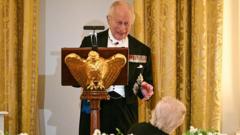
Donald Trump and King Charles III aren't exactly the most predictable pairing in modern history. One is a billionaire populist who loves a gold-trimmed golf club; the other is a lifelong environmentalist who waited decades for a crown. Yet, during a recent high-profile dinner, the two men found common ground in a place where politicians usually fear to tread: the messy, bloody, and deeply intertwined history of their two nations.
"If it wasn't for us, you'd be speaking French," Trump reportedly quipped during a dinner exchange that has since set social media on fire. It's a line we've heard before. It's a classic American "tough guy" refrain that usually surfaces during World War II debates or when someone gets annoyed at a Parisian waiter. But when the former U.S. President says it to the reigning British Monarch, the weight changes. The King didn't bristle. He laughed.
The dinner wasn't just about steak and polite nods. It was a masterclass in how personal rapport—and a shared sense of dark humor—can bridge the gap between two vastly different worldviews.
Behind the scenes of the French remark
Diplomacy is usually a script of boring, pre-approved platitudes. This was different. Trump’s comment leaned heavily on the "special relationship" between the U.S. and the U.K., but it also touched on a raw historical nerve. He was referring, of course, to the massive American intervention in both World Wars. Without the industrial and military might of the United States, the map of Europe—and specifically the British Isles—would look radically different today.
You've probably heard this trope at a pub or in a history classroom. It’s the idea that America is the ultimate insurance policy for Western democracy. By cracking this joke, Trump wasn't just being funny. He was asserting a specific kind of American dominance that resonates with his base. It’s bold. It’s slightly rude. It’s exactly what people expect from him.
King Charles, for his part, handled it with the seasoned grace of someone who has spent seventy years preparing for awkward dinners. He knows the history. He knows that his own family history is tied to these global shifts. Instead of a stiff-lipped correction, he leaned into the joke. It showed a level of comfort between the two that many analysts didn't think existed.
Why the French joke still works in 2026
History isn't dead. It's just resting. The reason this specific joke lands so hard is that it reminds everyone of the stakes. We live in a world where alliances feel shaky. NATO is constantly under the microscope. Trade deals are being torn up and rewritten. In that context, a joke about who saved whom serves as a reminder of why these two countries stay close.
British-American relations have always been a weird mix of "father-son" and "rival-sibling" dynamics. The UK provided the language, the law, and the initial blueprint. The US provided the muscle and the money when the 20th century turned into a nightmare. Trump’s "speaking French" line is a crude way of saying, "We have your back, but don't forget who brought the heavy lifting."
It's also a dig at the cultural rivalries that define Western Europe. The British and the French have been frenemies for a thousand years. By suggesting the British would be "speaking French," Trump played on that ancient rivalry. It’s a low-key way of celebrating British identity by imagining its erasure.
The King and the President a strange chemistry
On paper, this shouldn't work. Charles is a man of deep tradition and careful phrasing. Trump is a man of the moment and blunt force. But those who were in the room noted that the energy was surprisingly light. They aren't just talking about policy; they're talking about legacy.
What people get wrong about royal dinners
Most people think these events are all about the food. It's not. The menu is just a backdrop for the "soft power" being wielded. When Trump makes a joke like that, he’s testing the waters. He’s seeing how much he can push. If the King laughs, it signals to the world that the relationship is resilient. If the King freezes, it’s a diplomatic disaster.
- The King’s reaction proves he’s more adaptable than his critics claim.
- Trump’s persistence with this specific joke shows it’s a core part of his diplomatic brand.
- The lack of formal outrage from the French government (so far) suggests they know it's just theater.
The reality is that these men are both performers. They understand that a headline-grabbing quote is often more effective than a 50-page briefing paper. It creates a narrative of friendship that the public can actually understand.
Historical reality check
If we’re being honest, the "speaking French" comment is a bit of a stretch historically, but it contains a kernel of truth that makes it bite. During the Napoleonic era, the British were the ones preventing a French-dominated Europe. By the 1940s, the roles had shifted, and it was the American entry into the war that turned the tide against a different threat.
The joke ignores the nuances of the Lend-Lease Act and the grueling battles the British fought alone in 1940. But jokes don't need to be historically perfect to be effective. They just need to be relatable. Every Brit understands the fear of losing their sovereignty. Every American understands the pride of being the "liberator."
How this affects the Special Relationship
What does this mean for you? It means that despite the chaotic headlines, the core of the U.S.-U.K. alliance remains intact. It’s built on more than just treaties. It’s built on a shared culture that allows for this kind of ribbing.
You can expect more of this. As the global political climate gets more tense, leaders will likely lean harder into these "us against the world" narratives. It simplifies complex geopolitics into something that fits in a social media post.
Moving forward in a post-dinner world
Watch how the media in both countries handles this over the next week. The critics will call it "unpresidential" or "disrespectful to the monarchy." The supporters will call it "honest" and "refreshing." In reality, it’s just a moment of two powerful men acknowledging the oddity of their positions.
Pay attention to the next official state visit. If the humor stays this sharp, it’s a sign that the private channels between London and Washington are more open than they appear. Don't get distracted by the etiquette breaches. Focus on the fact that they're talking, laughing, and acknowledging the shared history that keeps the West together.
If you want to understand where the U.S.-U.K. relationship is headed, stop looking at the formal communiqués. Look at the jokes. They tell you more about the power balance than any official statement ever could. The next time you hear a politician say something "outrageous" at a dinner, ask yourself if it’s a mistake or a very calculated move to remind everyone who’s really in charge.