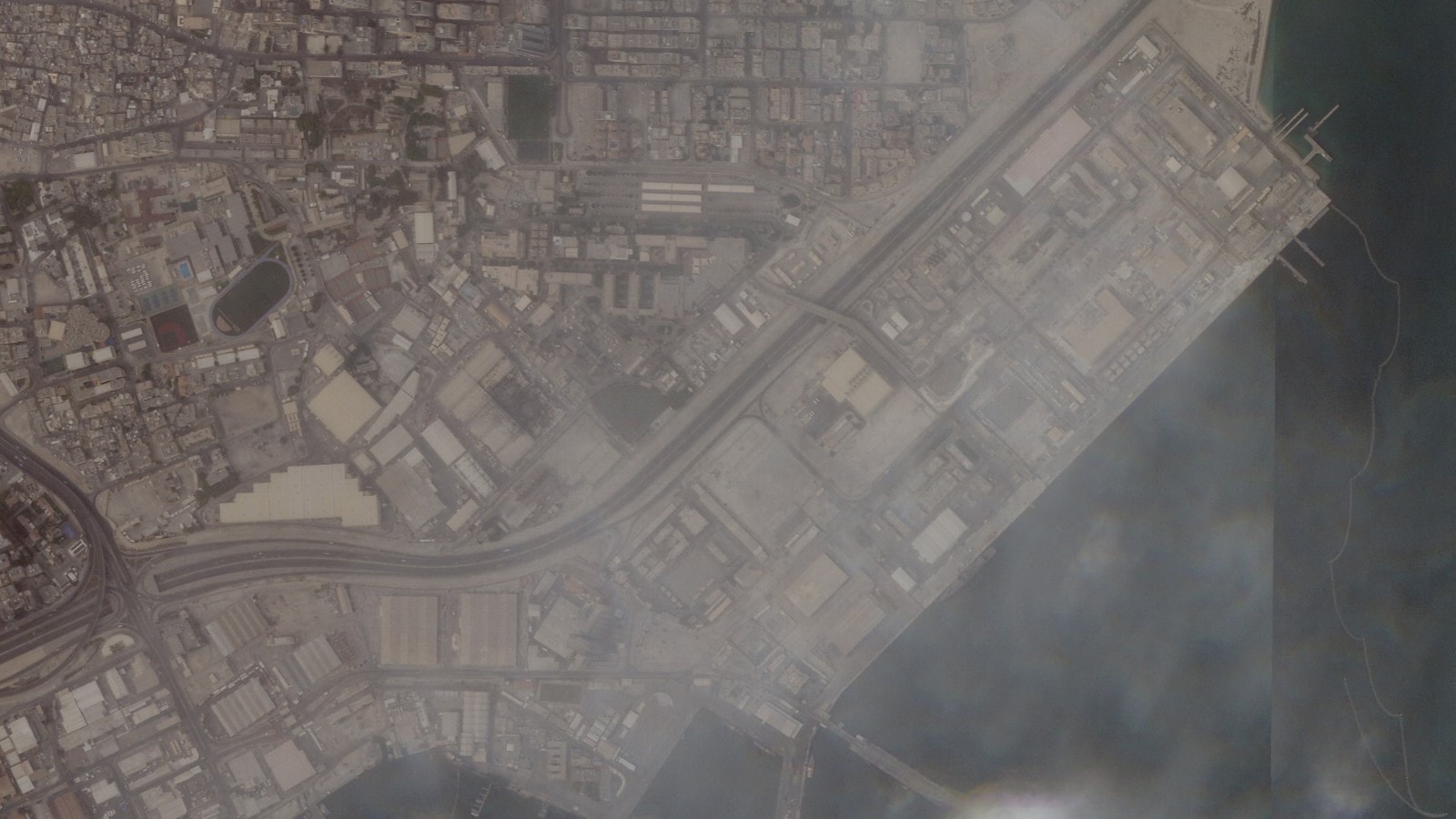
The kinetic exchange between the United States and Iran in June 2026 highlights a core reality of Middle Eastern geography: tactical disputes over airspace quickly escalate into direct challenges to maritime dominance. Following the downing of a US Army AH-64 Apache attack helicopter over the Strait of Hormuz and subsequent US Central Command (CENTCOM) strikes on air defense radars, Iran’s Islamic Revolutionary Guard Corps (IRGC) launched a retaliatory wave of Shahed-136 one-way attack drones against Naval Support Activity (NSA) Bahrain in Manama.
By targeting the physical headquarters of the US Fifth Fleet, Tehran did not merely execute a tit-for-tat military retaliation. It mathematically challenged the operational framework that secures the world's most critical maritime energy chokepoint. Understanding this escalation requires analyzing the structural asymmetry of the Persian Gulf theater, the operational infrastructure of the Fifth Fleet, and the strategic logic driving Iran’s retaliatory calculus.
The Asymmetrical Theater: Geopolitical and Physical Constraints
The Persian Gulf operates as a constrained naval arena. The entire body of water is roughly 250,000 square kilometers, characterized by shallow waters and narrow transit corridors. The primary maritime bottleneck is the Strait of Hormuz, a chokepoint measuring just 33 kilometers wide at its narrowest point, with shipping lanes divided into inbound and outbound channels each only two kilometers wide.
This geography creates an architectural constraint for traditional naval power projection while maximizing the efficiency of shore-based defensive and offensive networks.
[Persian Gulf Basin] <---> [Strait of Hormuz (33km Chokepoint)] <---> [Gulf of Oman / Indian Ocean]
          ^                                                                   ^
          |                                                                   |
   [NSA Bahrain HQ]                                                   [US Carrier Strike Groups]
(Command & Task Force 59)                                              (Deep-Water Maneuver)
The standard defensive capabilities of a blue-water navy—such as early warning radars, deep-water maneuverability, and missile defense depth—are structurally degraded when operating inside the Gulf basin. Conversely, Iran’s southern coastline, stretching from Jask and Sirik to Qeshm Island, serves as an elevated, contiguous firing platform. This positioning allows low-cost, land-based assets to directly threaten high-value maritime assets.
The Operational Architecture of the US Fifth Fleet
To counter this geographic disadvantage, the United States relies on NSA Bahrain, the nerve center for all naval operations across the Arabian Gulf, Red Sea, Gulf of Aden, and parts of the Indian Ocean. Reactivated in 1995 following the Gulf War, the Fifth Fleet serves as the naval component of CENTCOM, operating alongside US Naval Forces Central Command (NAVCENT).
The combat efficiency of the Fifth Fleet relies on four core operational pillars housed at the Manama headquarters:
- Centralized Command and Control (C2): The facility acts as the data aggregation hub for regional maritime domain awareness. Real-time telemetry from satellites, airborne early warning assets, and surface vessels is processed here to coordinate both unilateral US actions and multinational coalition task forces.
- Logistical and Support Infrastructure: While capital ships like aircraft carriers and guided-missile destroyers rarely remain stationary in the shallow Gulf, NSA Bahrain provides the repair, re-supply, and communication infrastructure required to sustain rotational deployments.
- Forward-Deployed Naval Forces (FDNF): The base permanently hosts littoral combat ships (LCS), patrol craft, and mine countermeasure (MCM) vessels specifically optimized for the shallow, high-threat environments of the Gulf.
- Task Force 59 Integration: Established to pioneer unmanned systems and artificial intelligence integration, Task Force 59 uses NSA Bahrain to manage networks of unmanned surface vessels (USVs) and unmanned underwater vehicles (UUVs). These assets extend the fleet’s sensory reach without risking crewed platforms.
The Strategic Logic of the Iranian Target Selection
The IRGC's decision to target the Fifth Fleet headquarters rather than a isolated surface vessel reflects a calculated escalatory framework. In asymmetric doctrine, targeting the command architecture offers a higher return on investment than engaging tactical assets.
1. Disrupting the Network Effect
Modern naval defense relies on networking. A single Arleigh Burke-class destroyer possesses a robust Aegis Combat System, but its localized radar horizon cannot secure the entire Gulf. By targeting the Manama C2 nodes, the IRGC seeks to degrade the data-sharing network that links satellite reconnaissance, land-based Patriot missile batteries, and forward-deployed ships. Even minor disruptions or data latency at the headquarters level degrade the overall air-defense readiness of the entire theater.
2. Testing Integrated Air Defenses
The strike involved Shahed-136 low-signature delta-wing drones, designed to saturate radar tracking systems. Launching these assets against a highly defended hub like NSA Bahrain allows Tehran to gather intelligence on the exact placement, reaction time, and radar frequencies of American and Bahraini air defenses, including Patriot (PAC-3) and regional tracking networks.
3. Redefining Deterrence Boundaries
By striking a sovereign state hosting US forces, Iran seeks to establish a new baseline for regional deterrence: any US attack on Iranian soil—even on localized radar stations in Jask or Qeshm—will result in direct strikes against the host nations of US installations. This leverages geopolitical pressure, forcing regional partners to weigh the security benefit of hosting US bases against the risk of becoming active targets.
Operational Realities and Defensive Limitations
Initial battle damage assessments following the June 2026 exchange indicate that the vast majority of incoming Iranian assets were intercepted by integrated air defense networks, resulting in minimal disruptions to Fifth Fleet operations. However, evaluating this engagement purely on a hit-to-kill ratio overlooks the underlying economic asymmetry of long-term attrition.
+------------------------------------------+------------------------------------------+
| Iranian Offensive Cost Function          | US Defensive Cost Function               |
+------------------------------------------+------------------------------------------+
| • Shahed-136 Unit Cost: ~$20,000 -       | • Patriot PAC-3 Interceptor: ~$4M per    |
|   $40,000                                |   unit                                   |
| • Infrastructure: Mobile, low-footprint  | • Logistics: Maintenance of complex,     |
|   commercial launch trucks               |   fixed radar arrays                     |
+------------------------------------------+------------------------------------------+
This stark cost differential creates an economic bottleneck for defensive forces. A sustained, multi-axis drone and cruise missile salvo can rapidly deplete available interceptor inventories, forcing commanders to make difficult decisions regarding asset allocation.
Furthermore, fixed military installations like NSA Bahrain are fundamentally constrained by geography. Unlike carrier strike groups that exploit open-ocean maneuverability to complicate targeting solutions, fixed headquarters rely entirely on hard-kill defense systems and localized electronic warfare to survive.
The Strategic Outlook
The strike on NSA Bahrain demonstrates that the era of uncontested American power projection within the Persian Gulf basin has transitioned into an active anti-access/area-denial (A2/AD) challenge. The traditional model of relying on large, centralized infrastructure hubs introduces concentrated vulnerabilities that state adversaries can exploit using low-cost, precision-guided munitions.
To maintain operational dominance, the strategic play for the US Fifth Fleet requires a shift away from concentrated base dependencies toward a decentralized operational model. This involves distributing command-and-control functions across mobile, cloud-linked nodes and expanding the footprint of Task Force 59's unmanned networks. By shifting from a single, high-value target profile to a highly distributed, modular architecture, the fleet can reduce the tactical value of shore-based missile and drone salvos, maintaining maritime stability through systemic resilience rather than static defense.