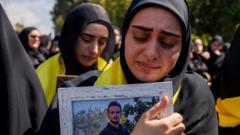
The lethal threshold of 3,000 casualties recorded by Lebanon's Ministry of Public Health exposes a profound structural failure in the operational design of the April 17 Washington-mediated ceasefire. The nominal baseline data—3,020 Lebanese fatalities (including 292 women and 211 children) set against 20 Israeli military deaths, two domestic civilian casualties, and one forward defense contractor—cannot be analyzed as a static ledger. Instead, these metrics reflect a complex kinetic friction engine where localized battlefield constraints override diplomatic frameworks.
The ongoing tactical reality invalidates conventional definitions of a truce. While political representatives from Jerusalem and Beirut engage in direct, US-backed bilateral talks targeted for a May 29 military delegation summit, the primary armed actor in Lebanese territory, Hezbollah, remains structural outside the negotiation framework. This exclusion creates an operational disconnect. Because the diplomatic track excludes the group executing the asymmetric defense, the formal diplomacy acts as a parallel process rather than a limiting mechanism on the physical battlefield. In related updates, we also covered: Inside the Baltic Brinkmanship Nobody is Talking About.
The Strategic Asymmetry Function
Evaluating this conflict requires moving past the simple reporting of strike counts to map the exact military cost functions driving both sides. The operational logic of the current confrontation operates on a stark structural mismatch in strategic goals and capabilities.
Israel's Kinetic Interdiction Mandate
The Israel Defense Forces (IDF) operate under a specific operational objective: the permanent degradation of Hezbollah's tactical infrastructure to prevent cross-border rearmament. This strategy relies on a continuous, high-tempo air and ground campaign focused on two primary targets: USA Today has analyzed this fascinating issue in great detail.
- Logistical Bottlenecks: Interdicting the supply lines running from the Syrian border through the Beqaa Valley, as demonstrated by the precise strike in Baalbek targeting Palestinian Islamic Jihad elements and regional transit networks.
- Active Launch Assets: Neutralizing forward-deployed tactical drone launch positions and subterranean storage facilities throughout southern Lebanon.
The military cost function for Israel is heavily front-loaded toward technology and intelligence. To maintain its defensive posture, Israel relies on high-density air-defense interceptors to protect its territory against low-radar-cross-section threats.
Hezbollah's Asymmetric Attrition Model
Hezbollah relies on a decentralized, low-signature strategy designed to bypass formal state structures. Because the group does not need to hold specific territory to claim tactical success, its military model focuses on imposing continuous costs on the enemy over time. This approach relies on two core elements:
- Low-Cost Kinetic Persistence: Deploying inexpensive autonomous explosive drones alongside traditional indirect fire systems. These weapons are designed to exhaust the ammunition supplies and test the radar limits of high-tier air defense networks.
- Exploitation of Border Geography: Utilizing defensive positions in the rugged terrain of southern Lebanon to ambush forward IDF elements, which limits Israel's ability to turn its technological superiority into definitive territorial control.
Structural Failure Modes of the Bilateral Diplomatic Framework
The fundamental reason the April 17 ceasefire has failed to stop the violence lies in its structural design. The negotiations in Washington are built on an invalid assumption: that the Lebanese state has the practical authority to enforce a monopoly on violence within its own territory. This creates a multi-layered diplomatic bottleneck.
[US-Mediated Diplomatic Track] <---> [Lebanese Government] (Seeks Armistice/Withdrawal)
                                              |
                                   (Structural Disconnect)
                                              v
[IDF Kinetic Operations]          <---> [Hezbollah Network] (Excluded from Track / Backed by Iran)
The Lebanese government, represented by President Joseph Aoun, approaches the talks seeking a formal security armistice and full Israeli withdrawal while maintaining a theoretical commitment to disarming non-state actors. However, Beirut lacks the military power to disarm Hezbollah by force.
Concurrently, Israel views the negotiations not as a return to the previous status quo, but as a framework for the systematic disarmament of Hezbollah and a step toward eventual diplomatic normalization. Because these goals are fundamentally incompatible, the diplomatic track has stalled. This impasse is compounded by President Aoun's refusal to meet directly with Prime Minister Benjamin Netanyahu, illustrating how internal Lebanese political risks prevent direct executive deal-making.
This diplomatic gap creates a dangerous feedback loop on the ground. Because Hezbollah is excluded from the Washington talks, it runs a separate strategic track. The group coordinates its actions with Iran through alternative channels mediated by Pakistan, ensuring that the fighting on the ground remains tied to the broader geopolitical standoff between Washington, Jerusalem, and Tehran. As a result, the formal ceasefire extensions function less as an actual pause in fighting and more as a diplomatic cover while both sides adjust their military positions for the next phase of the conflict.
Quantitative Population Displacement and Regional Destabilization Metrics
The human cost of this conflict goes far beyond primary casualty figures; it is defined by a massive, systemic displacement crisis that threatens Lebanon's basic societal stability. With over one million people displaced, the country faces an unprecedented logistical burden that its fragile public infrastructure is ill-equipped to handle.
+----------------------------------------+---------------------------------------+
| Emergency Shelter Metrics              | Value / Operational Status            |
+----------------------------------------+---------------------------------------+
| Total Established Emergency Centers    | 1,138                                 |
| Centers At Absolute Maximum Capacity   | 969 (85.1% Failure Rate)              |
| Primary Shelter Concentrations         | Coastal Highways, Beirut Waterfront    |
+----------------------------------------+---------------------------------------+
This concentration of displaced populations along major roads and urban waterfronts creates severe systemic vulnerabilities:
- Extreme Resource Strain: The rapid movement of over 20% of the national population into municipal centers has overwhelmed local water, sanitation, and electrical grids, creating acute public health risks.
- Severe Institutional Overload: The high occupancy rate of emergency shelters leaves state agencies with virtually no reserve capacity to handle further displacement if the fighting expands into new areas.
- Economic Disruption: The loss of agricultural production in southern Lebanon, combined with the blocking of commercial transport routes, has cut off key sectors of the domestic economy, accelerating the collapse of the national currency.
Tactical Realities of the Ground Engagement
The fighting in the border region has settled into a grinding war of attrition, exposing the operational limits of both militaries. In the southern border zones, the IDF’s push to clear Hezbollah infrastructure has run into distinct tactical hurdles.
While Israeli forces have established control over several forward border positions, they have struggled to completely stop incoming fire. Hezbollah has adapted by shifting its operations further north and using hidden, pre-positioned launch sites. This allows the group to maintain a steady stream of drone and rocket attacks despite intense Israeli aerial surveillance.
On the other side, Hezbollah's defensive strategy carries its own steep costs. By operating out of civilian areas in southern towns and cities like Tyre, the group exposes local population centers to heavy collateral damage. Whenever the IDF issues localized evacuation orders ahead of its strikes, it triggers fresh waves of internal displacement. This constant movement further disrupts the local economy and erodes the social fabric of communities along the coast, shifting the long-term burden of the war directly onto Lebanon's civilian population.
Expected Tactical and Strategic Developments
The upcoming direct military talks on May 29 will serve as a crucial test of whether the current conflict can be contained. Given the deep divisions between the two sides, the conflict is expected to develop along a specific operational trajectory over the next 45 to 90 days.
Israel is highly likely to expand its defensive perimeter in southern Lebanon, aiming to secure full tactical control over key high-ground positions like Bint Jbeil. This push is intended to push Hezbollah's short-range indirect fire systems further back from the border, creating a more secure buffer zone for northern Israeli towns.
To counter this, Hezbollah will likely increase its reliance on long-range explosive drones and precision guided munitions, aiming to bypass forward Israeli air defenses and strike deeper targets to maintain its leverage.
At the same time, the broader geopolitical environment will heavily shape the limits of the conflict. The friction between the US-led diplomatic effort and Iran's regional strategy means that any lasting resolution remains tied to wider Western-Iranian negotiations.
Until those broader issues are addressed, the local ceasefire extensions will likely remain unstable. Both sides are expected to use these diplomatic pauses to resupply their forces and adjust their strategies, ensuring that the border region remains a volatile flashpoint for the foreseeable future.