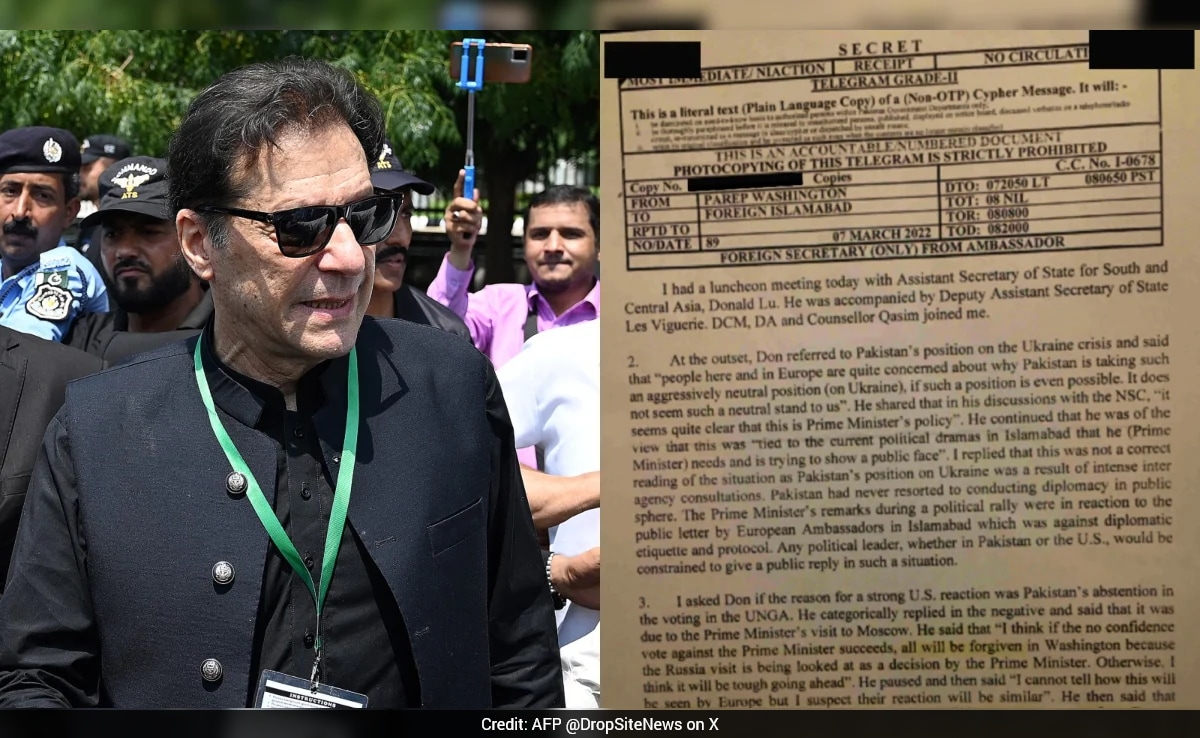
The removal of former Pakistani Prime Minister Imran Khan in April 2022 cannot be evaluated strictly through the lens of domestic political theater or an isolated foreign conspiracy. Instead, the declassification and full release of diplomatic cable I-0678—the classified "cypher" documenting a March 7, 2022, meeting between US Assistant Secretary of State Donald Lu and Pakistani Ambassador Asad Majeed Khan—exposes the precise structural mechanics of asymmetric geopolitical leverage. The document demonstrates how a superpower utilizes access to global financial architecture and diplomatic validation to enforce policy alignment upon a structurally vulnerable state.
By analyzing the verbatim transcripts and subsequent state actions, we can map the exact cause-and-effect relationships governing this bilateral rupture. The crisis was driven by a fundamental misalignment between Khan's pursuit of strategic autonomy and Washington’s enforcement of its global security architecture, specifically regarding Pakistan's "aggressively neutral" posture during the Russian invasion of Ukraine.
The Dual-Driver Model of State Vulnerability
To understand why a single diplomatic meeting possessed the kinetic energy to accelerate a prime minister's ouster, one must analyze Pakistan’s state architecture through two primary pillars: external financial dependency and internal civil-military structural dualism.
1. The Sovereign Debt and Liquidity Vulnerability
Pakistan’s economic baseline restricts its foreign policy execution. Operating under chronic balance-of-payments crises, the state relies on a continuous cycle of International Monetary Fund (IMF) bailouts, rolling over bilateral debts from Gulf allies and China, and maintaining access to Western commercial markets. When the US State Department explicitly warned that "it will be tough going ahead" if Khan remained in power, the statement operated as a direct threat to Pakistan’s economic survival. The cost function of maintaining an independent foreign policy became instantly mathematically unsustainable for the state's economic managers.
2. Civil-Military Fragmentation and Autonomous Bureaucracies
The secondary vulnerability is the divergence between the civilian executive and the military establishment. Cable I-0678 reveals that Washington explicitly decoupled the civilian prime minister from the rest of the Pakistani state apparatus. By framing the state’s neutrality on Ukraine as a "decision by the Prime Minister" rather than a consensus position of the state, US diplomats leveraged an existing fault line.
[Geopolitical Friction] -> [US Financial/Diplomatic Leverage Applied via Cable I-0678]
                                  |
                                  v
                      [Pakistani Military Realignment]
                                  |
                                  v
              [Domestic Legislative No-Confidence Vote] -> [Executive Ouster]
This structural decoupling signaled to the Pakistani military leadership that the civilian executive had become a net liability to the country’s core institutional interests—specifically, its access to Western military hardware, international financial assistance, and global diplomatic credibility.
Deconstructing the Mechanics of Cable I-0678
The diplomatic text contains highly specific operational variables that illustrate how international pressure is transmitted through diplomatic channels to induce domestic political realignment.
During the luncheon meeting, Donald Lu targeted Pakistan's neutrality on the Ukraine conflict, questioning if an "aggressively neutral position" was even structurally possible. The phrasing indicates that under a polarized global security framework, non-alignment is interpreted by dominant powers as active hostility. The critical mechanism of leverage, however, is contained in the explicit conditional offer:
"I think if the no-confidence vote against the Prime Minister succeeds, all will be forgiven in Washington because the Russia visit is being looked at as a decision by the Prime Minister."
This sentence functions as a classic incentive-alignment mechanism. It lowered the geopolitical cost of removing a democratically elected leader by promising immediate diplomatic and economic normalization. The phrase "all will be forgiven" implies the inverse: an absolute veto on bilateral relations, financial access, and strategic cooperation if the political status quo persisted.
The internal assessment appended by Ambassador Asad Majeed Khan confirms the structural weight of this interaction. The ambassador noted that the Assistant Secretary of State could not have delivered such an explicit, aggressive demarche without the direct authorization of the White House. The local diplomatic mission recognized that this was not informal rhetoric, but a formal policy position delivered via an intermediary to prompt a structural reaction within Islamabad.
Post-Ouster Policy Alignment and Empirical Verification
A hypothesis regarding external influence must be validated by observing the subsequent policy output of the target state. Following the success of the no-confidence vote on April 9, 2022, the incoming military-backed administration executed a clear shift in its strategic and economic behavior, verifying the transactional nature of the "forgiveness" offered in the cable.
- Subsidized Munitions Transfers: The post-Khan administration quietly integrated into the Western supply chain for the Ukraine war effort. Pakistan utilized third-party intermediaries and US defense contractors to supply artillery ammunition—specifically 155mm shells—to Ukrainian forces.
- Concessional Financing Windows: Coinciding with these munitions transfers, long-delayed IMF bailouts and structural adjustment loans were cleared with minimal friction, demonstrating how geopolitical compliance directly relaxes macroeconomic constraints.
- Strategic Realignment with Regional Partners: The replacement government reversed previous resistance to specific regional security architectures, including signing a comprehensive defense pact with traditional Gulf partners that the previous executive had actively blocked.
This structural shift reveals the real-world execution of the diplomatic transaction. The state traded foreign policy autonomy for short-term balance-of-payments relief and institutional preservation for its military elite.
Structural Limitations of Transacted Sovereignty
While the removal of an unaligned executive resolves immediate macroeconomic bottlenecks, the strategy carries severe long-term institutional risks. Relying on external diplomatic validation to maintain domestic stability introduces two structural systemic failures:
First, it creates a severe domestic legitimacy crisis. When a population perceives that the executive leadership is contingent upon external approval rather than internal democratic consensus, the social contract fractures. This introduces systemic political volatility, requiring escalating levels of domestic state coercion to suppress public dissent, as evidenced by the subsequent banning of political symbols and widespread incarcerations.
Second, it locks the state into a perpetual dependency trap. By solving a balance-of-payments crisis through geopolitical concessions rather than structural economic reform—such as expanding the tax base or boosting domestic industrial productivity—the state ensures it will face an identical crisis at the next geopolitical junction. The state effectively surrenders its long-term strategic flexibility for short-term liquidity.
The Strategic Play
For states operating under intense macroeconomic constraints within an increasingly fragmented global order, attempting to execute absolute strategic autonomy without foundational economic self-sufficiency yields highly predictable structural failures. To mitigate external vulnerabilities while preserving sovereign decision-making space, state planners must deploy a highly specific structural blueprint.
First, the state must establish a mandatory institutional consensus mechanism for foreign policy. Civilian and military leadership must mathematically align on the maximum acceptable geopolitical cost of any non-aligned action before it is executed on the international stage. This prevents external actors from exploiting internal institutional fractures.
Second, the state must aggressively diversify its critical financial and security dependencies. If a state relies entirely on a single Western-dominated financial architecture for its survival, its foreign policy choices will always be bounded by the strategic imperatives of those external powers. True strategic flexibility can only be achieved when the state's underlying economic survival is decoupled from the explicit political approval of any single foreign capital.
For further context on how these diplomatic maneuvers translated into domestic political shifts, you can watch this analysis detailing the Pakistan Cipher Leak and Donald Lu's Remarks, which tracks the timeline of the diplomatic pressure and the subsequent no-confidence vote.