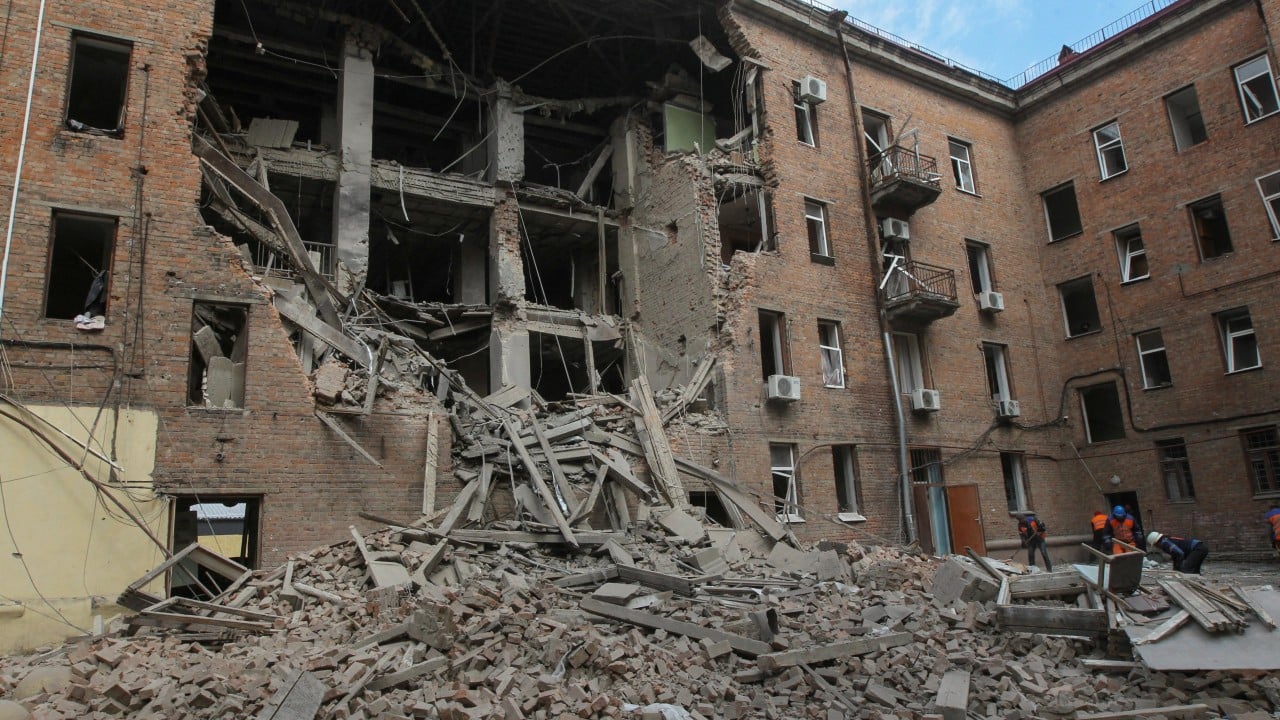
The sirens didn’t scream this time. They drifted. On the anniversary of the world’s most infamous nuclear disaster, the air in Ukraine didn't smell of ozone or ionized particles; it smelled of cordite and wet earth.
April 26 is a date etched into the marrow of Eastern Europe. It is the day the clocks stopped in Pripyat in 1986. But in 2026, the remembrance was punctuated not by silent vigils, but by the thud of cruise missiles. Sixteen people are dead. They aren't victims of a core meltdown or a "China Syndrome" scenario. They are victims of metal and high explosives, falling onto a land that is already a graveyard of atomic ambition. In related news, we also covered: The Red Brick Soul of Barnsley and the Man Who Would Take It.
The irony is thick enough to choke on. We spent decades fearing the invisible killer—the alpha, beta, and gamma rays that seeped into the pine forests of the Exclusion Zone. Now, the danger is visible, loud, and entirely man-made. The nuclear risks of the Russia-Ukraine war have transformed from a theoretical physics problem into a gritty, tactical nightmare.
The Concrete Shell and the Steel Rain
Imagine standing inside the New Safe Confinement at Chernobyl. It is a marvel of engineering, a shining silver arch designed to keep the remains of Reactor 4 sealed for a century. It cost billions. It represents the collective will of dozens of nations. The Washington Post has provided coverage on this fascinating issue in great detail.
Now, imagine a Kh-101 missile screaming past it at five hundred miles per hour.
The engineers inside the control rooms of Ukraine’s remaining active plants—Zaporizhzhia, Rivne, Khmelnytskyi—aren't just monitoring pressure gauges anymore. They are listening for the whistle of incoming fire. They are civilian technicians caught in a kinetic cage match. When the power grid flickers because a substation miles away was leveled by a drone, these operators have to pray the backup diesel generators kick in.
A nuclear power plant is a beast that needs to be constantly fed with electricity just to stay cool. If the heart stops beating, the fever begins.
[Image of a nuclear power plant cooling system diagram]
A Hypothetical Walk Through the Dark
Let’s look at a man we will call Viktor. He’s a shift supervisor at a plant not far from the front lines. Viktor grew up in the shadow of the 1986 disaster; his father was a liquidator who died young from "respiratory issues" that everyone knew were actually radiation burns on the soul.
Viktor doesn't fear the atom. He respects it. He knows that $U-235$ is a fickle partner. To keep the reaction stable, he needs a precise balance of coolant flow and control rod positioning. But today, the vibration in his boots isn't from the turbines. It’s from an Iskander missile hitting a transformer three miles away.
The lights flicker. The hum of the room changes pitch. This is the moment where the "nuclear risk" becomes a human heartbeat.
If the external power stays off for too long, the water surrounding the spent fuel rods begins to boil away. It doesn't happen in a flash. It’s a slow, agonizing simmer. Without electricity to pump fresh water, the heat builds. The metal cladding on the fuel starts to oxidize. Hydrogen gas builds up.
This is the physics of a nightmare. It’s not a mushroom cloud. It’s a dirty, messy, localized catastrophe that would render the surrounding breadbasket of Europe a no-man’s land for generations.
The Hostage at Zaporizhzhia
The situation at the Zaporizhzhia Nuclear Power Plant is the most egregious violation of atomic safety in history. It is the first time a major nuclear facility has been occupied and used as a shield. It is a six-reactor hostage crisis.
Experts from the IAEA (International Atomic Energy Agency) wander the halls like ghosts, their yellow vests a stark contrast to the camouflage of the soldiers occupying the turbine halls. They write reports. They use phrases like "highly volatile" and "precarious."
But let’s be blunt.
The safety of millions is currently resting on the hope that a stray piece of shrapnel doesn't find its way into a dry-storage cask for spent fuel. Or that a tired, stressed operator doesn't make a fractional error in judgment while staring down the barrel of an assault rifle.
The "anniversary" of Chernobyl used to be a time for reflection. It was a moment to say "never again." Now, it is a reminder that "never" is a fragile word. The sixteen lives lost in the most recent strikes are a tragedy of the present, but they also serve as a grim herald of what happens when high-tech infrastructure meets low-barbarity warfare.
The Invisible Stakes
We often talk about nuclear energy in terms of megawatts and carbon footprints. We debate the safety of the $10^{-7}$ probability of a meltdown. But those statistics assume a world that plays by the rules. They assume that nobody is going to intentionally target the life-support systems of a reactor.
The war in Ukraine has ripped up the safety manual.
Consider the "spent fuel pools." These aren't the dramatic, glowing cores you see in movies. They are deep, quiet pools of water where used fuel sits for years to cool down. They are often located in buildings that were never designed to withstand a direct hit from a bunker-buster missile. If a pool is breached and the water drains, the fuel can catch fire.
The resulting plume wouldn't care about borders. It wouldn't care about who fired the missile. It would follow the wind. One day it might be over Kyiv; the next, it could be over Moscow, Warsaw, or Berlin.
The Weight of the Anniversary
On this anniversary, the sunflowers in the fields around Chernobyl are starting to poke through the soil. Nature has a way of reclaiming the scars we leave behind. The wolves and boars in the Exclusion Zone don't know about the war. They don't know that the humans are at it again, flirting with the same fire that turned their home into a wilderness forty years ago.
The sixteen people who died in the latest strikes weren't part of a nuclear accident. They were fathers, mothers, and children. But their deaths are inextricably linked to the shadow of the cooling towers.
The risk isn't just about a "second Chernobyl." The risk is the erosion of the fundamental taboo: that nuclear sites are off-limits. Once that line is blurred, every reactor on the planet becomes a potential weapon of mass disruption.
The men and women in the control rooms across Ukraine are tired. They are working double shifts under the sound of air raid sirens. They are the thin line between a localized war and a continental catastrophe. They deserve more than our thoughts on an anniversary. They deserve a world where the power of the sun isn't kept in a house made of glass, surrounded by people throwing stones.
The sun sets over the Dnipro River, casting long, orange shadows over the concrete sarcophagus of the past. The radiation monitors still tick—a quiet, rhythmic reminder that some mistakes stay hot for ten thousand years. We are currently watching the world gamble with a fire that doesn't know how to go out.
The sirens have stopped for the night, but the silence feels even heavier than the noise.