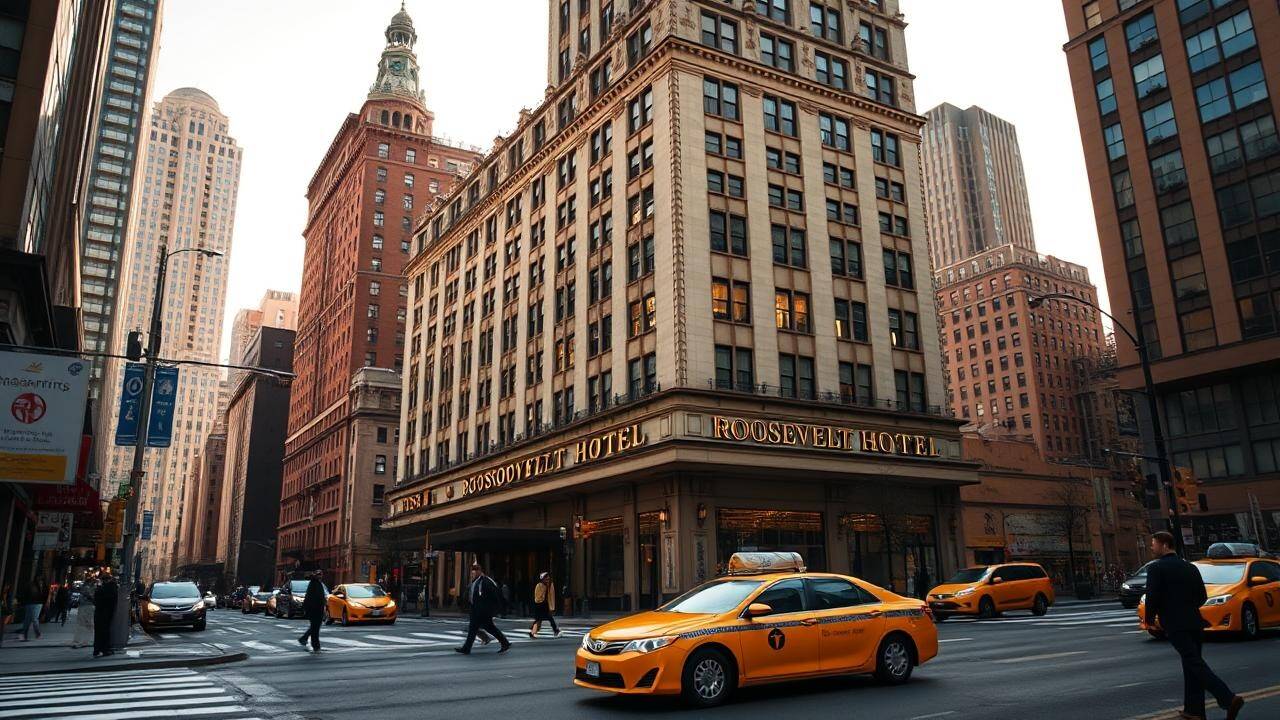
The velvet ropes are gone, but the dust remains. If you stand on the corner of Vanderbilt Avenue and East 45th Street, the Roosevelt Hotel doesn’t just look like a building. It looks like a heavy, limestone exhale. For a century, this grand dame of Midtown Manhattan welcomed presidents, movie stars, and the kind of jazz that made the Prohibition era feel like a permanent party. Guy Lombardo played "Auld Lang Syne" here for the first time. It was the "Grand Central of Hotels."
Now, the music has stopped, but the meter is still running.
Behind the majestic facade of the Roosevelt, a financial knot is tightening. The hotel, owned by the Pakistani government through the Pakistan International Airlines (PIA) Investment Ltd, finds itself in a bizarre, bureaucratic purgatory. It is a shelter for thousands of migrants seeking a foothold in the American Dream, yet it is simultaneously drowning in a sea of red tape and unpaid debts. Recent reports reveal that despite a massive windfall from the City of New York to house these families, the Roosevelt still owes the city $14.6 million in back taxes and interest.
It is a paradox wrapped in a landmark.
The Weight of the Crown
Imagine owning a mansion but being unable to pay the gardeners. That is the precarious reality for the Pakistani government. The Roosevelt closed its doors to traditional guests in 2020, a casualty of the global pandemic that turned the world’s most vibrant city into a silent movie. For three years, it sat as a shuttered relic, a hollowed-out monument to a lost era of travel.
Then came the pivot.
In May 2023, the City of New York, desperate for space to house an unprecedented influx of asylum seekers, struck a deal. The Roosevelt would become an intake center. A sanctuary. The city agreed to pay roughly $220 million over three years to lease the space. On paper, this was a lifeline for a cash-strapped foreign government and a solution for a city in crisis.
But money has a way of disappearing into the cracks of old buildings. The $14.6 million debt isn't just a number on a spreadsheet; it represents a fundamental breakdown in how we value public space and private ownership. While the city pays the hotel to stay afloat, the hotel fails to pay the city to stay legal. It is a circular flow of capital where the only thing that stays stagnant is the debt itself.
The Invisible Ledger
Consider a hypothetical family: let’s call them the Morales family. They arrived at the Roosevelt after a journey that spanned continents. To them, the lobby—with its ornate ceilings and echoes of grandeur—is a miracle. They see the marble and think of safety. They don't see the property tax liens. They don't see the interest accruing at a rate that would make a loan shark blush.
For the Morales family, the Roosevelt is a beginning. For the City of New York, it is an emergency measure. For the government of Pakistan, it is a distressed asset.
These three perspectives are currently colliding in a way that serves no one perfectly. The city's Department of Finance records show that the hotel hasn't made a property tax payment since the middle of 2023. This isn't a case of a small business owner forgetting a bill. This is a sovereign-owned entity navigating a complex web of international finance, domestic pressure in Islamabad, and the brutal reality of Manhattan real estate.
The irony is thick enough to choke. The city is essentially paying a landlord who, in turn, is using the lack of payment as a form of unintentional leverage—or perhaps just a symptom of a much larger rot.
The Cost of Stagnation
Why does a $14 million debt matter in a city with a budget of over $100 billion?
It matters because of the precedent. It matters because of the "broken window" theory of high finance. When a landmark as prominent as the Roosevelt is allowed to fall into tax delinquency while simultaneously being propped up by public funds, it signals a crack in the system.
The Pakistani government has faced its own internal storms. PIA, the national carrier, has been on the brink of privatization for years. The Roosevelt is their crown jewel, but it’s a jewel that requires constant polishing. The maintenance costs alone for a 1,000-room historic hotel are staggering. Steam pipes burst. Elevators fail. The cooling systems are artifacts of a different century.
When you add the tax burden, the "windfall" from the migrant contract starts to look more like a temporary bandage on a severed artery.
Consider the logistics of the current arrangement. The city pays roughly $200 per night for rooms that once commanded double or triple that from tourists. It sounds like a bargain until you realize the city is also providing the services, the security, and the social workers. The hotel provides the shell.
But if the shell is crumbling under the weight of debt, what happens next?
A House Divided
The tension isn't just financial; it's emotional. There is a specific kind of sadness that clings to a grand hotel used for purposes it was never designed for. The Roosevelt was built for transit, for the fleeting magic of a night in New York. It wasn't built to be a permanent waiting room for the displaced.
The staff who remain—the skeletal crew of maintenance workers and security—walk hallways that once smelled of expensive perfume and now smell of industrial disinfectant and the crowded reality of 3,000 people living in close quarters.
In Islamabad, the Roosevelt is a political football. Opposing parties argue over whether to sell it, renovate it, or continue to milk the city's lease. Every month the tax bill goes unpaid, the interest compounds. In New York, the interest rate on delinquent property taxes for large properties is roughly 18%.
Mathematically, that is a trap.
If the debt is $14.6 million today, and no payments are made, the interest alone will swallow any potential profit from the migrant contract within years. It is a slow-motion foreclosure on a piece of history.
The Human Toll of Policy
We often talk about these issues in terms of "the city" or "the government." We forget the people who walk those halls every day.
There is a sense of transience that permeates the Roosevelt. The migrants know they cannot stay forever. The Pakistani government knows they cannot keep the building in this state indefinitely. The City of New York knows the migrant crisis is a shifting tide, not a permanent fixture.
Everyone is waiting for the other shoe to drop.
If the city moves to seize the property for unpaid taxes, it triggers an international incident. If Pakistan sells the property, the city loses its primary intake center, potentially throwing thousands of people back into the streets or into tent cities in Randall’s Island.
The stakes are invisible because they are tucked away behind the revolving doors of 45th Street. They are buried in the fine print of lease agreements and the loud debates in the Pakistani Parliament.
The Ghost in the Machine
We have a habit of looking at buildings as static objects. They aren't. They are living organisms that require the fuel of capital to survive. When that fuel is diverted—or when the owners are too paralyzed by their own internal crises to provide it—the building begins to die.
The Roosevelt is currently a ghost of its former self, haunted by the debt it owes to the very city that is trying to keep its lights on. It is a partnership born of necessity, but it is currently functioning as a tragedy of errors.
There is no easy exit. Selling the hotel would likely fetch upwards of $1 billion, even in its current state. That money could wipe out the debt and infuse the Pakistani treasury with much-needed cash. But the hotel is a symbol of national pride. To sell it is to admit defeat. To keep it is to watch it slowly be consumed by the unforgiving math of New York City real estate.
As the sun sets over Midtown, the shadows of the surrounding skyscrapers stretch across the Roosevelt's facade. The lights are on in the rooms. Children are doing homework on desks where CEOs once signed mergers. Mothers are washing clothes in sinks that once held iced champagne.
It is a beautiful, heart-wrenching, and fiscally irresponsible scene.
The debt remains. The interest grows. The limestone exhale continues.
The city continues to write checks to a landlord who isn't paying his dues, while the landlord waits for a miracle that may never come. We are watching a slow-motion collision between the humanitarian needs of the present and the financial obligations of the past.
There is a point where a building stops being an asset and starts being an anchor. The Roosevelt reached that point long ago, and as the $14.6 million figure looms larger, the anchor is only getting heavier, dragging both the city and the sovereign owners into a deep, dark harbor of uncertainty.
The red carpet is long gone, replaced by the red ink of a ledger that refuses to balance.
The city is waiting. The migrants are waiting. The world is waiting.
But the interest? The interest never waits.