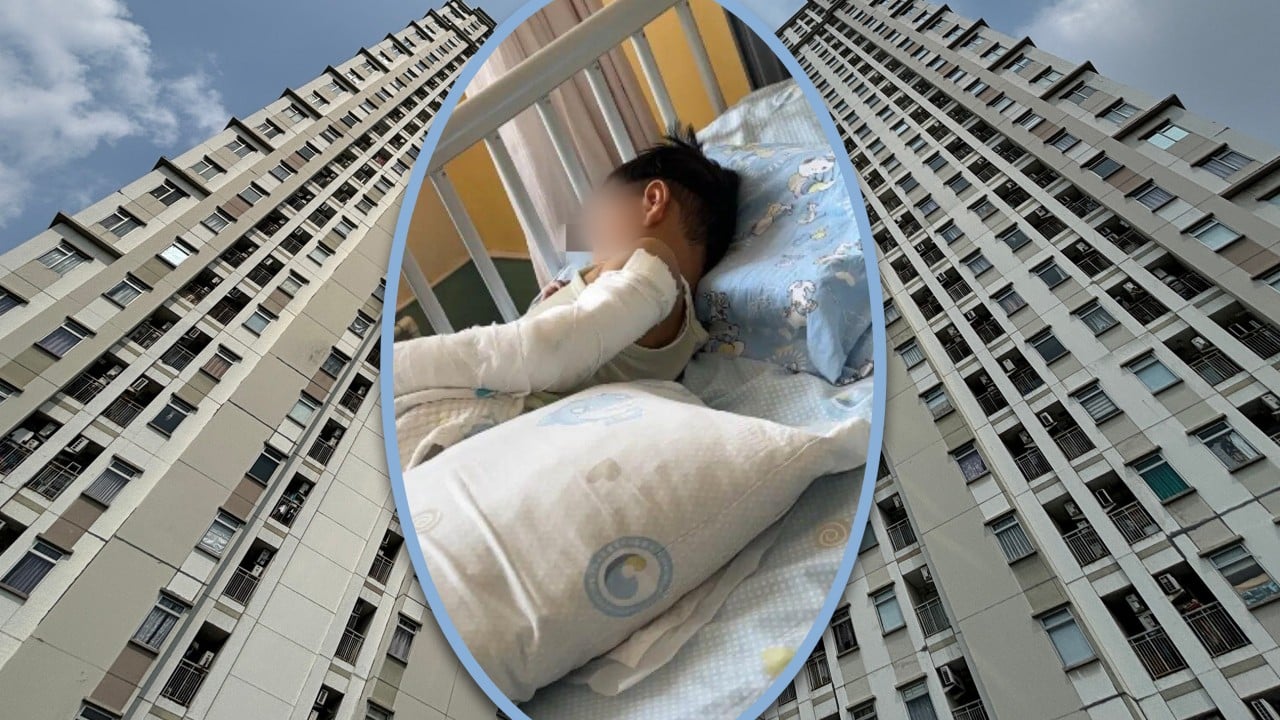
The air at forty meters up is different. It is thinner, colder, and entirely indifferent to the fragility of human bone. On an ordinary afternoon in Changzhou, Jiangsu province, this was the invisible stage for a miracle that defies every law of physics and probability. A four-year-old boy, driven by the most primal instinct known to our species—the need to find his parents—stepped into the empty space of an eleventh-story window.
He didn't jump. He didn't fall in the way an object slips from a shelf. He climbed.
To understand how a child survives a hundred-foot plunge into the earth, you have to look past the headlines and into the quiet, terrifying mechanics of a house left briefly empty. We often treat our homes as fortresses, but for a toddler, a locked door is a riddle and a high window is a vantage point. The boy’s parents had stepped out, reportedly to run a quick errand, leaving the child asleep. In the logic of a four-year-old, the world begins and ends with the presence of his protectors. When he woke to silence, the apartment didn't feel like a home. It felt like a cage.
The Mathematics of a Miracle
Gravity is a constant. When a body falls from the eleventh floor, it reaches a velocity that usually renders the impact unsurvivable. We are talking about a terminal force that should, by all rights, end a life in a fraction of a second. Yet, this boy is alive.
How?
The answer lies in a series of chaotic, fortunate obstructions. Imagine the descent not as a straight line, but as a pinball machine of urban architecture. Eyewitnesses and later reports suggested that the boy’s fall was broken. First, by the metal frames of laundry racks protruding from the floors below. Then, by the lush, rain-softened canopy of trees that lined the apartment complex's base. Finally, he hit the ground—not concrete, but a patch of earth dampened by recent weather.
Every one of those obstacles took a piece of his kinetic energy. The laundry rack bent, absorbing the initial shock. The branches snapped, slowing the acceleration. The soil gave way, cushioning the final contact. It was a sequence of events so precise it feels scripted, yet it was nothing more than the messy, beautiful randomness of a world that occasionally decides to be kind.
The Invisible Stakes of a Growing City
This isn't just a story about a lucky break. It is a reflection of the modern urban "landscape"—a word people use to describe the concrete forests we’ve built, but which rarely accounts for the people living in the canopy. In rapidly developing hubs across China and the world, high-rise living is the default. We stack families on top of one another, separated from the ground by layers of glass and steel.
The danger is silent. It exists in the gap between a window sill and a safety grate. In many of these apartment complexes, the desire for "unobstructed views" often battles the necessity of "child-proof barriers." When the boy climbed onto that window, he wasn't looking for danger. He was looking for a silhouette on the sidewalk. He was looking for the familiar gait of a mother or father returning with groceries.
Consider the psychological weight of that moment. A child wakes up. The sun is hitting the floorboards. The rooms are echoing. He calls out, but there is no answer. Panic in a child is not like panic in an adult; it is a physical, vibrating need to move. He saw the window. He saw the world outside where his parents were. In his mind, the distance between the eleventh floor and the street was merely a distance of sight, not of peril.
The Aftermath of the Plunge
The most haunting part of the report wasn't the fall itself, but what happened after. The boy didn't lie still. He didn't wait for an ambulance. Driven by a cocktail of shock and adrenaline, the four-year-old stood up.
He walked back into the building.
He was found by neighbors and building security, a small, dusty figure wandering the hallways, looking for the very people whose absence nearly cost him his life. He was eventually rushed to the hospital, where doctors braced for the worst. Internal bleeding, shattered pelvis, traumatic brain injury—these are the standard expectations for an 11-story drop.
The diagnosis? Multi-organ contusions and a few fractures. He was stable.
The medical community often speaks of the "plasticity" of children, the way their bones are less brittle and more pliable than those of adults. Their bodies are built to bounce, to some extent. But no amount of biological resilience accounts for a fall from that height. This was a case where the universe blinked.
The Burden of the "Quick Trip"
There is a temptation to judge the parents. We see the headline and the immediate reaction is a sharp, judgmental intake of breath. How could they leave him?
But if we are honest, we recognize the thin ice we all walk on. It is the "I’ll just run to the mailbox" or "he’s napping, I’ll be back in five minutes" mentality. It is the calculated risk that usually pays off, until the one time it doesn't. This family now lives with a trauma that will outlast the bruises on the boy’s skin. They are the survivors of a tragedy that didn't happen, which in some ways carries a heavier, more haunting debt.
The incident has sparked a renewed conversation about "left-behind" children and the safety of high-rise living. It forces us to ask: are our homes designed for the people we love, or just for the lives we lead?
Installing safety mesh or window limiters is a mundane task. It’s a Saturday afternoon chore involving a drill and some screws. Yet, in the context of this story, those screws are the difference between a normal evening and a lifetime of mourning. We treat safety as a chore until we see it as a lifeline.
The Sound of Silence
Imagine the parents returning. They walk up the stairs, perhaps laughing about something they saw at the market. They open the door. The apartment is quiet. The window is open.
The sheer terror of that silence is something no news report can fully capture. It is a hollow, ringing void in the chest. Then comes the call, or the shout from the courtyard below. The transition from a mundane afternoon to the darkest day of your life happens in the space of a heartbeat.
The boy is recovering now. He will likely grow up with only a hazy, dreamlike memory of the day he flew. He might remember the feeling of the wind, or the sudden, jarring contact with the green leaves of the trees. He will certainly remember the way his parents held him afterward—with a grip that suggested they might never let him go again.
The miracle in Changzhou wasn't just that a boy survived. It was a reminder that the structures we build to house our lives are only as safe as the attention we pay to the smallest people inside them. We live in the sky, but we are made of earth and bone.
Sometimes, the trees reach up to catch us. Sometimes, the ground is soft. But we cannot count on the mercy of the wind. We can only count on the barriers we build and the vigilance we keep.
The boy went back inside to find his parents. He is still looking for them, and they are still holding him, and the window is finally, mercifully, shut.