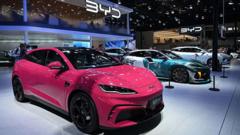
Wang Chuanfu does not look like a man trying to conquer the world. When he speaks, he often carries the measured, slightly weary tone of a chemistry professor who has spent too many nights in the lab. Yet, the company he built, BYD, recently did something that once seemed mathematically impossible: it outsold Tesla in global electric vehicle deliveries over a fiscal quarter.
The Western world reacted with a mix of shock and reflexive protectionism. In Washington, the response was swift. Tariffs. Trade barriers. A literal and figurative "No Vacancy" sign hung on the American border. The logic was simple: if we keep them out, we win.
But there is a quiet, almost uncomfortable truth vibrating through the floorboards of the global economy. BYD doesn't need the United States. Not today. Not tomorrow. Perhaps, not ever.
The Ghost in the Assembly Line
To understand why a company would walk away from the wealthiest consumer market on earth, you have to look at the dirt. Specifically, the lithium-soaked brine and the cobalt-heavy crust of the earth.
Consider a hypothetical engineer named Elena. She works for a legacy American automaker in Detroit. Elena is brilliant, but she is fighting a war of attrition. Every time she tries to source a battery cell, she is looking at a supply chain that stretches across three continents, involves six middle-men, and is subject to the whims of shipping lanes in the Red Sea. Her car costs $55,000 to manufacture. She has to sell it for $62,000 just to keep the lights on.
Now, look at her counterpart in Shenzhen. Let’s call him Chen. Chen works for BYD. When Chen needs a battery, he walks across the street. BYD began as a battery company. They didn't learn how to make cars and then buy batteries; they learned how to make batteries and then built a shell around them. This is vertical integration taken to its logical, terrifying extreme.
Because BYD owns the mines, the processing plants, and the chip-making facilities, they can produce a sleek, high-tech hatchback called the Seagull for less than $10,000.
Ten. Thousand. Dollars.
In a world where the average American car payment is a suffocating weight on a family's chest, that number sounds like a typo. It isn't. It is the sound of the floor falling out from under the old guard.
The Arithmetic of Ambition
The American market is a prize, certainly. It is high-margin and prestigious. But it is also a geopolitical minefield. For BYD, the math of entering the U.S. looks increasingly like a bad gamble. Why spend billions fighting a legal and regulatory battle in a country that views your existence as a national security threat?
Instead, BYD has looked at a map of the world and realized that the United States is an island. A wealthy island, yes, but an island nonetheless.
They are pouring their resources into the "Global South"—Brazil, Southeast Asia, the Middle East, and Uzbekistan. These are places where the "luxury" of a $70,000 electric SUV is an absurdity, but a $12,000 reliable EV is a revolution. In Thailand, BYD captured over a quarter of the EV market almost overnight. In Brazil, they are reviving old Ford plants that the Americans abandoned.
This is the invisible stake. While the U.S. focuses on protecting its domestic borders, the rest of the planet is being wired with Chinese hardware. If you control the charging ports of Jakarta, Cairo, and São Paulo, does it really matter if you can't sell a sedan in Ohio?
The strategy is one of encirclement. By the time American manufacturers figure out how to build a mass-market EV without losing $40,000 per vehicle, the rest of the world will already have a BYD key fob in their pocket.
The Myth of the Level Playing Field
We often talk about trade in terms of "fairness." It’s a comforting word. It suggests that if everyone just followed the same rules, the best product would win.
But the "rules" were written for an era of internal combustion engines and slow-moving supply chains. The reality of the modern EV market is a brutal, high-speed collision between state-backed industrial policy and raw capitalistic efficiency.
Critics point to Chinese government subsidies as the "cheat code" that allowed BYD to thrive. There is truth there. The Chinese state poured billions into the sector. But subsidies alone don't explain why BYD’s batteries are more energy-dense or why their manufacturing process is leaner than anything in Europe. Subsidies can buy you a head start, but they can't buy you the ability to innovate at the speed of light.
BYD’s "Blade Battery" is a masterpiece of engineering. It’s safer, thinner, and cheaper than the cylindrical cells used by many Western rivals. It is so good, in fact, that Tesla—the very company BYD is supposed to be "fighting"—buys them.
Think about that for a moment. The "American champion" of EVs is powered, in part, by the very competitor our tariffs are designed to stop. The walls we build are porous.
The Human Cost of the Wall
If you sit in a BYD showroom in Mexico City, you don’t see a geopolitical threat. You see a young couple.
They are looking at a car that looks like it stepped out of a sci-fi film. It has a rotating touchscreen, voice commands that actually work, and a range that covers their weekly commute. They don't care about trade deficits. They don't care about the rivalry between Washington and Beijing. They care that for the first time in their lives, they can afford a new car that doesn't burn gasoline.
When we talk about "thriving without the US," we are talking about these people.
There are billions of them.
The U.S. market represents roughly 15 million vehicle sales a year. The rest of the world represents over 60 million. By ceding the U.S. market, BYD isn't giving up on growth; they are simply choosing the path of least resistance. They are betting that the future isn't a high-priced suburban driveway in California. It’s a crowded street in Bangkok.
The Irony of Protectionism
There is a recurring pattern in history where empires build walls to keep out "inferior" goods, only to find that those walls actually kept out the very innovations needed to survive.
By insulating the American auto industry from Chinese competition, we are creating a hothouse environment. Our companies are being "protected" from the reality of $10,000 EVs. But outside that hothouse, the storm is raging.
If American automakers don't have to compete with BYD at home, they will lose the muscles required to compete with them abroad. We are essentially telling Detroit that it’s okay to be slow, expensive, and inefficient, as long as they stay within our borders.
But the borders are shrinking.
BYD’s executives are fond of saying that the "international market is a sea." If that’s true, then the U.S. is a heavily guarded harbor. BYD has decided it is much more profitable to sail the open ocean than to spend decades trying to force a gate that is rusted shut.
The Silent Shift
Wealth is moving. Influence is moving.
For nearly a century, the American consumer was the North Star of the global economy. If you didn't sell in the U.S., you didn't exist. That era is quietly ending.
When BYD reports its record-breaking profits, they aren't coming from the pockets of Americans. They are coming from the emerging middle class of nations that the West has long ignored. These countries are building their infrastructure around Chinese standards. Their mechanics are learning to fix Chinese motors. Their software is integrating with Chinese ecosystems.
We are witnessing the decoupling of the world, but it’s not the clean break we imagined. It’s not two equal halves drifting apart. It’s one side building a fortress and the other side building a new world around it.
The most dangerous thing about BYD isn't that they are coming for us. It’s that they have realized they don't have to.
Somewhere in a factory in Xi’an, a robot arm swings with terrifying precision, spot-welding the frame of a car that will never see an American highway. It doesn't matter. The car is already sold. The buyer is waiting in Jakarta, and they are paying in a currency that is increasingly comfortable with a future where the "American Dream" is just an old movie they used to watch.
The Great Wall was never built to start a war. It was built to define a world. BYD has simply decided which side of the wall they want to be on, and they are finding the view from the outside to be surprisingly bright.