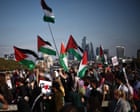
The British government is moving toward a historic confrontation with street-level activism. Keir Starmer has signaled a hardening stance against pro-Palestine demonstrations, suggesting that certain marches could face outright bans if they are deemed to threaten public order or community cohesion. This is not merely a tweak in policing strategy. It represents a fundamental shift in how the state balances the individual’s right to assemble against the collective right to security. Organizers are already preparing for a legal and political battle that will test the limits of civil liberties in the United Kingdom.
The tension centers on the Public Order Act and the discretionary powers granted to the Home Secretary and the Metropolitan Police. While the government argues these measures are necessary to prevent the intimidation of minority communities and to keep the peace, critics see a politically motivated attempt to silence dissent. This is the friction point where law meets the raw emotion of international conflict. Recently making news lately: The Strait of Hormuz Peace Myth Why Global Markets Crave Tension Not Solutions.
The Mechanics of a Protest Ban
To understand how a ban actually happens, one must look past the rhetoric and into the statutory framework. Under Section 13 of the Public Order Act 1986, a police chief can apply to the local council or the Home Secretary to prohibit a march. This isn't a power used lightly. The threshold is high. The police must prove that their existing powers to impose conditions—like changing the route or timing—are insufficient to prevent "serious public disorder."
The current debate pushes this threshold into new territory. The government is increasingly focused on the "cumulative impact" of weekly demonstrations. They aren't just looking at individual acts of violence, which have been relatively few given the hundreds of thousands of people involved. Instead, they are citing the psychological weight on the city, the cost of policing, and the discomfort of residents. More information on this are covered by NBC News.
The Problem of Discretionary Power
The law is written with enough ambiguity to allow for political interpretation. When a minister talks about "threatening" behavior, they are moving into a subjective space. What one person views as a legitimate cry for justice, another perceives as a targeted threat.
The police find themselves in an impossible position. If they don't ban the march, they are accused of "two-tier policing" by the right. If they do ban it, they face accusations of being an arm of the state used to suppress minority voices and anti-war sentiment. This pressure is eroding the operational independence of the police, making every weekend a high-stakes gamble for the Met Commissioner.
Organizers and the Strategy of Defiance
The groups behind these marches, including the Palestine Solidarity Campaign and various coalitions, are not retreating. Their strategy is two-fold: legal challenges and mass mobilization. They argue that the government’s threats are a form of "pre-crime" punishment—banning an event based on what might happen rather than what has actually occurred.
If a ban is enacted, the organizers have indicated they will seek an immediate judicial review. The courts would then have to decide if the ban is a proportionate response under the Human Rights Act. This could lead to a constitutional crisis if the judiciary strikes down a ban that the Prime Minister has publicly demanded.
Beyond the courtroom, there is the reality of the streets. Banning a march does not mean the people disappear. It often results in "static" protests, which are harder to police because they don't move along a set route. Or, worse for the authorities, it leads to spontaneous, uncoordinated gatherings that can quickly turn into chaotic cat-and-mouse games across central London.
The Cost of Containment
Policing these events has already cost tens of millions of pounds. By threatening bans, the government might be trying to save money and man-hours, but the opposite usually happens. An unauthorized protest requires more officers, more barriers, and a more aggressive posture.
Resource exhaustion is a real factor. The Metropolitan Police have had to cancel leave and pull officers from local neighborhoods to manage the crowds. This creates a secondary political problem for Starmer: how to justify the drain on police resources when crime rates in other areas are a major public concern.
The International Lens and the Domestic Fallout
Britain does not exist in a vacuum. The images of London police dragging away peaceful protesters would be broadcast globally, complicating the UK’s diplomatic standing. Starmer is trying to project a "return to normalcy" and a serious, rule-following Britain. However, the optics of suppression are rarely helpful for a leader trying to cultivate an image of stability and moral clarity.
Domestically, the threat of bans is driving a wedge within the Labour party itself. There is a significant faction of MPs and local councillors who view the protests as a vital outlet for their constituents' anger. By taking a hardline stance, Downing Street risks alienating its own base in an attempt to court the "law and order" vote.
The Shift in Political Language
The language used by the current administration is notably different from its predecessors. There is a cold, technocratic focus on "suitability" and "impact." This moves the conversation away from the content of the protest and toward the logistics of control.
Cumulative exhaustion is the phrase being whispered in the corridors of power. The government believes the public is tired of the disruption. They are betting that the average voter cares more about their Saturday shopping trip being uninterrupted than they do about the finer points of the right to assembly. It is a cynical but perhaps accurate calculation of the current British mood.
The Legal Precedents at Risk
We are looking at a potential rewrite of the "British tradition" of protest. Historically, the UK has allowed a wide berth for dissent, even when that dissent is loud and offensive to some. If the "threat" of a ban becomes a standard tool of the Home Office, the default setting for British democracy shifts from "allow unless dangerous" to "allow if convenient."
This change would affect everyone, not just pro-Palestine marchers. Environmental groups, labor unions, and far-right organizations would all be subject to this new, lower threshold for suppression. Once the mechanism for banning a march is normalized, it becomes a weapon available to any future government, regardless of their political leaning.
The Practical Reality of Enforcement
If a ban is signed tomorrow, how do you stop 100,000 people? You can't. Not without a level of force that would be politically suicidal. The police know this, even if the politicians pretend they don't.
The likely outcome is a series of increasingly restrictive "conditions" that stop just short of a total ban. The government gets to look tough, the police get to keep some semblance of control, and the protesters still get their day in the street, albeit in a more confined and frustrated manner. This middle ground satisfies no one, but it prevents the total collapse of public order.
The organizers are currently analyzing the routes of every major march for the next six months. They are identifying "choke points" where police might try to kettles or redirect the crowd. This is becoming a tactical game of chess played out in the streets of Westminster.
Why the Rhetoric is Escalating Now
The timing of this "threat" is not accidental. As the conflict abroad continues without a clear end, the domestic pressure builds. The government feels it must "do something" to signal control. By targeting the marches, they are addressing the symptom because the cause—the geopolitical situation—is largely out of their hands.
The risk is that by closing down the legitimate, organized avenues for protest, the government pushes the movement toward more radical, less predictable forms of action. A march is a controlled release of pressure. If you plug the valve, the pressure finds another, more violent way out.
The Civil Liberties Battlefield
This is the most significant challenge to the right to protest in a generation. It is not just about one specific cause. It is about whether the state has the right to decide which opinions are "too loud" or "too frequent" to be heard in public spaces.
The lawyers are sharpening their briefs. The activists are checking their megaphones. The police are checking their overtime budgets. And Keir Starmer is sitting in Number 10, trying to figure out if he can actually follow through on a threat that could redefine British democracy.
The coming weeks will reveal if the government’s stance is a genuine policy shift or a performative act of strength. Either way, the relationship between the citizen and the state has been fundamentally altered. The era of the "unlimited" march is over, replaced by a period of intense scrutiny and potential prohibition.
Every time a minister stands at a podium and talks about "protecting our streets," they are implicitly saying that the streets no longer belong to the people who wish to use them for protest. That is a massive claim to make. It is a claim that will be contested in the courts, in Parliament, and most visibly, on the tarmac of the Whitehall.
The organizers have signaled they will not be deterred by the threat of arrests or the imposition of new laws. They view the right to march as a non-negotiable part of their identity. This leaves the government with two choices: escalate to the point of mass arrests or find a way to climb down without losing face.
There is no easy exit from this situation. The government has framed the marches as a threat to the British way of life, while the marchers see the government’s response as a threat to the very liberty that the British way of life is supposed to guarantee. This is a classic deadlock.
The resolution will not come from a single policy paper or a clever speech. It will be decided by the sheer numbers of people who decide to show up, regardless of what the Home Secretary says. If 200,000 people show up to a banned march, the law becomes unenforceable. That is the ultimate fear of any government: the moment the public realizes that the state's power is based on consent, and that consent can be withdrawn.
The battle for the streets of London is no longer just about the Middle East. It is about who owns the public square and how much noise we are allowed to make in it. The answer to that question will define the Starmer era more than any budget or trade deal ever could.