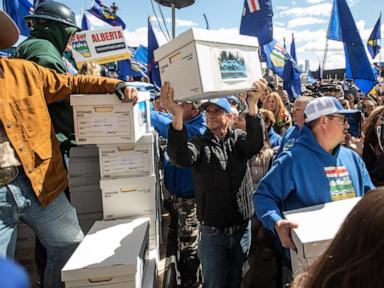
The movement to pull Alberta out of the Canadian confederation has moved from the fringes of social media into a phase of logistical reality. Organizers for the "Free Alberta" movement now claim they have secured the necessary signatures to force a provincial referendum on independence. While the provincial government has not yet verified these numbers, the announcement marks a dangerous escalation in the decades-long friction between the resource-rich West and the federal seat of power in Ottawa. If these claims hold water, Canada faces a constitutional crisis that could reshape the economic map of North America.
The Math Behind the Rebellion
Securing signatures is a grueling administrative task. In Alberta, the Referendum Act provides a narrow window for citizens to force a vote on issues of public interest. To reach this threshold, organizers had to mobilize a network of volunteers across rural constituencies and urban centers like Calgary and Edmonton. They aren't just capturing signatures; they are capturing a specific brand of resentment.
The core of the grievance is the federal equalization formula. Under current Canadian law, provinces that generate higher tax revenues—primarily through oil and gas—see a portion of that wealth redistributed to "have-not" provinces. For many Albertans, this feels like a systematic drain on their local economy. They see billions of dollars flowing east while federal regulations, particularly those aimed at carbon emissions and pipeline restrictions, stifle the very industry that pays the bills.
Why the Federal Response is Failing
Ottawa has historically treated Western alienation as a temporary flare-up of populist anger. This is a mistake. Unlike previous waves of separatist sentiment, the current movement is backed by a sophisticated digital infrastructure and a donor base that feels it has nothing left to lose.
The federal government’s strategy of "carrots and sticks"—offering green energy subsidies while maintaining strict environmental oversight—has failed to bridge the cultural divide. When the Prime Minister’s office speaks about a "just transition" away from fossil fuels, workers in the oil patch hear a death sentence for their communities. This isn't just about money; it is about identity. The separatist group has tapped into the feeling that Alberta is a colony rather than a partner in the federation.
The Legal Quagmire of Secession
Actually leaving Canada is not as simple as winning a vote. The Supreme Court of Canada’s 1998 ruling on the Secession of Quebec established that a province cannot unilaterally declare independence. A "clear majority" on a "clear question" would trigger a constitutional obligation for the rest of the country to negotiate, but those negotiations would be a nightmare.
Consider the land. Much of Alberta is covered by Treaties 6, 7, and 8, agreements made between the Crown and Indigenous peoples. These treaties were signed with the federal government, not a provincial administration. If Alberta exits, those treaties are effectively voided or must be entirely renegotiated. Indigenous leaders have already signaled that they have no interest in joining a new "Republic of Alberta," which would leave a separatist state as a Swiss-cheese map of disputed territories and landlocked corridors.
Market Volatility and the Investor Exodus
Capital is cowardly. At the first sign of genuine constitutional instability, institutional investors begin looking for the exit. We are already seeing the "uncertainty tax" being applied to Alberta-based assets. If a referendum becomes a certainty, the risk premium on provincial bonds will spike.
The irony of the movement is that independence might destroy the very prosperity it seeks to protect. An independent Alberta would be a landlocked nation. It would still need to negotiate with Canada or the United States to get its oil to tidewater. Without the leverage of being a G7 member state, a new nation of 4.5 million people would find itself bullied at the negotiating table by its larger neighbors.
The Pipeline Paradox
Separatists argue that a sovereign Alberta could build pipelines wherever it wants. This is a fantasy. A pipeline still has to cross someone else's borders to reach a refinery or a port. By leaving Canada, Alberta would lose its constitutional right to force inter-provincial infrastructure through. Instead of dealing with the National Energy Board, they would be dealing with international treaties and the sovereign laws of British Columbia or the United States.
The movement's leadership often ignores these logistical realities in favor of fiery rhetoric about "taking back control." They point to Norway as a model for a sovereign oil wealth fund, forgetting that Norway has a coastline and complete control over its maritime borders. Alberta has mountains, prairies, and neighbors who may not be inclined to offer favorable transit rates to a defector.
Breaking the Equalization Cycle
The most potent weapon in the separatist arsenal is the tax grievance. Between 1961 and 2017, Alberta taxpayers sent over $600 billion more to Ottawa than they received in federal spending. When the provincial economy is booming, this is a point of pride. When the price of Western Canadian Select drops and layoffs hit the Calgary suburbs, it becomes an intolerable insult.
Federal politicians have been slow to reform the equalization formula, fearing the political fallout in Quebec and the Maritimes. By refusing to touch this "third rail" of Canadian politics, they have given the separatist movement a permanent recruiting tool. Every time a new federal budget is released, the "Free Alberta" crowd gains a fresh set of data points to prove their case.
The Role of Digital Echo Chambers
Social media has fundamentally changed the speed at which these movements can scale. In the 1980s, Western separatism was a slow-moving series of town hall meetings. Today, it is a 24-hour content engine. Encrypted messaging apps allow organizers to coordinate petition drives with military precision, bypassing traditional media gatekeepers who would challenge their economic assumptions.
This digital mobilization has created a feedback loop where only the most radical voices are heard. Moderate conservatives who want a better deal within confederation are increasingly drowned out by those calling for a hard break. This polarization makes it nearly impossible for the provincial government to negotiate with Ottawa in good faith without being labeled as "traitors" by their own base.
The United States Factor
A silent but critical factor in this drama is the role of the United States. Alberta is the single largest foreign supplier of crude oil to the U.S. market. Washington values stability above all else on its northern border. If the separatist movement gains enough traction to threaten the reliability of energy exports, the U.S. State Department will not remain a neutral observer.
The separatist leadership has flirted with the idea of seeking "special status" or even eventual statehood within the U.S., but this is a pipedream. The U.S. has no desire to inherit Canada’s internal constitutional crises or its complex Indigenous land claims. A fractured Canada is a weakened North American security partner, and that is a scenario the Pentagon views with extreme skepticism.
The Burden of Proof
As the petition signatures undergo the verification process, the burden of proof lies with the organizers. They must prove that their numbers are legitimate and that they represent more than just a vocal minority of the disaffected. If they succeed, the Premier of Alberta will be forced into a corner.
Refusing to hold the vote would be seen as a betrayal of the democratic will. Holding the vote could trigger a chain reaction that ends with the dissolution of the country. The federal government can no longer afford to dismiss this as a "fringe" issue. The numbers, if real, indicate a systemic failure of the Canadian federal model.
The Economic Consequences of a "Yes" Vote
The day after a successful referendum, the Alberta economy would likely face an immediate liquidity crisis. Banks headquartered in Toronto would have to reassess their exposure to a "foreign" market. The Canadian dollar would face intense downward pressure.
For the average Albertan, this means higher interest rates on mortgages, a potential flight of skilled labor, and a long period of legal limbo where no one knows which laws apply to which businesses. The "Free Alberta" movement promises a future of autonomy and wealth, but the path to get there leads through a valley of deep economic contraction.
Ottawa’s Final Warning
The federal government’s next move is critical. If they respond with hostility or dismissiveness, they will only validate the separatist narrative. If they offer meaningful concessions on equalization and resource autonomy, they might still be able to peel away the moderate supporters of the movement.
However, the window for a "middle ground" solution is closing. The claim of enough signatures to trigger a referendum is a signal that the movement has reached a level of maturity that cannot be ignored. The "Alberta problem" is no longer a regional grievance; it is a national emergency.
Every signature on that list represents a citizen who has given up on the idea of Canada. Whether the referendum happens or not, the fact that such a large portion of the population is willing to sign their names to a breakup letter is a damning indictment of the status quo. The federation is fraying at the edges, and the scissors are being held by the very people who have powered the country's economy for half a century.