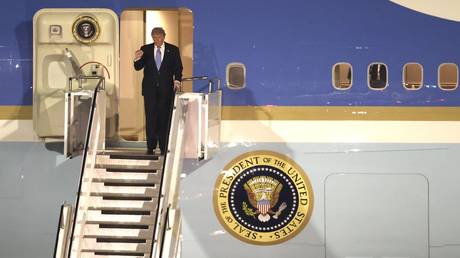
Donald Trump has publicly insisted that Riyadh must formalize diplomatic relations with Israel, declaring that time has run out for diplomatic hesitation in West Asia. This pressure campaign, echoing decades of American-led normalization frameworks, treats regional integration as an inevitable transaction. It assumes that security guarantees, advanced military hardware, and economic carrots will eventually break through Saudi resistance.
Reality is far more stubborn. Behind closed doors in Riyadh, the calculus is not about whether a deal can be struck, but whether the political price is survivable. For an alternative look, consider: this related article.
Statecraft rarely bends to simple timelines. Decades of reporting from the region reveal a persistent blind spot in Western capitals: the belief that ruling elites can entirely detach foreign policy from domestic public sentiment. For Saudi Arabia, normalization with Israel without a credible, irreversible pathway to a Palestinian state is an existential gamble. King Salman and Crown Prince Mohammed bin Salman sit atop a society where public solidarity with Palestinians remains intense, unfiltered, and deeply felt.
The Abraham Accords altered the diplomatic geography of the region, but they did so by bypassing the central conflict. Nations like the United Arab Emirates and Bahrain faced minimal internal pushback when signing those agreements. Their populations are smaller, their domestic political structures differ sharply from the Saudi monarchy, and their historical relationship with the Palestinian issue carried less ideological weight. Further reporting on this trend has been shared by Al Jazeera.
Saudi Arabia is different. As the custodian of Islam’s two holiest sites, the Kingdom claims a unique religious and political legitimacy across the wider Muslim world. To sign away that leverage for a defense pact with Washington and a technological partnership with Tel Aviv requires extraordinary political cover.
The Washington Calculus
American strategic planners view normalization through the lens of containment and architecture. For years, Washington has sought to construct a unified regional security perimeter against Iran. Tying Israel's military capabilities together with the Gulf monarchies creates a neat, manageable bloc on paper.
This approach minimizes the friction of boots-on-the-ground commitments. It outsources deterrence to local actors while securing long-term economic alignments.
Yet, this architecture ignores structural cracks. A security pact that lacks broad regional legitimacy is fragile. When external pressure forces a government to act against the deep-seated instincts of its population, internal stability quietly erodes. Intelligence reports across multiple administrations have consistently warned that bypassing the Palestinian question creates fertile ground for radicalization, even within wealthy Gulf states.
The American pitch relies heavily on sweeteners. Security guarantees modeled after NATO articles, access to sensitive defense technology, and civil nuclear cooperation are dangled before Riyadh like keys to a kingdom. Yet, the Crown Prince has repeatedly signaled that these benefits cannot substitute for concrete achievements on the ground for Palestinians.
The Riyadh Dilemma
Crown Prince Mohammed bin Salman is executing an ambitious economic overhaul. Vision 2030 requires massive foreign investment, stability, and a calm regional environment to succeed. Megaprojects like Neom demand uninterrupted capital flows and international confidence.
Conflict is bad for business. Integration with Israel's tech sector offers obvious economic upsides in artificial intelligence, water desalination, and cyber defense.
At the same time, the domestic risk profile is severe. The Saudi population skews young, highly connected, and digitally vocal. Social media spaces in Riyadh, Jeddah, and Dammam reflect deep outrage over ongoing military campaigns in Gaza. Ignoring this sentiment carries real dangers for a regime that relies on a delicate balance of modernization from above and traditional legitimacy from below.
To square this circle, Saudi diplomats have pushed for non-negotiable terms. They want an irreversible, time-bound framework leading to a Palestinian state. They want guarantees that Washington cannot easily discard after a change in administration.
Israel's current political leadership rejects those terms outright. Prime Minister Benjamin Netanyahu and his coalition partners have built their domestic standing on opposing Palestinian statehood. Forcing a choice between right-wing coalition survival in Jerusalem and a grand strategic deal with Riyadh leaves very little room for compromise.
The Trap of Forced Diplomacy
History suggests that manufactured diplomatic breakthroughs often decay rapidly when underlying grievances are ignored. The Camp David Accords and the Oslo process both demonstrated that agreements signed at the top without roots in the population tend to fracture under pressure.
Trump’s push assumes that personal relationships and transactional leverage can override structural realities. That assumption is dangerous. When leaders are pushed into corners by foreign partners, they often adopt delaying tactics, making grand gestures while quietly backing away from implementation.
Riyadh can afford to wait. The Kingdom's oil revenues, though fluctuating, provide strategic independence. Its diplomatic outreach has expanded to include normalization with Iran brokered by Beijing, membership in BRICS, and active engagement with various global powers. Saudi Arabia is no longer a dependent client state taking orders from a single capital.
The demand for normalization is less a masterstroke of diplomacy than an attempt to lock in a legacy achievement before regional dynamics shift further out of Western control.
The Regional Ripple Effects
Beyond Riyadh and Jerusalem, other actors are watching the pressure campaign with acute anxiety. Tehran views the prospect of a formal Saudi-Israeli axis as a direct challenge, responding with its own flurry of diplomatic charm offensives across the Gulf.
Jordan and Egypt, nations that maintain cold peace treaties with Israel, are equally nervous. A Saudi deal that sidelines the Palestinian issue entirely threatens to destabilize Jordan's internal security, where a majority of the population is of Palestinian descent. Amman relies heavily on Saudi financial backing and political alignment to withstand domestic pressures.
If Riyadh caves to American pressure without securing Palestinian statehood, the moral authority of the Saudi leadership takes a permanent hit. If it walks away, Washington faces the collapse of its grand design for the Middle East.
The insistence that "it’s time" ignores the reality that time is precisely what is required to mend fractures that decades of violence have widened. Rushing a historic treaty to fit an election cycle or a diplomatic scrapbook guarantees a brittle outcome. True regional integration requires addressing the root causes of conflict, not papering over them with defense treaties and photo opportunities.
The pressure will intensify in the coming months. Washington will offer more tech, more security promises, and more personal flattery. Riyadh will nod, take the meetings, and continue to calculate the precise point where compliance becomes too expensive to bear.